



A few hours after several former Generalitat councilors were brought before the Supreme Court to testify for their participation in the 1-O, in December 2017, and while Carles Puigdemont was already taking refuge in Belgium after fleeing Spanish justice, the independence movement began demanding amnesty for the Catalan government dismissed under Article 155. On the balconies where the estelada flags hung, a banner was added with the legend «Amnesty. Fem-los lliures» and the yellow ribbon, which set the new political goal of the independence movement: neither resignation while waiting for the sentence, nor a pardon that would imply accepting the magnanimous forgiveness of the Spanish state. Amnesty or amnesty: to free the prisoners, to erase the crime they committed, and also to launch an offensive against the judges and “end the judicial persecution” against Catalan independence. An amnestyagainst the rule of law and the judges.
Read more The Supreme Court authorizes Trump to temporarily continue the works at the White House
That reaction from the independence movement, to remain politically alive after the application of 155, served to dilute for a couple of years the combination of collective deception and failure that was the procés; and it sent a very clear message to Pedro Sánchez, with whom Junts and ERC were already finalizing the details of the motion of no confidence against Mariano Rajoy, about the final price he would have to pay to place him in La Moncloa. Sánchez took good note of that warning and ended up fulfilling the nationalist wishes with an Amnesty Law in which he assumed the entire independence narrative: the 1-O was the expression of a historic political conflict between Catalonia and Spain.
A concession that, however, did not manage to steer the legislature: the Government has been unable to approve a single Budget and, periodically, has had to resolve new crises in its relationship with the independence partners, especially with Puigdemont, from whom it hopes to return soon to Catalonia after the ECJ’s endorsement of the Amnesty Law. This tension around the granting of amnesty has accompanied Sánchez throughout his second term and has ended up being the pretext for a joint attack by the Government and the independence movement on the judges, one of the main pillars of the rule of law that resisted the separatist assault in 2017 and which they now accuse of leading a judicial persecution against Sánchez and his partners. The dialectic and methods of the Catalan independence process jumped to Madrid. The so-called Spanish procés.
Despite the public disdain that the independence leaders showed in 2018 towards the pardon that the Government was beginning to offer them – “they can shove it wherever it fits,” said Oriol Junqueras after his conviction for sedition -, Sánchez managed with this act of grace to secure ERC’s support for his first legislature. And when, on June 22, 2021, the Government granted the pardon to the nine prisoners of the procés, forgiving them the sentence for sedition, although not for embezzlement, the Catalan establishment celebrated it as an indisputable gesture of reconciliation.
The pardon seemed like the end point. From that moment, the Government refused to go further because the amnesty requested by Puigdemont and Junqueras was, in the socialists’ view, outside the Constitution. Very forcefully and clearly, the then opposition leader in the Parliament, Salvador Illa, spoke on January 13, 2022, at a conference in Madrid: “There will be no referendum, no amnesty, nothing of the sort.” A speech rejecting amnesty that Sánchez repeated throughout the 23-J campaign. Until that election night, and against all odds, the PP leader, Alberto Núñez Feijóo, fell short of the promised absolute majority and, instead, the unexpected seven deputies obtained by Junts gave Puigdemont the key to the new Government.
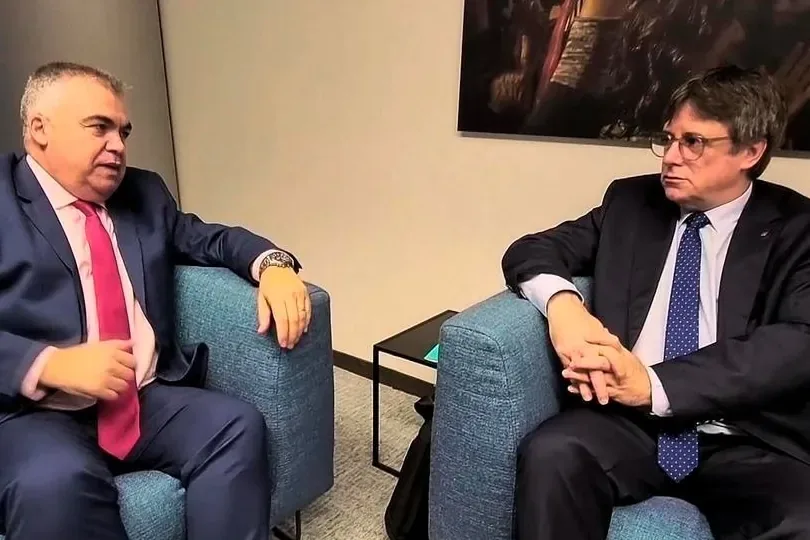
In a few hours everything changed, and Puigdemont soon responded to the Government’s calls to negotiate the investiture by recovering the demand for amnesty to be able to return to Catalonia. In short, his political and social reinstatement. Thus, in the first meetings of Junts with the PSOE delegation, led by the Secretary of Organization, Santos Cerdán, still free of corruption suspicion, the socialists made a first and decisive political concession to Puigdemont by assuming that those prosecuted in the procés had suffered political persecution by judges and police. A lawfare thesis that was thus endorsed, black on white, in the investiture agreement signed on November 9, 2023.
The inclusion of the term lawfare angered all associations of judges and prosecutors without exception, regardless of whether they were considered progressive or conservative, and they deemed it unacceptable that the Government assumed the independence narrative. This step forward taken by all judicial associations further strained their relationship with the Minister of Justice, Félix Bolaños. The Supreme Court, the National Court, the governing chambers of the superior courts of justice, the provincial courts, and the senior judges criticized in various writings the measure promoted by Sánchez. There were no cracks against amnesty.
Nevertheless, the Government and Junts were still far from the white smoke. In the investiture agreement negotiations between PSOE and Junts in October 2023, former president Rodríguez Zapatero took a very active role. Thanks to the good relationship he had with Artur Mas from his time in Moncloa, in which they reached the Statute pact, the socialist leader managed to establish a close relationship with Puigdemont’s trusted team. Zapatero acted as Sánchez’s plenipotentiary emissary in the dialogue with Junts in Madrid, Geneva, and Brussels. In that phase, his work was to convey calm, educate about the limits of amnesty (only political crimes, no violence), and help keep channels open between Puigdemont and Moncloa.
The main obstacle between the Government and Junts is that the amnesty is not allowing Puigdemont to return to Spain. The Supreme Court maintained from the beginning the charge of embezzlement, and the former president of the Generalitat, who since 23-J had regained a leading role on the Spanish political stage, began to get nervous. He felt deceived by Sánchez and his people, so he demanded that the president pressure the Supreme Court “just as he pressures the judges to save his wife.” Puigdemont has handed the Presidency of the Government to Sánchez and demands that the amnesty be total. Quid pro quo, “something in exchange for something,” and above all to return to Catalonia.
The PSOE’s concessions to Junts, such as the future publication of fiscal balances or the failed transfer of immigration powers to Catalonia, did not manage to reduce nationalist anger. And it was at that moment that Zapatero, who presented himself to Junts and PSOE as a figure who can give moral legitimacy to the agreement after his complex negotiations with ETA, took on an even more important role in the dialogue with Puigdemont. He is the one who proposed, for example, the Salvadoran mediator to preside over the agreement monitoring table.

In a climate of distrust, on January 30, 2024, Junts deputies voted in the Congress against the amnesty decree-law and sent it back to the Justice Commission to be renegotiated, after the PSOE refused to remove from the list of non-amnestiable crimes those of treason and terrorism. In that unexpected decision, which highlighted the Government’s dependence on the seven Junts deputies, much of the responsibility lay with lawyer Gonzalo Boye, who convinced Puigdemont that, with that wording, the law “was going to be a sieve” for judges to find a way not to comply with it. During that negotiation phase, elections were held in Catalonia, in which socialist Illa won and Puigdemont fell far short of the expected results. In addition, the Koldo case and numerous revelations implicating Begoña Gómez in possible influence peddling broke out in Madrid.
Despite this accumulation of adverse circumstances, the agreement gradually matured and Sánchez decided to bring the law to a vote on May 30, 2024, which was the great nationalist victory since the beginning of the procés in 2012: an amnesty that subjugates the Government, breaks the principle of equality among Spaniards, and assaults, by assuming lawfare, all public servants – judges, prosecutors, and police – who in the fall of 2017 stopped the coup d’état.
That vote, however, did not solve Sánchez’s problems with Puigdemont. For the Junts leader soon felt betrayed after Cerdán confessed to him, in what would be the last PSOE-Junts bilateral meeting, what the fugitive suspected: the Government could not guarantee that the Supreme Court would apply amnesty in his case. “We don’t control it,” admitted Cerdán. From that moment, the relationship between the Government and Junts was tense, distant, and marked by Puigdemont’s feeling of being the fool in the movie. The Amnesty Law was made especially for him, but he remains trapped in Belgium. Weeks after Cerdán’s confession, and after failing to gain clarity and progress with the PSOE, Junts decided to stop supportingSánchez in Congress.
Thus, faced with a very significant part of the judicial establishment and without a parliamentary majority, the Government waited for months for the ECJ ruling – and pressured through Bolaños in the appropriate offices in Brussels and Strasbourg – as its last chance to attract Junts and secure their support to complete the legislature. When the European court endorsed the amnesty on July 17, 2026, the Government insisted on the message of reconciliation. But there is another idea conveyed by Sánchez’s speech after the ECJ: the Government complied, did everything possible to approve the amnesty, and only the bad practices of the judges have prevented and prevent Puigdemont from returning. This idea, reinforced by Illa with a public intervention after the ECJ ruling demanding the immediate application of the amnesty, is what allows Junts and ERC to talk again about lawfare, attack the judges, and celebrate that Europe gives them reason. And it is only Puigdemont’s return that remains to consider the amnesty against the rule of law fulfilled and executed.