





All the autonomous communities gathered this Thursday with the Ministry of Youth and Childhood have voted in favor of sending 25 million euros to Ceuta for the reception of unaccompanied foreign children and adolescents who are in Ceuta following the massive entry on July 30. Castilla y León, Extremadura, and Aragón have rejected this measure in writing, having been absent – as they did in the preparatory meeting for this encounter – and these are regions governed by the PP where Childhood policies are in the hands of Vox.
The rest of the PP regions have supported the financial transfer, although they have considered it “insufficient” to meet all the needs of more than 1,500 children and adolescents. “25 million will only cover two months of care,” pointed out the Madrid Family Councilor, Ana Dávila-Ponce de León, who defended that “all minors who are in Ceuta” must return with their families and be sent back to Morocco and rejected that they be transferred to the Peninsula and distributed among the autonomous communities.
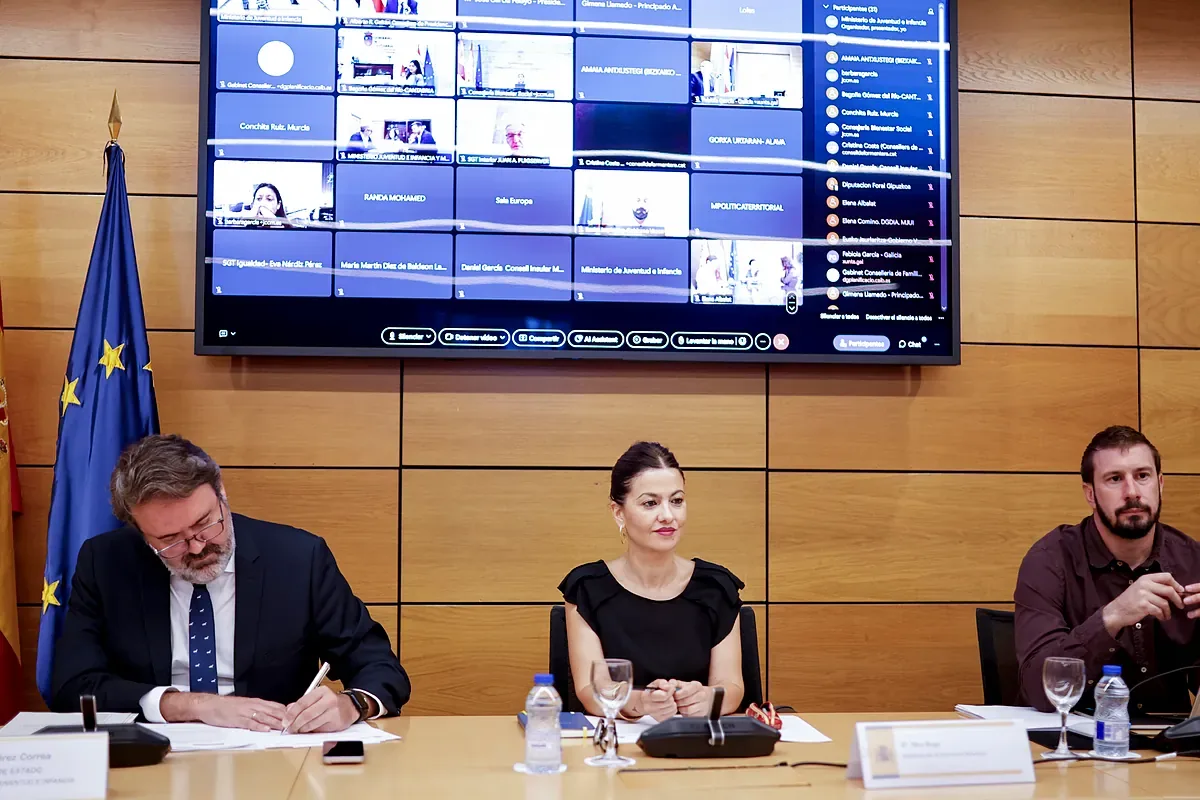
The Ministry of Youth and Childhood and the majority of regional governments met this Thursday in the Sectoral Conference, the highest body of dialogue on minors between the State and the autonomous communities. Two points were on the agenda: the transfer of 25 million euros and the situation of minors in the autonomous city, an issue that the PP regions opposed discussing because they considered it had been included “irregularly” and was finally withdrawn by the Ministry.
The representative of Andalusia, who is from the PP, did attend – as in the previous call – as well as the representatives of the other popular territories: Madrid and Canarias (co-government of CC and PP) attended in person, while Galicia, Cantabria, La Rioja, Murcia, the Valencian Community, Balearic Islands, Ceuta, and Melilla did so virtually.
Also present in person were the socialist Navarra and Catalonia, and virtually Basque Country (PNV), Asturias (PSOE), and Castilla-La Mancha (PSOE).
The acronyms are important because they define the four positions on this matter: boycott by Vox, presence with reservations in the case of the PP, and collaboration with the Government in the remaining five regions. A separate group is formed by Ceuta, Melilla, and Canarias, which seek to share responsibility with the rest of the territories.
The Government is working with the “priority” of returning minors to their families, but repatriation will not always be possible because for that they have to contact the families or find a safe place for them in Morocco. In any case, the Ministry says that these procedures, if done in Ceuta, will take a long time, and proposes that they be immediately distributed among the autonomous communities and that it be in the different territories where identifications and interviews are carried out. And from there, decide whether they are sent back home, stay in that region, or are taken in elsewhere.
“The process can be done equally in Ceuta as in Albacete,” sources from this department indicate.
The minister, Sira Rego, has also proposed that 500 girls be urgently transferred to private NGO resources on the Peninsula, a decision that, sources from her Ministry have recalled, “must be made by Ceuta, which has guardianship of the minors.”
It has not been clarified exactly how many minors are in Ceuta. NGOs spoke of 4,000, while the Minister of Economy, Carlos Cuerpo, said there were more than 2,900. Sources from Sira Rego’s team say these figures were not correct because they referred to “files that in several cases were duplicated” and that, “once these figures were cleaned up,” the result is that there are 1,500 registered minors. However, there are still children and adolescents unidentified and unregistered who are not included within these 1,500.
Read more Sánchez now opts for the most “tough and restrictive” line of the European migration and asylum pact