





In Vancouver‘s Downtown Eastside, there are women addicted to cocaine who prostitute themselves in alleys to pay for their next dose and end up contracting syphilis. There are suicidal women, hooked on opiates, who refuse HIV treatment. There are young people with mental illnesses who die of liver cancer or hepatitis C infections. There are crack addicts who scratch gravel from sidewalks looking for an imaginary dose. And there are human beings who rummage through their festering sores trying to find another vein to inject themselves. In the Downtown Eastside, there are overdoses that end in an ambulance and overdoses that end in silence.
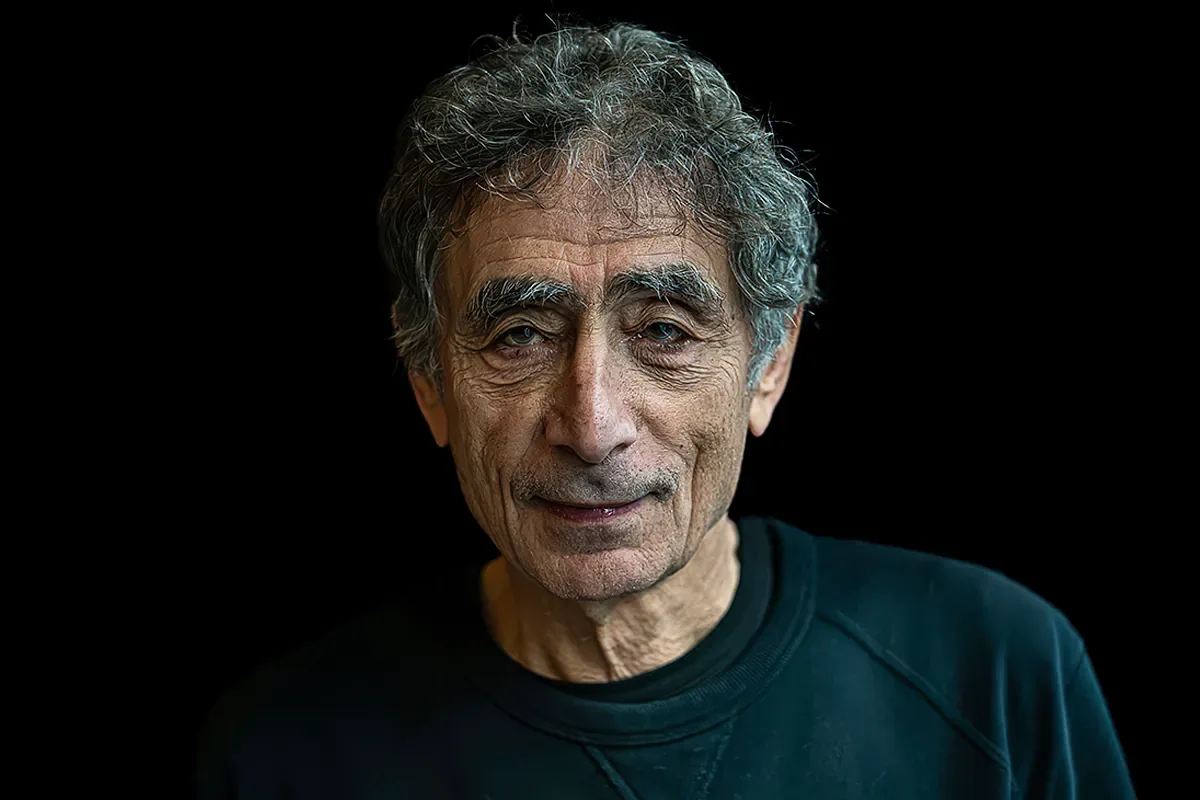
For more than a decade, Dr. Gabor Maté (Budapest, 1944) walked those streets as a doctor for the Portland Hotel Society and became a direct witness to one of the largest concentrations of drug addiction in the West. After years of reliving the same pattern, he came to a conclusion that dismantles much of the traditional discourse on addictions: “The question is not why addiction, but why the pain.”
- But we keep asking ourselves the first one.
- Because we focus on what we can see. In the West, and especially in North America, there are two ways of understanding addiction. The dominant idea is to think that people choose to consume and the system should punish them for making wrong decisions. And the other is to see it as an inherited genetic disease. But in neither case do we look at people’s life experiences. We stay on the surface, we don’t observe what’s underneath.
And what lies beneath runs through all his work, the meaning of his life, and the pages of In the Realm of Hungry Ghosts, which has just been published in Spain by Capitán Swing, and which made Maté a world reference in trauma and and addictions. In Buddhist cosmology, hungry ghosts are creatures condemned to perpetual desire, forever unable to be filled.
The economist of inequality: “Globalization has shattered the self-esteem of Western workers”
- Redacción: JORGE BENÍTEZ
“When one is frustrated and depressed, hating the other is a great psychological relief”
- Redacción: ANDRÉS SEOANE Madrid
- What is addiction?
- Addiction manifests as any behavior that provides temporary pleasure or relief, a compulsive desire that, although it eventually brings negative consequences, is not abandoned. These can be legal drugs like caffeine, nicotine, alcohol… or illegal ones like cocaine or heroin; or food, or shopping, gambling, pornography, sex, extreme sports, self-harm, bulimia. When I ask people if they have ever had an addiction, most say yes. Then I ask them: what was good about it? What did it give you that you needed? Because the question is not what was bad about it, but what function it served.
- Perhaps calm, pleasure…
- Exactly. Many addicts describe drugs as the first time they felt calm. Now, what does it mean not to feel calm? What does it mean not to feel pleasure? It means experiencing something unpleasant. That’s why I say addiction is not the main problem. The problem is the absence of calm, the absence of pleasure. That is the pain. Addiction is an attempt to solve an internal problem.
- Your theories clash with decades of classical discourse on drug addiction, that drugs create chemical dependence and hijack the brain.
- I don’t deny the part about dopamine, serotonin, reward circuits, and how repetitive consumption neurologically reconfigures a person. But if substances are so addictive on their own, why do most people who try them never develop a severe dependence?
- Why?
- Childhood trauma is always at the root. Sexual abuse in childhood. Domestic violence. Alcoholic parents. Emotional neglect. Homes permeated by constant fear. And in many cases, not even major visible tragedies, children who grew up without feeling safe, loved, or simply seen. It doesn’t matter what the addiction is. There can be different levels of trauma, of course, but trauma means there is a wound. And addiction tries to temporarily alleviate that wound. This happens in all addictions. The human brain is not born finished, but develops in relation to the emotional environment. A child subjected to constant stress, fear, or disconnection ends up building survival systems that years later can become anxiety, impulsivity, or addictive behaviors.
- But to what extent does childhood determine an adult addiction?
- Up to 100%.
- And what about individual responsibility?
- I’m not talking about excuses, I’m talking about reasons. If I say: “I can’t help it because I had a difficult childhood and society hurt me,” then I’m avoiding my responsibility. But understanding the origin of a problem allows for better assumption of that responsibility. If I was hurt in childhood, it is still my responsibility today to heal that wound. No one can do it for me. Understanding the origin does not eliminate individual responsibility; it simply helps to understand what is happening. Because if you don’t understand anything, you end up thinking: “I’m a bad person.” And no: perhaps you’re not a bad person, but a wounded person. But it’s still your responsibility to heal yourself.
- Is there an addiction epidemic? Is it linked to our societal model?
- Addictions are activated by trauma and stress. The more stress a person endures, the less able they are to emotionally regulate themselves and feel good about themselves, and the more they need to seek something outside to calm what’s happening inside. We live in a society that generates a lot of stress. And the more stress there is, the more mental health problems, addictions, and diseases appear. It’s an insecure society, with fewer bonds, more isolation, and a greater sense of threat.
- In your book, you say that we live in a society obsessed with anesthetizing, distracting, and escaping from itself. Social networks designed to generate dopamine. Platforms that monetize attention. Screens that eliminate any space for silence. A constant consumption of stimuli that makes boredom unbearable.
- Research shows that extreme loneliness poses a health risk comparable to smoking a pack of cigarettes a day. Lonely people get sick sooner and die sooner. In the UK, they even had to appoint a Minister for Loneliness. Loneliness is a social phenomenon linked to neoliberal economics and politics. And the lonelier a person is, the more likely they are to fall into an addiction.
- It seems impossible to live free from addictive behaviors.
- It is possible. It requires a lot of work, but it is possible.
- You are quite belligerent about the war on drugs. Has it failed?
- No, it hasn’t failed. It has succeeded.
- Succeeded?
- If the goal was to end consumption or trafficking, it’s a failure. The war on drugs is doomed to perpetual failure, the question is why it continues to be waged. But if the goal is to enrich certain legal industries, increase social control, or control minorities – as happens in the United States – then it has been a huge success. It all depends on what the true intention was.
- So, what should we do?
- First, scientifically understand the problem. Addiction prevention begins with the first prenatal visit. The stress of a pregnant woman affects the baby’s brain development. If we want to prevent drug use, we must support young families and care for parents. And when children have problems, instead of punishing them, we should treat them with compassion, because many future addicts were once children with difficulties. People with severe addictions often have brains predisposed to consumption due to childhood trauma, and healing requires time and appropriate treatment. There is much we can do, but first we must be scientific and human at the same time.
- After all you’ve seen, what have you learned about human nature?
- People often think that human nature is selfish or aggressive, but if we look at how our species evolved, we see that we survived for millions of years living in cooperative groups. If we hadn’t been cooperative, we wouldn’t have survived. There isn’t a single human nature. What exist are human needs. If you study an elephant in a zoo, it will seem like a passive animal. But if you observe it free in the African savanna, it will behave completely differently. The same happens with human beings: it depends on the environment and whether our emotional needs are met. A baby needs unconditional love as much as it needs oxygen. It’s not a luxury. And if those emotional needs are not met, people develop very different behaviors. Hitler was human. Buddha was human. Franco was human. Jesus was human. Human nature is a range of possibilities that depends on the environment.
- What mistakes do families of addicted people usually make?
- First, it’s important to understand that the isolated family is not historically natural. For millions of years, we lived in tribes and communities where children were raised by the entire group. Today, parents raise children alone, without support, and are also expected to mold their children to fit into a society where many people do meaningless jobs and have little control over their lives. The biggest mistake is trying to force children to become something specific instead of helping them develop their own nature in a safe environment. And another big problem is that parents unknowingly transmit their own traumas. I did too. Not because we don’t love our children, but because we often ignore our own wounds.
- What would you say to someone who currently feels they cannot escape their own compulsion?
- First: “I understand you, because I’ve been there too.” These compulsions are very powerful because there is pain inside, and one desperately tries to escape. I have seen people take their own lives because they couldn’t find a way out. So I perfectly understand that despair. Second: “Help exists. Right now it may seem impossible, but many people have gotten through it, and you can too if you decide to ask for help.”