






On July 2, 1994, a fire in Villarluengo (Teruel) caused by a lightning strike marked the beginning of what has gone down in Spanish history as “the black week.” In just seven days, a wave of forest fires in Aragón, the Valencian Community, Castilla-La Mancha, Murcia, Catalonia, and Andalusia devastated more than 110,000 hectares (ha) and caused the death of about twenty people. Two years earlier, the Forest Fire Reinforcement Brigades (BRIF) had been created, inspired by the US helitack units, and as Ignacio Pérez-Soba, a forestry engineer, recalls, that tragedy “was a turning point” in the way forest fires are tackled in Spain.
Another tragedy — the death in 2005 of 11 members of the firefighting crew during a fire caused by a barbecue in Riba de Saelices, in the province of Guadalajara — led to the creation that same year of the UME, the Military Emergency Unit intended to intervene in disasters.
And after the shock of the black August of 2025, when a dramatic episode of simultaneous fires mainly affecting Castilla y León and Galicia resulted in four deaths and 30,000 evacuations, 2026 is surpassing the most pessimistic forecasts. After the 14 deaths in the large fire in Los Gallardos (Almería), caused, it is believed, by the fall of an electric cable, more than 200,000 citizens have been evacuated or confined to their homes in the last two weeks due to severe fires in La Mierla (Guadalajara), Madrid, Toledo, Castellón, and Ávila. The latter has been the largest in Spain’s history, with more than 50,000 hectares burned.
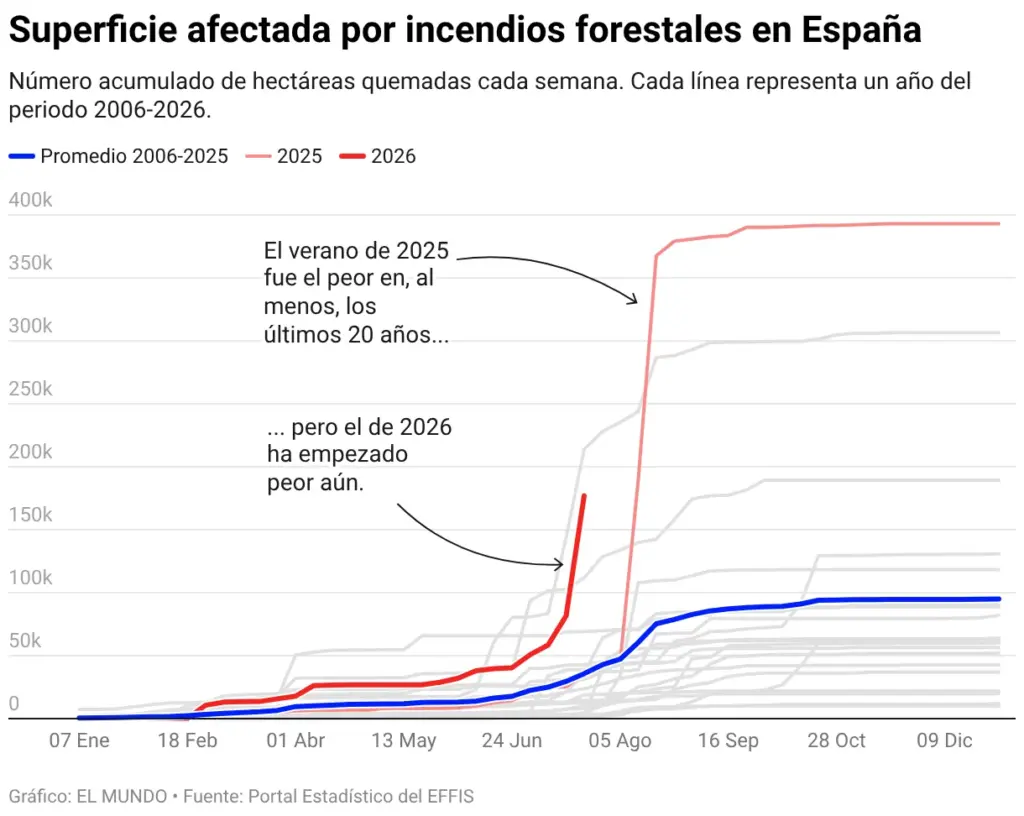
The figures are dizzying: since the beginning of 2026 until August 1, 38 large forest fires or GIF (those that burn more than 500 ha) have broken out compared to 12 recorded in the same period last year. In total, 186,480 hectares of forest have burned, while last year at this time the total was 33,360.
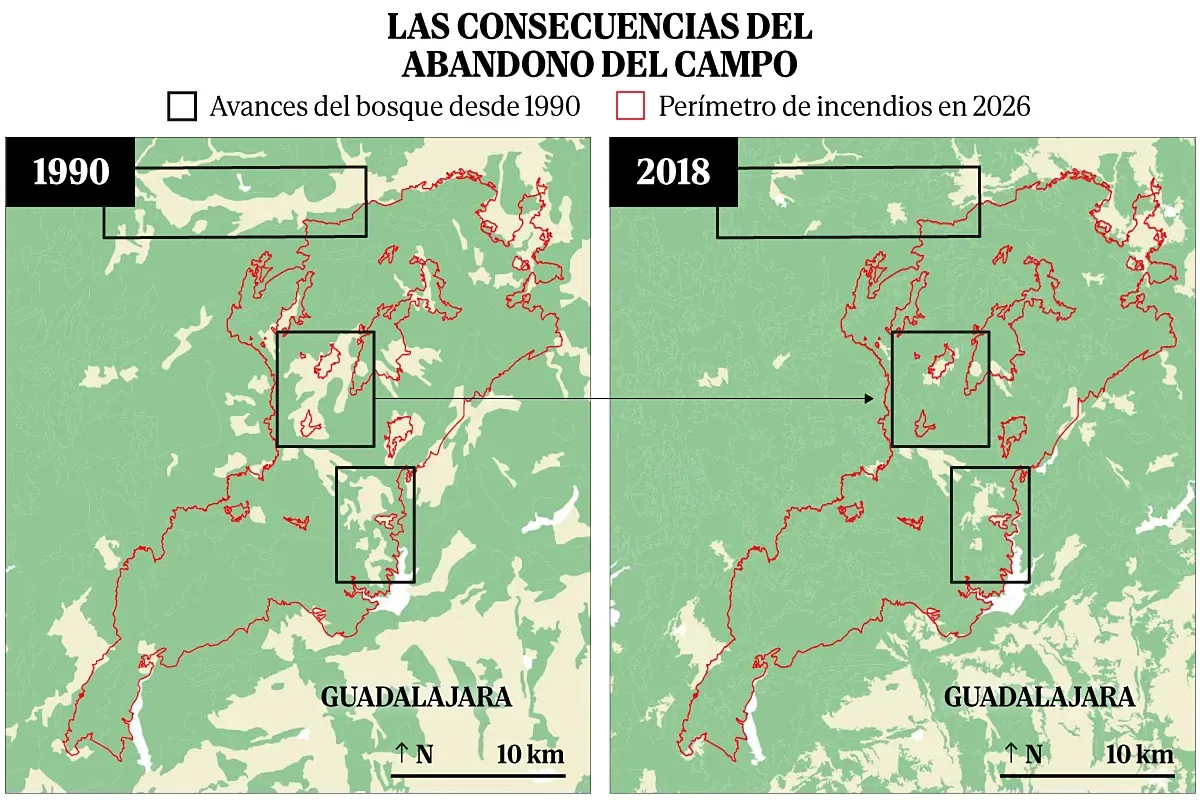
How did we get here? Experts agree in attributing this blazing summer to a combination of causes, among which stand out the gradual abandonment, over the last half-century, of traditional uses of the rural environment, with the consequent accumulation of biomass due to insufficient and ineffective forest management. The effects of climate change and the weather we have had this year are the other two key factors that have turned Spain into a tinderbox for fires.
EVOLUTION OF THE FIRES
For Pérez-Soba, dean of the Official College of Forestry Engineers (COIM) of Aragón, “it makes no sense to try to draw conclusions from what has happened in one year or a few years.” “If we analyze the general forest fire statistics that MITECO has since 1968, we see that more or less from the mid-1990s to the early 21st century, all indicators have improved in Spain, clearly. All except one. What is getting worse is that large forest fires are getting bigger, to the point that their definition should be reconsidered since now we are facing fires that burn tens of thousands of hectares. And of course, being bigger, they affect more and more property and people and are generally associated with very violent and very unpredictable behaviors.”
If we focus on the last decade, between 2015 and 2024 the average was 105,614 hectares of burned area and 24 GIF, according to MITECO, with peaks in 2022 (270,289 ha and 60 GIF) and 2025 (354,746 ha and 63 GIF). The best years in that period were 2018 (26,994 ha and 3 GIF) and 2024 (49,762 ha and 16 GIF). Without reaching the levels of 2015 and 2022, in 2021 (92,556 ha and 19 GIF) there were also very severe fires, among which stood out the two fires in Sierra Culebra, Zamora, which devastated 60,000 ha, and the one in Navalacruz, Ávila (20,000 ha).
Currently, around 90% of fires are extinguished before reaching five hectares of surface, but those that become GIF are increasingly difficult to control. 2025 was an example of this. The total number of fires was 8,199 compared to the average of 9,171 between 2015 and 2024, but that year saw five of the 16 fires larger than 20,000 hectares recorded in the entire historical series (1968-2025).
LACK OF PREVENTION AND ACTIVE FOREST MANAGEMENT
“That discordant GIF indicator,” says Pérez-Soba, “is what tells us there is a failure in the strategy followed so far,” which he summarizes as follows. “Little is invested in management, a lot in extinction, and very little, almost nothing, in restoration.”
And this despite the fact that Spanish forest area covers almost 56% of the national territory — 28.2 million hectares, of which 18.7 million are wooded — according to the Spanish Forest Strategy Horizon by MITECO in 2021. In 1950, the Spanish forest area was 25.1 million hectares, according to the Forest Statistics of Spain by the Ministry of Agriculture published in 1952.
An increase that, according to the Spanish Institute of Engineering (IIA), is largely due to demographic exodus, population aging, regression of extensive livestock farming, and the end of traditional use of firewood and timber, which have favored the accumulation of plant fuel in the forest.
Forest replantings carried out (around four million hectares between 1940-1999, and 430,579 ha between 2000 and 2020, as well as the afforestation of agricultural lands favored by the European Union’s Common Agricultural Policy (CAP) in the last decade of the 20th century (298,482 ha from 2000 to 2020) have also contributed to the increase in forest mass. Overall, since 1999, the wooded forest area has increased by almost 1.5 million ha.
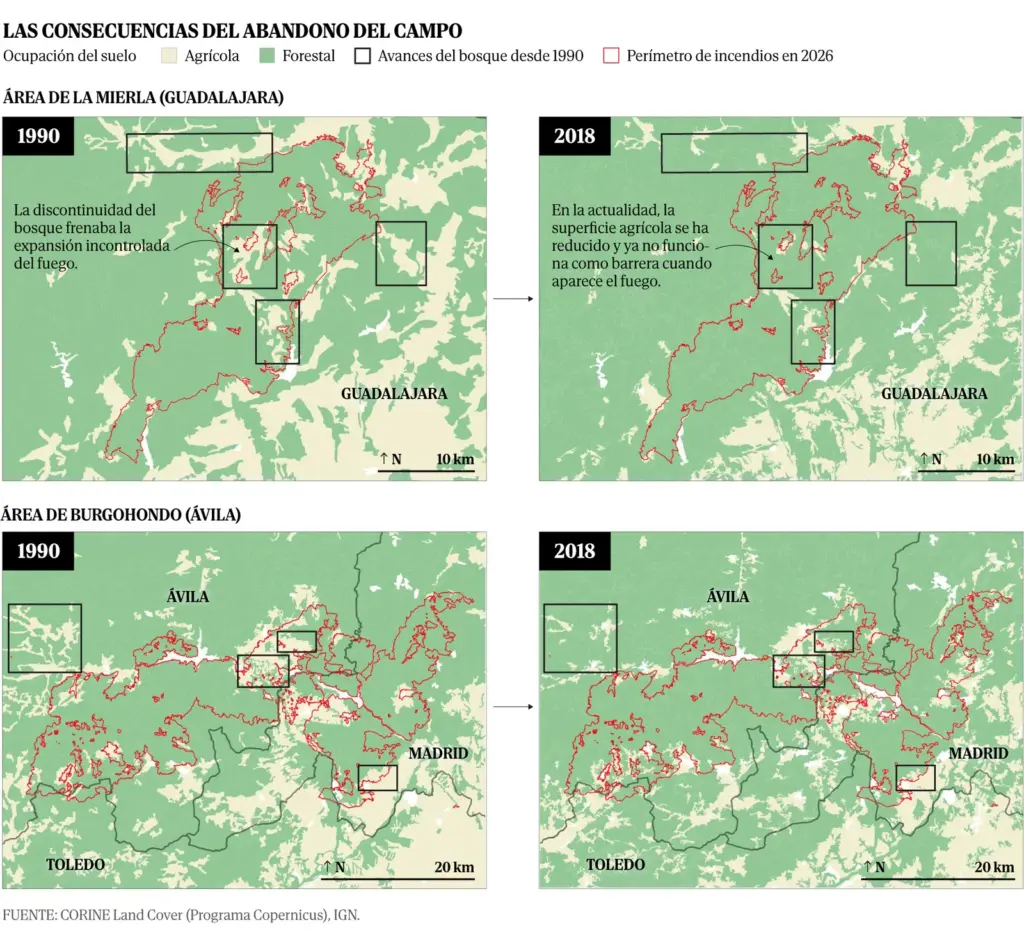
Likewise, it is estimated that 72% of forests are privately owned, individually or collectively. In this regard, Carlos del Álamo Jiménez, president of the Committee on Engineering and Sustainable Development (CIDES) and spokesperson for the IIA, considers that “the lack of knowledge of forest ownership” in much of the territory hinders proper management of a forest fragmented into a very high number of plots.
Adding to this difficulty is the fact that “as the rural environment depopulated,” Pérez-Soba reviews, “almost all administrations stopped investing in improving and managing forests, since firefighting operations became much more expensive. For example, aerial means are very costly. And instead of being paid with extraordinary funds, they were financed at the expense of investment in prevention and forest management. That is, subtracting from silvicultural treatments, the construction of forest roads, traditional forest works and services, which are now called prevention tasks and are the most important to prevent fires. And if you stop managing forests for 40 years, you should not be surprised that they suffer major disturbances.“
The engineer considers that “the firefighting operation had to be improved, but without strangling forest management in Spain. The expansion of aerial means and the professionalization of firefighting devices made us a leading country in this field. But the firefighting system we have now is the same that improved 30 years ago, only much larger and much more expensive. We have 18 firefighting systems (17 communities and MITECO’s), which coordinate amicably but in a poorly planned way,” he maintains.
From his point of view, “we have an unbalanced investment model regarding fires and great political courage is needed to change it. Because all forest management actions succeed or fail after 10-12 years at the earliest, so we are talking about at least three legislative terms,” Pérez-Soba summarizes.
However, he considers that “the real problem is not rural depopulation itself, but the disconnection of the rural population from management and forest uses.” And as an example, he points out that there are very depopulated territories whose forests burn less than average, such as Soria, with a great tradition of forest management, systematic and sustainable timber use, and maintenance of a traditional but also modern forest business network.”
Margarita Hernández, spokesperson for COIM, estimates that our forests need at least a sustained investment of 3 billion euros per year in forest management, a figure that “is infinitely more efficient and economical than allocating funds to the subsequent restoration of burned areas.” This amount is far from the approximately one billion per year that, according to COIM estimates, is currently allocated by all administrations, since according to the Spanish Forest Strategy Horizon, an average of 38 euros per hectare per year is invested. In this regard, MITECO points out that between 2024 and 2026, the Government increased the prevention budget by nearly 30%.
Regarding livestock, the INE Agricultural Censuses reflect a collapse in the number of farms working with the main groups of ruminants: cattle, sheep, and goats. In the last 20 years, four out of ten farms have ceased to exist, without this implying a comparable decrease in the number of livestock heads.
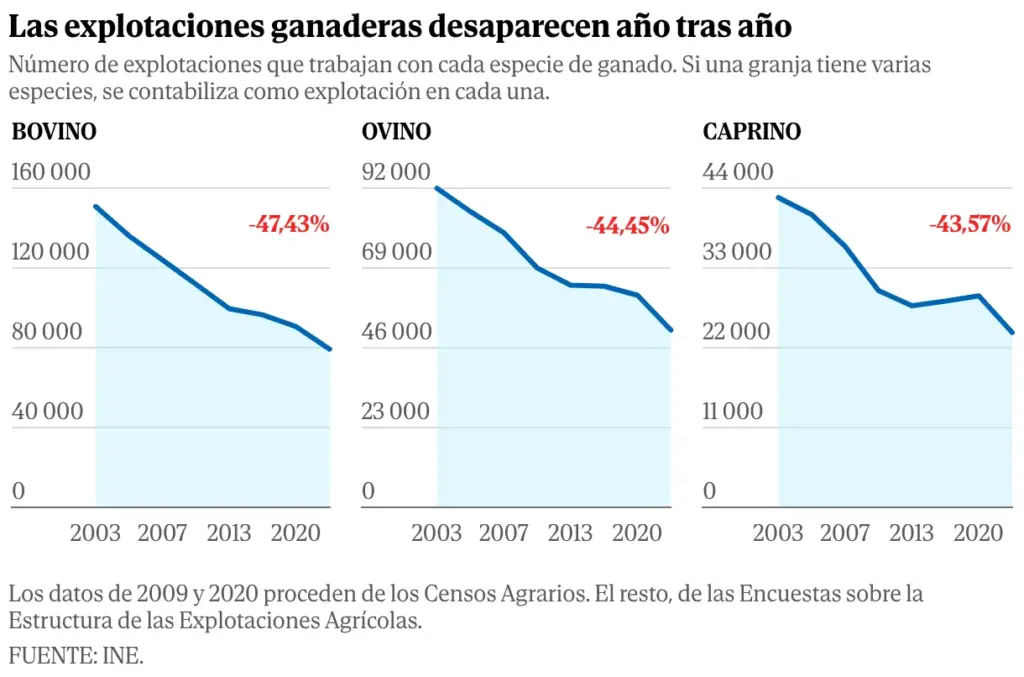
In Spain, there are no official records of extensive livestock farms (those that feed livestock by grazing and help control vegetation in forests) or intensive farms (which use feed and are housed) that allow measuring exactly the decline in each type of management.
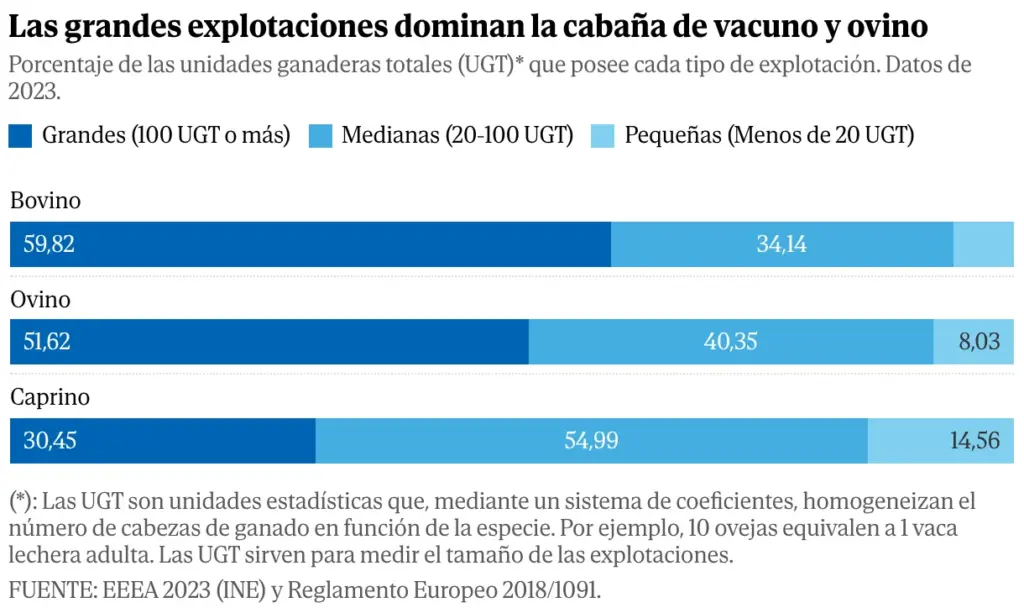
INE does provide data on the heads of livestock in active farms. María Turiño, from the Platform for Extensive Livestock and Pastoralism, warns that this data is not conclusive in itself to determine whether a farm is extensive or not, since “what really links extensiveness is the feeding.” However, there is a clear trend toward concentration in farms with more animals than in the past, reports Alberto Hernández.
Another factor highlighted by experts like Hernández is the need to better manage the urban-forest interface to protect people: “The existence of population enclaves in forest masses makes it a priority to promote a culture of effective self-protection. Their inhabitants must know and apply basic safety guidelines to defend their property and act in case of emergency,” he points out.
LONGER AND HOTTER SUMMERS
Climate changes are another fundamental aspect explaining this black July: “Summer conditions now appear more than a month earlier than in the 1970s and 80s. In 2026, we had July-like heat at the end of May,” points out Rubén del Campo, spokesperson for Aemet. “We had a very rainy start to the year, with one storm after another. It was the rainiest first two months since 1979, while the period from April to July will be among the three driest in the historical series. All that vegetation, that fuel, which grew due to the large amount of rain, has dried out extremely.”
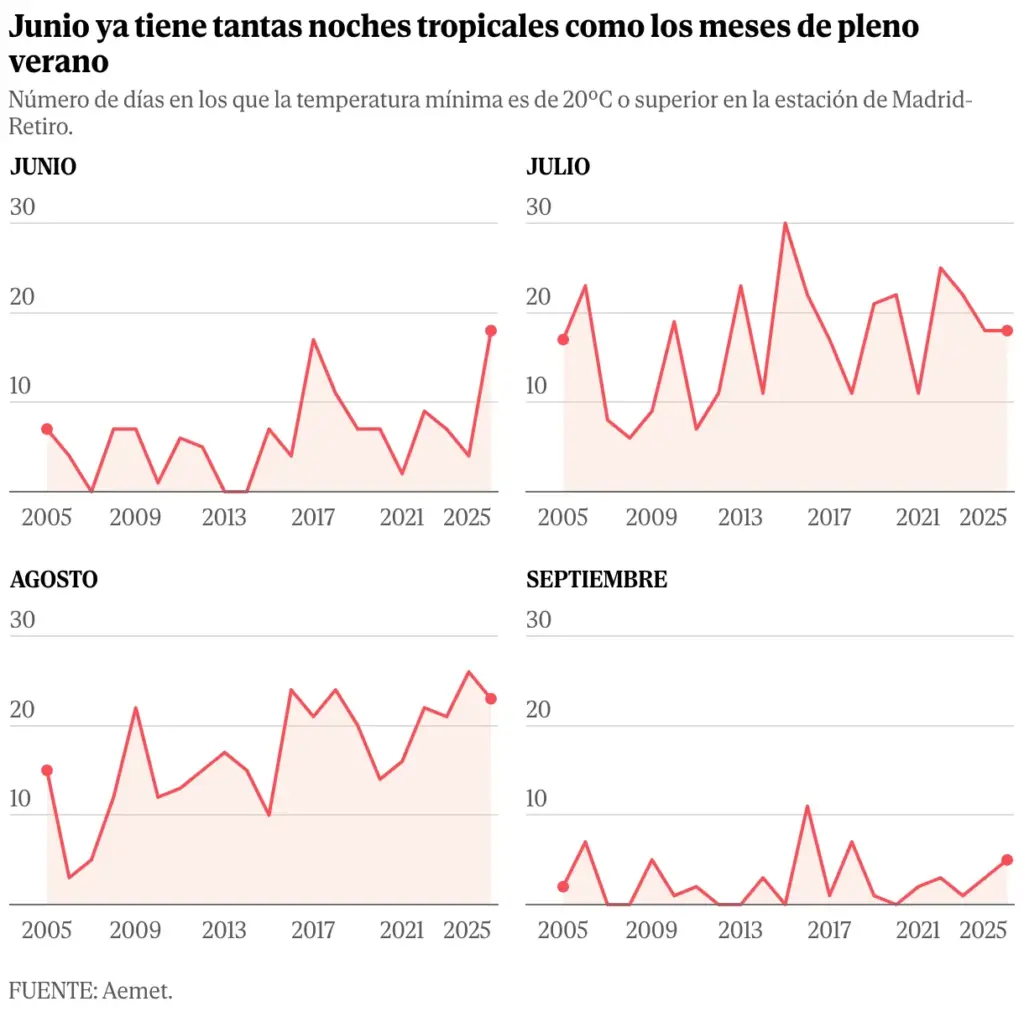
Moreover, since 1961, when Aemet’s historical record series begins, “summers have warmed by about two degrees, which is translating into more frequent, longer, more intense heat waves affecting a larger area of the country,” says Del Campo. “We have seen a statistically significant increase. This means it has not happened by chance, but behind it is the background of climate change,” he notes.
These heat waves cause the fuel, especially fine vegetation like grasses or shrub pieces, to dry out extremely and when there is an ignition, it burns very easily and the fire spreads quickly. “What a few years ago would have remained a flare-up or a smaller fire can now be much more difficult to control,” he points out.
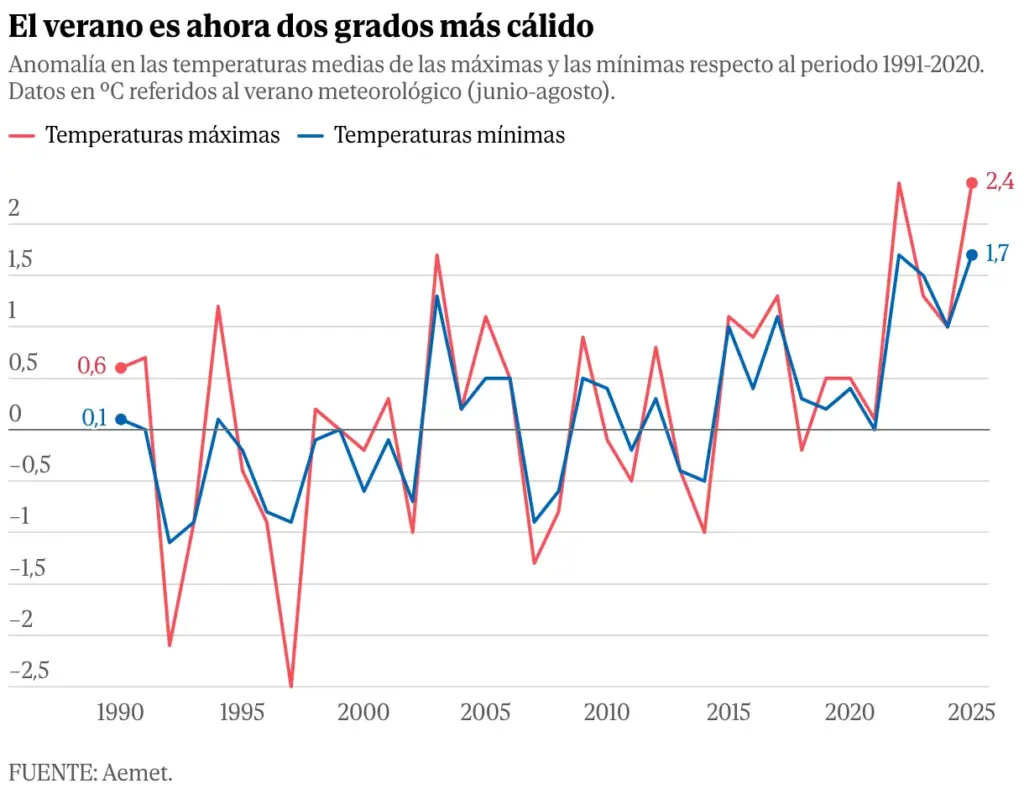
In his analysis of heat waves, Rubén del Campo mentions what he calls the rule of three: “Since 1975, for every decade that passes, heat waves in Spain last three days longer. Or in other words, now on average, we have between 12 and 15 more days of heat waves each summer compared to the 1970s. They are more extensive, as on average, for every decade that passes, they affect three more provinces. Also, there is an increase of three tenths of a degree per decade in the maximum temperatures reached during heat waves.”
Another issue “is that if we have heat waves affecting much larger areas, there are more chances that large fires will occur simultaneously in more areas, which is a challenge for control and extinction.”
Torrid or equatorial nights (those that do not drop below 25 degrees) have quadrupled in Mediterranean cities like Valencia since the mid-20th century, according to Del Campo, who gives another revealing fact: “At the Madrid-Retiro station, no minimum temperature above 25 degrees was recorded from 1920 until 1986. The first was in 1987 and since then there have been 52, of which 31 have been recorded in the last six years.”
Behind this increase in torrid nights is a combination of factors, according to the meteorologist: the rise in temperatures due to climate change, the growth of cities, and the urban heat island (the climatic phenomenon that causes cities to record higher temperatures than the natural areas surrounding them).
All these conditions have made the fire risk season longer: “My father was also a forestry engineer, and when I was a child, he always said that when he slept restlessly, it was from Santiago to the Virgin of August [from July 25 to August 15*]. Before, fires were usually concentrated in a period, which also allowed concentrating firefighting operations. But traditional fire periods are shifting toward the margins,” says Ignacio Pérez-Soba, who is 54 years old.
In fact, the two hottest summers Spain has had this decade, 2022 and 2025, have been the worst for fires in this period. And with the temperatures recorded in June and July 2026, this summer has already surpassed those of 2022 and 2025, according to Del Campo.
A trend supported by a report published on Friday by climate scientists from the World Weather Attribution group, which concludes that human-caused climate change made the extreme weather conditions that fueled the fires 20 times more likely in the case of central Spain. These conditions, they estimate, can now occur every six years in the central peninsula.
On the other hand, a study conducted with data from Spain, Portugal, France, Italy, and Greece published this week in the journal Scientific Reports, concludes that since 1981 the intensity of weather conditions favoring fires — heat, drought, and wind — increased by up to 50% between 2016 and 2025, compared to the period between 1981 and 2010. “This means that the Fire Weather Index (FWI) increased by up to 50% in some of the most affected regions of southern Europe. Also, the number of days with extreme weather conditions for fires has multiplied. In many areas of the Iberian Peninsula, we have gone from having fewer than ten summer days with extreme conditions during the 1981-2010 period to recording up to about 25 days in the last decade,” says Ecuadorian engineer and atmospheric physicist Raúl Cordero, co-author of the study.
Most striking, he highlights, is that the number of fires has decreased: “However, climate change is increasing the frequency of extreme conditions. When heat waves, prolonged droughts, and abundant plant fuel coincide, fires that manage to escape initial attack become much more intense and difficult to control.”
According to Cordero, “the tools we have had over the last decades to manage fires are no longer sufficient on their own. It will be necessary to complement firefighting capacity with more active fuel management and better landscape planning,” he proposes.
THE IBERIAN PENINSULA, THE MOST AFFECTED REGION IN EUROPE
According to statistics from the EFFIS tool (European Forest Fire Information System) , Portugal and Spain are the most affected European countries by fires (Portugal by percentage of the country’s surface burned — 3.04% last year — while Spain leads the ranking by hectares burned).
In fact, in the European context, Spain ranks second in forest area (only preceded by Sweden) and third in wooded extent (after Sweden and Finland).
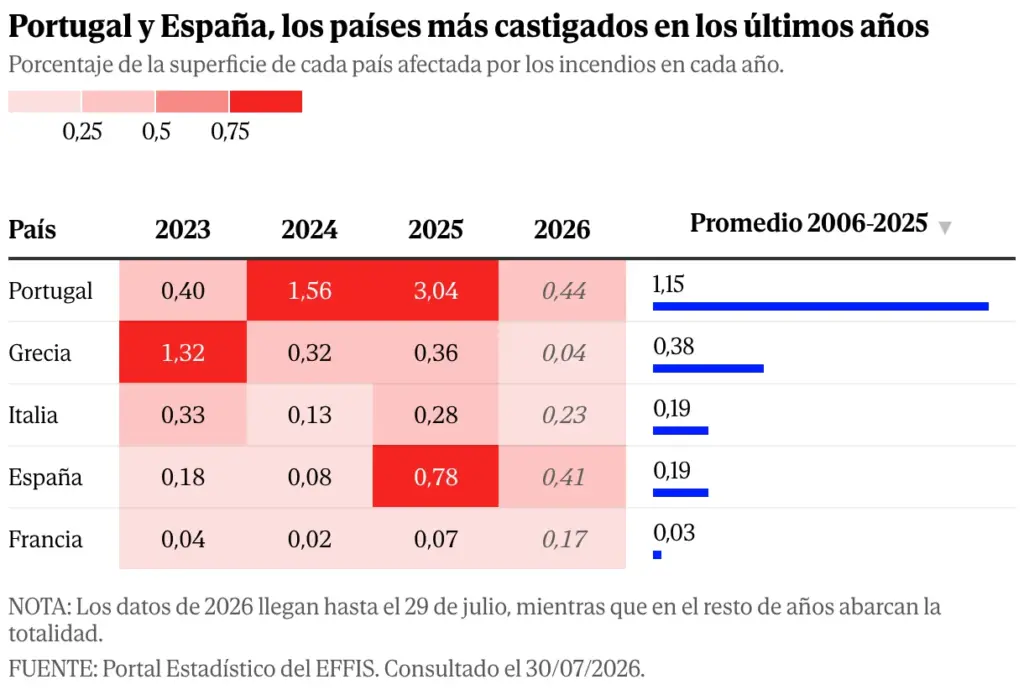
The results of the climate study led by Raúl Cordero also show that the Iberian Peninsula “clearly stands out within southern Europe” as the most affected area by fires. “Although the entire Mediterranean region has warmed, Spain and Portugal combine that warming with a reduction in summer rainfall and increasingly frequent droughts. That combination makes the conditions favorable for fire spread more intense than in other Mediterranean regions.”
In contrast, he adds, in parts of southern Italy and Greece, they have observed that summer rainfall has slightly increased in recent decades. “That increase does not eliminate the fire risk, but it seems to have partially mitigated the effect of rising temperatures.”
Portugal has also been the country that has suffered the most human losses, particularly in the 2017 campaign, when 65 people died in the fire declared in Pedrógão Grande, many trapped on the road. Between 2013 and 2017, 117 people died in our neighboring country and more than 300,000 hectares burned.
France is now dealing in the south of the country with the worst fire in its history, which has devastated about 42,000 hectares, while in 2007 it was Greece that experienced a great tragedy, with fires that ravaged half the country and killed more than 50 people trapped in their homes or during escape. Added to this are, among others, the large fires in 2023 on the islands of Corfu and Rhodes, and those declared this week in Paros, Crete, and southern Peloponnese, with three firefighters dead.
“The situation in these countries is similar, although there are differences depending on the areas. One year it hits one country and another year it hits another, but we are all there, suffering the same consequences of a very similar set of circumstances: a cumulative effect of rural depopulation, abandonment of traditional uses, lack of forest management, urbanism encroaching on the forest…,” summarizes Luis Suárez, Conservation Coordinator at WWF Spain.
According to this biologist, the problems we have in southern Europe will move north as the climate crisis advances. “I believe the European Union is already starting to react. In Spain, for many years we have had a very effective firefighting system, considering the large area we have, but now it is being completely overwhelmed by these very difficult fires to extinguish.”
HUMAN ACTION CAUSES 80% OF FIRES
Forests do not burn just because it is very hot. An ignition is needed to cause the fire. In Spain, those caused by natural causes, mainly lightning strikes, represent about 5% of the total. According to data provided by MITECO, eight out of ten fires are caused by human action, whether by accidents, negligence, or intentionally.
Of those eight out of ten fires caused by humans, it is estimated that three are due to accidents, carelessness, or negligence, such as barbecues or poorly controlled burns. The other five are intentional fires, mostly due to improper use of fire such as illegal agricultural burns or burns to regenerate pastures. According to MITECO, fires caused by arsonists represent about 2% of the total.
The percentages vary in the 2025 General State Prosecutor’s Office Report, according to which between 2020 and 2024, 65.6% of fires were caused by negligence or accidents (involuntarily caused by human activity) compared to 23.6% intentional fires.