




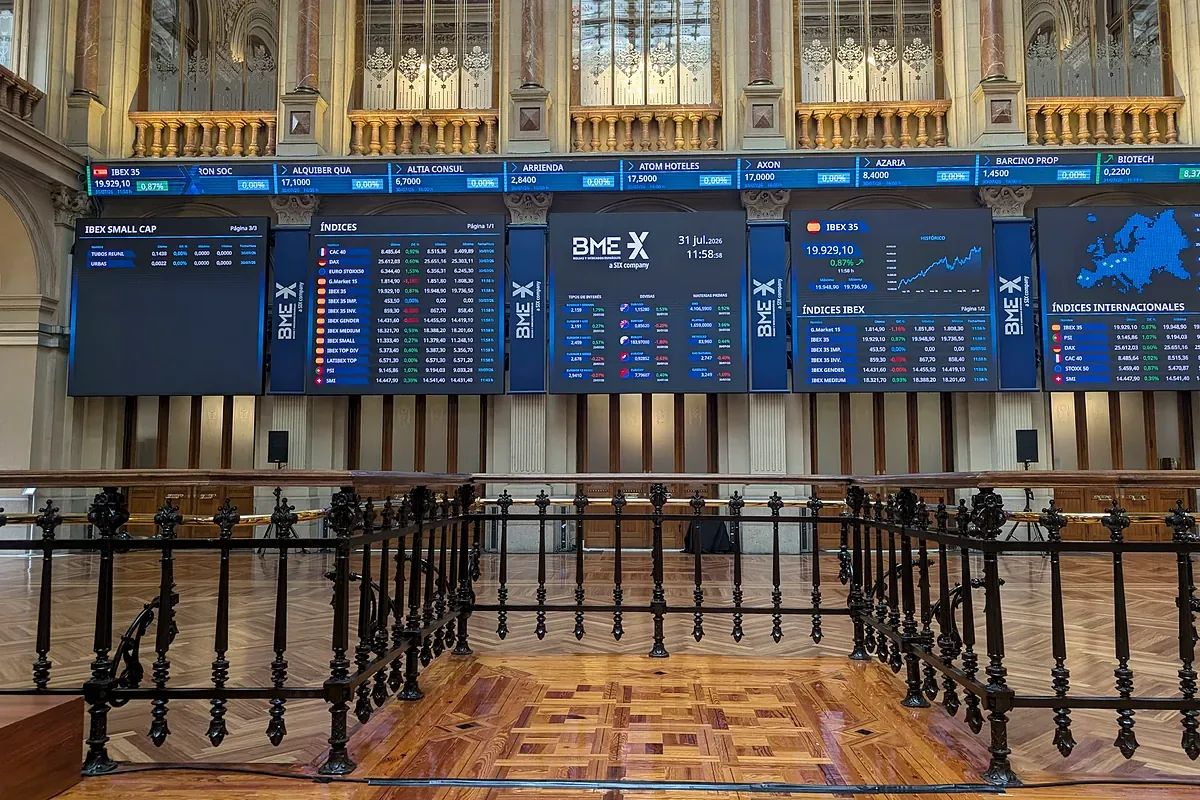
Spanish learned with blood what a decade of crisis, post-crisis, and 0% interest rates was. If it was not in the domestic market, it was because it had lost faith in scraping some profitability in Spain. And so it arrived at the summer of 2022 when the European Central Bank (ECB), after months of pre-announcing it to the market, raised official rates for the first time. It would do so nine more times after that. And in a market loaded with banks, it is gasoline to keep rising. The point is that when the Ibex rose 10% in the last three months of 2022, Spanish families were caught off guard. In 2023 the index went from 8,229 points to trading around 10,100, up 23%, and it still hadn’t fully penetrated investor sentiment. In 2024 the jump was another 1,500 points, almost 15%. But the total party arrived in 2025. From the sidelines, the national investor saw the index go from 11,600 to 17,300 whole points, a 49% rise surpassing practically all international stock markets, even the all-powerful Wall Street. The Spanish stock market has gained speed and if it took 20 months to go from 10,000 to 15,000 points; the next 5,000 have been achieved in half the time, leaving far behind those historic highs reached just before everything blew up in the great financial crisis of 2008. The Ibex 35 has set a new all-time record after conquering 20,000 points this Tuesday. In fact, it ended the day at 20,023.6 points.
Saying that Spain is in fashion is almost a pleonasm. It sank more than other European countries due to the pandemic that hit especially the service sector, and since then it has grown more than its peers and the forecast is that 2026 will be more of the same. The government has just revised upwards, to 2.6%, its forecast for this year, and the stock market is advancing in double digits. There is almost a fever not to be left out. That American FOMO in its Spanish version. At the close of the first half of the year, the Spanish stock market has shot up its trading volumes by 34%, with more than 254 billion euros exchanged and a daily average of more than 2.06 billion, according to data collected by SIX. We are talking about levels comparable to eight years ago. If it maintains this streak, the national market could close 2026 with more than half a trillion euros traded, something not seen since 2018, and it has not been because household participation in the stock market has increased especially, not even professional investors. The latest data, still provisional, speak of a “marginal increase” in the holding of Spanish shares by families, which would be around 16%, according to BME. Those who have increasingly more are the large foreign investors – especially Americans and British – who would already control more than half of the national stock market, where The Vanguard Group, BlackRock, Amundi, or Charles Schwab stand out. In fact, the firm led by Larry Fink has just made Spain its biggest bet worldwide for the second half of this year.
That “Spanish Cainism“, as defined by José Ramón Iturriaga, manager of Abante Asesores and head of two funds that have shone especially in recent years in the Spanish stock market, such as Okavango Delta or Spanish Opportunities, is what together with the current “political noise” “makes the level of exposure of the retail and Spanish institutional investors very low“, even more today amid corruption scandals or the lack of general budgets for three years. “We don’t quite trust” that the rise of the domestic stock market is consistent over time. “The problem will come when we believe it and enter a phase of euphoria,” says the manager. The reality is that the Ibex, which has been said over and over that it came from much further behind than its European peers, leads all gains with a rise of more than 120% in the last five years. This is more than Italy, which is the only stock market also capable of doubling its capitalization in this time; and more than Germany (60%), the very EuroStoxx 50 itself, and more than the French Cac, which is not living its best moment due to the country’s strong political instability and with skyrocketing public debt (30%).
“The Spanish economy maintains a good overall perception because internal political issues are practically irrelevant when a cold diagnosis is made from outside,” say Bankinter analysts, who believe that Spain’s leadership will enter “a phase of gradual moderation,” “rather caused by the inaction of economic policy combined with tax pressure (…) not at all aimed at improving productivity”. Still, they see the Ibex 35 beyond 22,300 points next summer. This is one of the big questions for those who have seen how the Ibex doubled its valuation in recent years without joining the party.
Too late to enter?
Right now there are four companies in the market that are above the 100 billion euro capitalization barrier: Banco Santander, at 184 billion; Inditex, around 180 billion; Iberdrola at 137 billion and BBVA reaches 137 billion euros. CaixaBank trades around 88 billion euros. Rate hikes notwithstanding, the six listed banks have posted revaluations between 300% and 470% from Unicaja and Santander to Banco Sabadell which, freed from BBVA’s takeover bid, has limited itself to resting from gains in the last year. The banking chapter seems about to end, despite the ECB being the only central bank that dared to return to the path of rate hikes to chase the inflation caused by the conflict in the Middle East. Since July last year, steelmakers like ArcelorMittal, the construction and services firm ACS, or defense value like Indra have led the Ibex, with gains reaching 100%.
“The context continues to be pro-market and favorable to risk acceptance. The opportunity cost of staying out remains higher than the potential loss that would be associated with a sudden deterioration of the context,” says Bankinter, within a clear favorable outlook for stocks, especially after the signing between the US and Iran of the MoU (Memorandum of Understanding) aimed at ending the conflict in the coming months. For Iturriaga “the Spanish stock market has the tailwind thanks to a banking sector that, without ruffling feathers, has guaranteed growth for three years just by balance sheet expansion with valuations that remain reasonably cheap” because their skyrocketing stock prices came to compensate for the bargain prices at which they traded before 2021. “The risk-return ratio is much more attractive here than in global stock markets [especially in the US] where there is an obvious concentration problem underneath, with valuations that only hold if you believe that 20% profit growths are sustainable” over time.
That ‘money attracts money’ is also being seen among Spanish investors, who have increased interest in buying. This is what Ricardo Seixas, head of equity at Bestinver, assures, who confesses that despite “the significant market advance, we are still behind” compared to European peers. In his opinion, and this is widespread among analysts and managers, it is time to return to basics considering the Iran war as a transitory episode in stock market terms. “We return to a continuous environment (compared to January this year) with strong company profit growths and shareholder remuneration that continues to rise and is above the average” of other markets.
Read more Concern for Ceuta dominates the Royal Family’s reception in Marivent
“Spain, which was identified with banks that were not investable, has gone from being down and having no interest to being an index that is back,” Glen Spencer, head of equity and credit strategy at Banco Sabadell. “Banks remain attractive by valuation after an improvement in their forecasts, as they have moved from a scenario where the value of money was zero or negative to normalized rates that allow you to make a living” with their traditional business of lending money.
In any case, Rocío Maldonado, head of equity at Santander AM, believes that “it is not the best time to enter aggressively and without discrimination after such a strong rise. The entry point is no longer as obvious as a few months ago. That said, we also do not believe that Spain should be avoided simply because it has risen.” In the same vein, Natalia Aguirre, head of Analysis at Renta 4, identifies a “limited upside” for the Ibex, with much focus on the earnings season that is already starting and with a “predictable spike in volatility during the 60 days that peace negotiations will last, with important aspects to clarify, mainly those related to how the full opening of the Strait of Hormuz will be (when and under what conditions), what will happen with frozen Iranian assets and with the reparations committed to Iran”.
If Renta 4 gives a valuation of 20,100 points for the Ibex at the end of 2026, Sabadell does not even reach that level until the end of 2027. Spencer believes it is very likely that in the summer, given the drop in volumes and the spike in volatility, a market correction will be seen to which the Ibex “would not be immune”.
BEYOND BANKING
Experts agree that it will be difficult to see a double-digit rally in the second half of the year. It should not be forgotten that the Ibex added more than 10% until June. They also believe that its potential is based on more profits, dividends, and sectors that are called to lead the new market gains within “structural trends such as investment in infrastructure, electrification, and tourism,” says Maldonado.
The domestic market, dominated by banks and utilities, also hosts niche firms, within industry, automotive or renewables, that are international leaders and with a very relevant weight of exports. “As long as geopolitical or geostrategic doubts are cleared up, we should have significant potential,” says Seixas. In the same vein, Abante points to companies like Acerinox (with half of its revenues in the US), Gestamp (tier-1 global automotive supplier), Tubacex, pharmaceutical Grifols, or pool manufacturer Fluidra. “They are firms that trade cheaply, that will continue to support the Spanish stock market and that have not yet entered the investor radar,” he emphasizes. The defense sector also remains liked, says Sabadell, represented in Spain by Indra and Amper: and also technology derivatives such as “data centers or utilities in the supply and connection of these companies, like ACS, Merlin Properties or Redeia,” lacking semiconductors or large artificial intelligence firms where Spain – and almost Europe – is still a wasteland.