





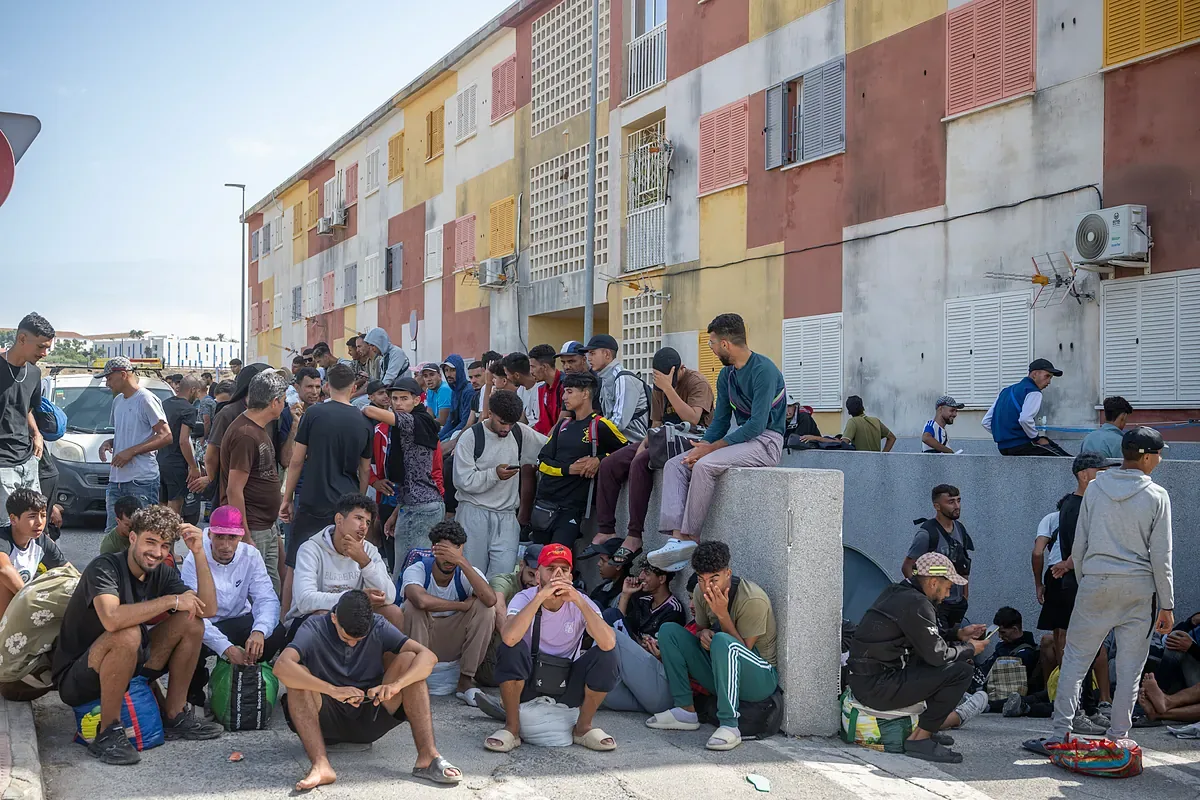
The Government celebrates that “90%” of the immigrants who entered Ceuta through the Tarajal border returned to Morocco in the days following the avalanche on July 30, but fears that the final solution will become more entrenched than expected due to legal procedures. Not only because the expulsion of immigrants is “very complex” and “takes a long time,” but also because officials “are refusing to sign the files for fear of being convicted of malfeasance” for the express repatriations, according to sources from the Government revealed to EL MUNDO.
This unequivocally slows down the process. According to what this newspaper has learned, the first ordinary repatriation files for unaccompanied minors will begin to be sent this very week, a month after the assault on the European border.
They will be around 25 minors, out of the approximately 1,200 still in Ceuta, according to the consulted sources. That is, just over 2% of that total. Although the Government hopes to scrape a few more, up to 35.
The Executive acknowledges that they need a huge push to unblock the bureaucratic bottleneck delaying the returns. If the solution to the Ceuta crisis comes in dribs and drabs, the risk of social tension worsening could skyrocket. And yet, in Moncloa they continue to insist that Morocco is willing for “absolutely all” those who took part in the assault to return to its territory.
In that sense, government sources say that 200 adult immigrants have been expelled through the extraordinary route. That is, for having committed minor offenses (serious crimes are tried in Spain).
What is happening? Why are officials, both governmental and local, reluctant to speed up the deadlines as much as possible to ease Ceuta’s social tension? Why are expulsions getting stuck if Morocco accepts that they all return? Because officials refuse to shorten any deadlines. And they have conveyed this to the authorities, both to Immigration and those of the autonomous city.
The key to everything lies in a ruling by the Provincial Court of Cádiz, which in 2025 sentenced the former Government delegate in Ceuta Salvadora Mateos and the former first vice president of the autonomous city Mabel Deu to nine years of disqualification for a crime of “administrative malfeasance,” following the express repatriation of 55 minors to Morocco in 2021.
“No official wants to expedite the files, for fear of being convicted. No one wants to sign a paper. What this ruling has caused is this, that no one wants to take responsibility for anything, neither in the General State Administration, for adults, nor the officials of Ceuta, for minors. People do not deviate even a millimeter [from the literalness of the rule], everything goes by the book, and the law is very clear and very protective,” government sources explain to this newspaper.
To the problem of the slowdown of the files is added another: the lack of real guarantees that Morocco will process them quickly. And that, in case they do not ignore them completely, since the Minister of Youth and Childhood, Sira Rego, revealed last week that the neighboring country is holding no less than 600 files of unaccompanied foreign minors who arrived in Ceuta before July 30.
The Government acknowledges the legal problem they face and their helplessness in speeding up the processes: “It is difficult: all those who enter and want to stay now request political asylum. That complicates the file. Interviews and other procedures must be done,” they recall. “We are very protective. The delays in the files are attributable to Spain and the ruling, not to Morocco, which is receiving everyone,” for now, the sources assure, adding: “Morocco, in this episode, is cooperating, and it has to do more when it has the files with all the guarantees.” “It is all very difficult,” they sigh.