





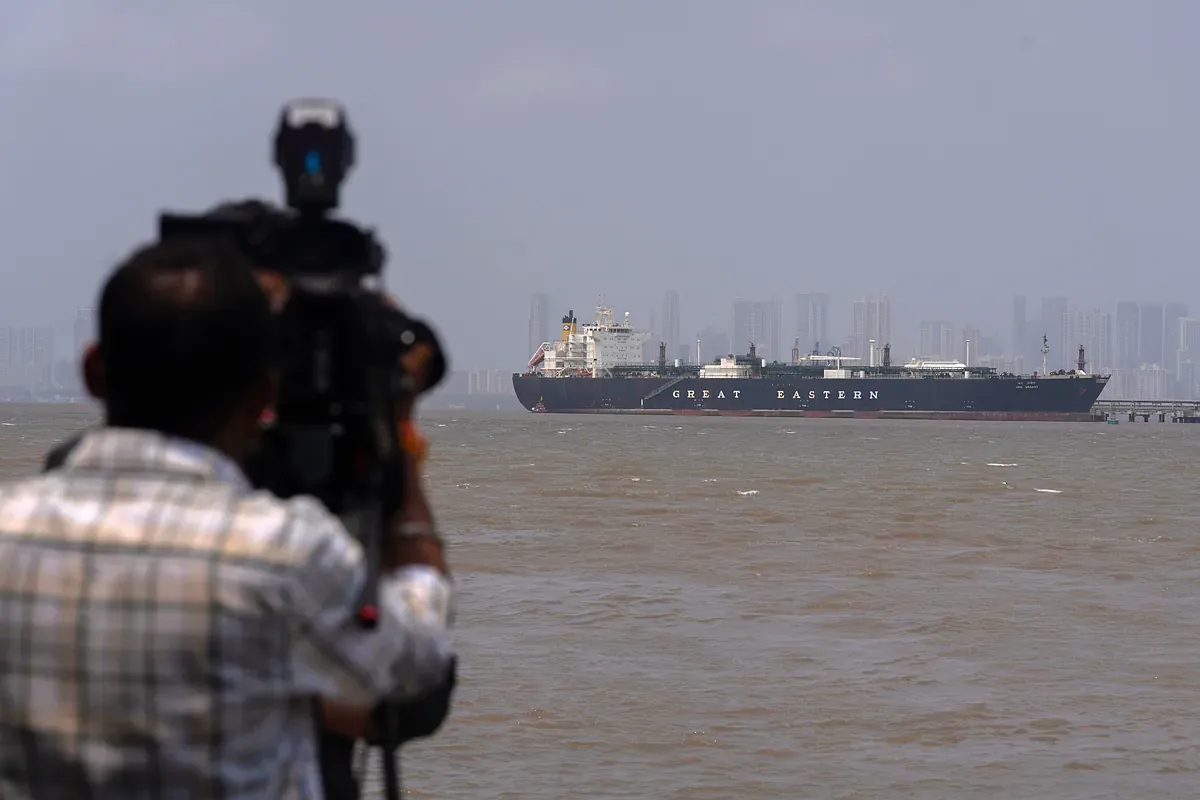
Critical day for the commodity market: another day of tensions in the Middle East concludes, which has resulted in new price increases for the Brent crude oil barrel, a benchmark in Europe. Specifically, it has once again surpassed the 100-dollar barrier, something that had not happened since May, and has stood at 100.90 dollars, after an intraday increase of 7.26% but still below the March-May average, when it reached 101.9 dollars.
Read more Borges whispers to Zapatero to resist
The origin of this new surge is once again the cross-attacks between the US and Iran last night, which are increasingly leaving behind the memorandum of understanding signed between Washington and Tehran just over a month ago, and once again put the passage through the Strait of Hormuz in the eye of the storm, where, until the start of the open war last February, 20% of global fuel transport circulated.
Specifically, the objective of the latest round of American bombings precisely had the declared purpose by Donald Trump of undermining Tehran’s capacity to threaten commercial traffic. And in parallel, in recent hours there have been new attacks by Yemen’s Houthi rebels against Saudi oil tankers in the Red Sea, which they have accused of “violating the blockade imposed” by the militias against Saudi Arabia.
And it has been this last intrusion that has pushed oil prices up this Thursday, although it is true that since traffic in Hormuz has been surrounded by bombings, crude prices have been subjected to constant pressure that has sometimes led the price of a Brent barrel to 120 dollars. Today, for its part, the West Texas Intermediate (WTI) barrel, a benchmark in the United States, has revalued by up to 5.3% to trade at 91.5 dollars.
“The market no longer values risk solely based on geopolitics; it now focuses on the resilience of physical oil flows,” emphasize Rystad Energy. “Much of the world’s available production capacity has already been utilized, while strategic and commercial oil inventories are lower than they were when the war began, leaving the market with less room to cope with a prolonged supply disruption. As the conflict evolves, the direction of prices will ultimately depend on three factors: whether crude flows to Asia can be maintained, whether refineries can adapt to a changing mix of crude grades, and how geopolitical developments evolve.”
Natural gas is also not immune to price tensions, although it is true that today, measured by the Dutch TTF index, it trades at 62.13 euros per megawatt/hour and shows a slight drop of 0.64% compared to yesterday. “The rebound in energy commodities keeps alive the risk of further actions [by the ECB] after the summer,” Banca March clarifies. They add: “Since the beginning of the month, oil and gas have accumulated advances of +32% and +46% respectively, in a context marked by eleven consecutive days of attacks in the Middle East. The escalation of hostilities has pushed Brent back towards 100 dollars/barrel and gas above 64 euros/megawatt. From our perspective, we continue to anticipate a final hike before the end of the year.”
Similarly, Renta 4 analysts warn that “the concern that higher energy prices could keep inflation at high levels and complicate monetary policy prospects” is fueled. With the Fed meeting scheduled for next week, markets assign approximately a 30% probability to an interest rate hike and a 70% probability that policymakers will keep them unchanged.” They add that, with the memorandum of understanding broken and a resumption of cross-attacks, “vigilance over the Strait of Hormuz (and the Red Sea given Houthi threats to Saudi Arabia) and energy prices (the Brent barrel increasing 30% since early July) must be extreme.”
Precisely in Europe this Thursday, the Governing Council of the European Central Bank (ECB) has reported that it is keeping interest rates unchanged, although it has foreseen that uncertainty persists and the full inflationary impact of the energy crisis has not yet manifested.
This marked the European stock market session, where the Ibex 35 ended Thursday’s session with a fall of 1.55%, to stand at 19,267 points. Tensions spread from one index to another, leaving a red session in Europe: the British FTSE 100 closed with falls of 0.73%; the French Cac 40 by 1.64%; the German Dax with another negative 1.55%; and the Euro Stoxx 50, which includes the 50 largest European companies, retreated 1.69%.
In Spain, another day marked by the publication of corporate accounts saw some of those that presented results trading in a brilliant green, such as Indra (+7.08%), Repsol (+3.65%) and Rovi (+3.38%). At the other extreme, that of losses, IAG led (-3.88%), followed by Banco Santander (-3.86%) and Grifols (-3.49%).
This Thursday, within the bond market, the yield on the Spanish 10-year sovereign bond reached 3.689%, a slight increase compared to 3.632% at Wednesday’s close. Thus, the risk premium against German debt reached 46.29 basis points.