


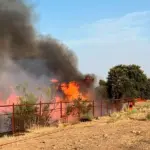




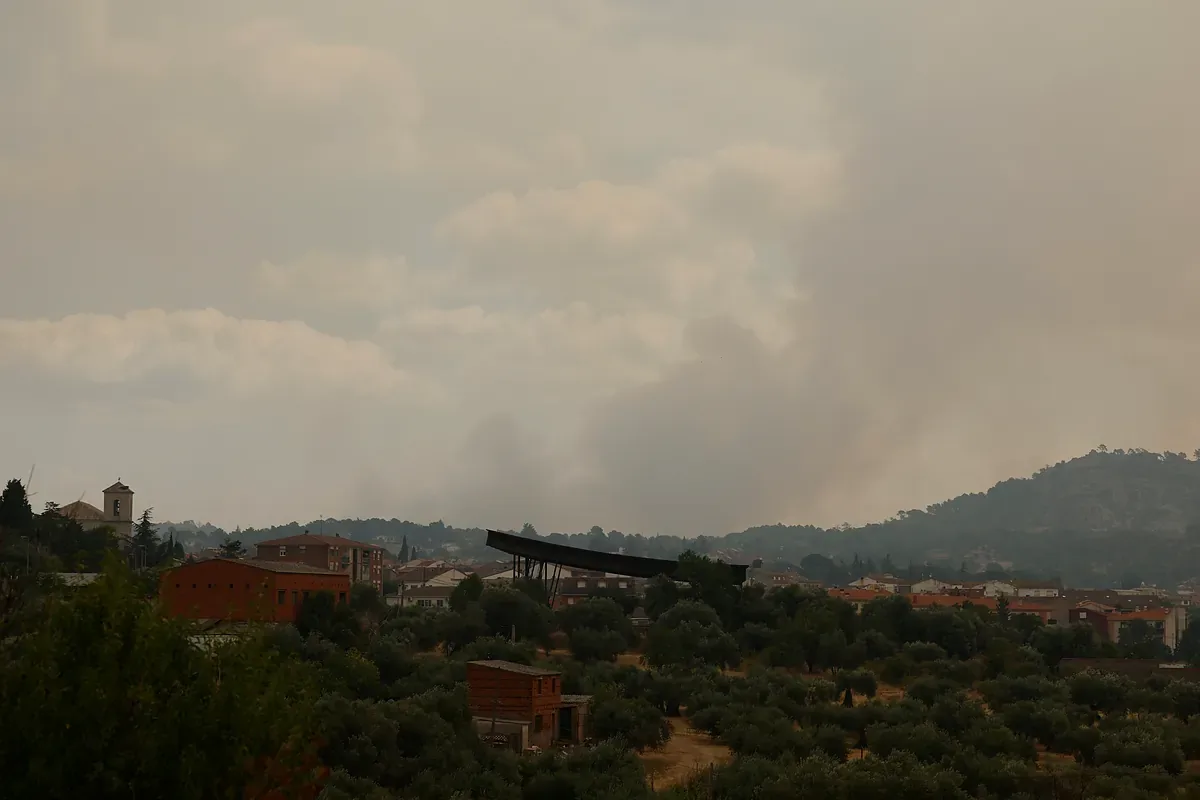
The damage from fires does not stay in the scorched land and in the immediate and nearby destruction. Smoke can travel and affect populations hundreds of kilometers away. In fact, air quality has seriously worsened in recent hours in the Community of Madrid and various city councils and institutions have issued recommendations for these reasons.
Samur-Protección Civil, the Government Delegation in the Community of Madrid or Emergencias Madrid have issued various messages about air quality, wind forecasts and protection measures for citizens. The Minister of Health, Mónica García, has also warned on her X account (formerly Twitter) to avoid staying outdoors and, if doing so, to use FFP2/95 masks.
This worsening of the air due to smoke translates into an increase in asthmatic crises, exacerbations of chronic obstructive pulmonary disease (COPD), respiratory infections, visits to emergency services, hospitalizations and mortality due to respiratory causes.
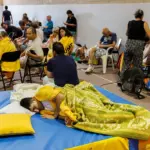
So far, according to EFE, 110 health care services have been registered for people affected by forest fires in the Community of Madrid, of which 25 have required hospital assistance for respiratory problems and six have been admitted to a hospital, none of whom present a serious condition, according to the regional Government. In addition to deploying assistance devices and psychological support teams in reception centers for the affected population, coordination efforts are being made to guarantee the supply of medication and oxygen therapy to chronic patients.
In addition to forest fires, there is an intrusion of air masses of African origin affecting the center of the Iberian Peninsula, hence the great deterioration of air quality in the Community of Madrid, with an increase in concentrations of particulate matter (PM). Therefore, in this region it is recommended to follow the instructions of the competent authorities and adopt the usual precautionary measures during pollution episodes due to small particles less than 2.5 microns (PM2.5) from fire smoke.
Why does smoke hundreds of kilometers away also impact the body?
The fine particles that arise in fires are not visible to the naked eye, like splinters, as they measure less than 2.5 microns (human hair is 80 microns thick), but they mainly damage our heart and our lungs. They can be breathed even if the street does not smell of smoke.
In addition, this contaminated air can contain benzene, formaldehyde, sulfur dioxide and some of these compounds are highly carcinogenic.
In all fires, the same type of particles are not released into the air depending on the type of forest burned, human constructions burned or vehicles (which contain chemical substances), etc.
Who should protect themselves the most?
In general, precautions should be taken especially in the case of the vulnerable population (children, the elderly, pregnant women and people with respiratory or cardiovascular diseases), who should avoid or reduce physical activity outdoors and seek medical attention if necessary.
In extreme cases, it may be prudent for these people to stay at home while the pollution episode lasts.
What are the protection measures?
The main recommendations provided by the :
- Stay indoors with windows closed. As far as possible, all ventilation in the house (chimneys, extractor hood, ventilation grilles or similar) should be restricted to prevent smoke from entering.
- Use FFP2 or N95 masks in case of exposure, given that surgical masks, handkerchiefs or scarves do not offer safe protection against smoke particles. FFP2 masks with active carbon filter also protect against polluting gases.
- Always stay informed through official sources and follow the recommendations of the authorities.
What are the consequences of inhaling fire smoke?
The Environmental Epidemiology Working Group of the Spanish Society of Epidemiology (SEE) warns that the combination of extreme heat and pollution from forest fire smoke increases public health risks through respiratory, cardiovascular and mental illnesses, especially in the elderly, children, pregnant women and chronic patients.
A recent study by a team of Canadian researchers analyzed almost a million emergency room visits for migraines or headaches that occurred between 2010 and 2023 in two Canadian provinces during the period of highest risk of forest fires.
Robert Belvís, clinical head of the Headache and Neuralgia Unit in the Neurology Service of the Hospital de la Santa Creu i Sant Pau in Barcelona, points out that “exposure to fire smoke had already been assessed as an aggravating factor for migraine and other primary headaches previously in Australian, North American and Korean studies,” as reported by SMC.
“Smoke probably carries particles capable of activating the trigeminovascular system, which is the main system that activates headaches,” explains Belvís. His analyses show that the presence of PM2.5 particles originating from fires was associated with an increase in emergency room visits for migraines and headaches. The study is published in JAMA Network Open.
Last summer, the journal The Lancet Planetary Health also published a paper stating that mortality associated with forest fire smoke could be underestimated by 93%.
At the end of summer 2025, an analysis in Nature predicted that premature deaths due to fire smoke pollution would multiply to reach nearly one and a half million deaths per year by the end of the century. The authors calculate that the increase will be much greater in Africa —11 times more deaths in 2095-2099 than in 2010-2014— than in Europe and the US —up to twice as many—.
How long should precautions be maintained?
The effects can appear a few days after exposure and are especially relevant among people who already suffer from respiratory diseases.