




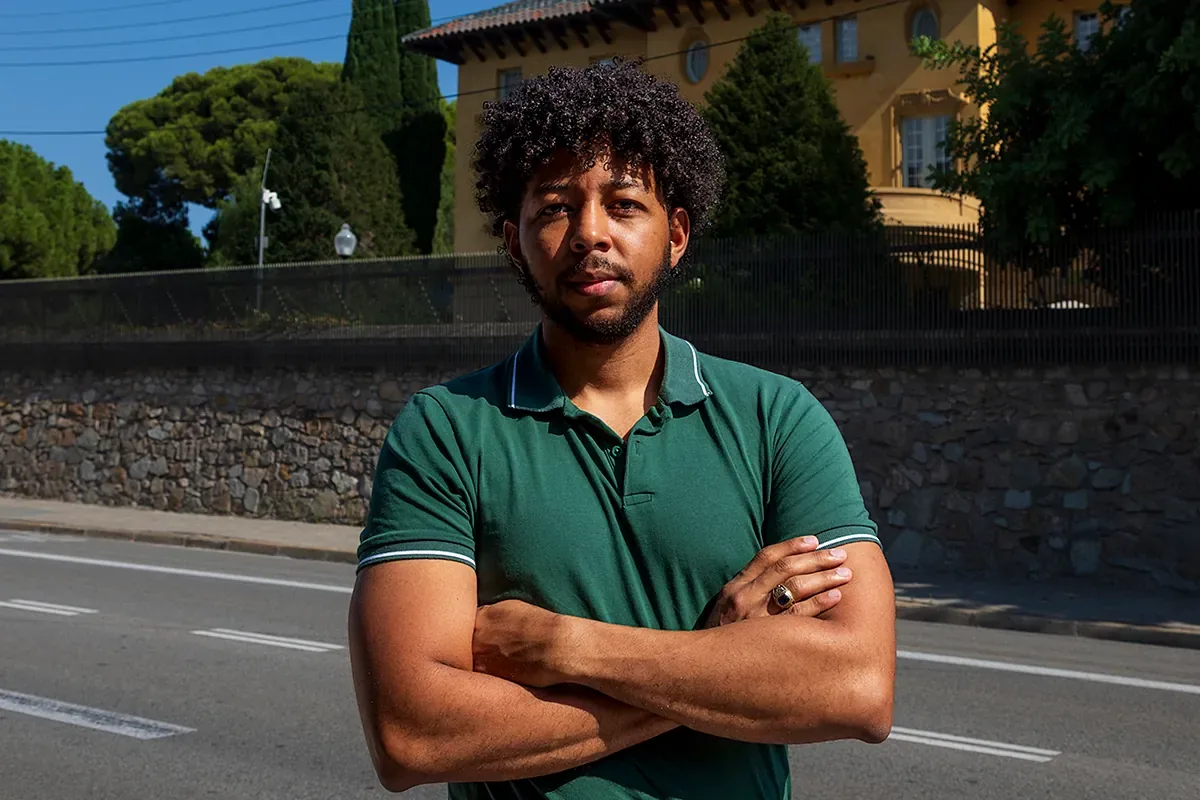
“You know? Many times I have broken down during this investigation,” says York Louis Celestino Herrera as he tries to reconstruct, message by message and document by document, how the hell his name ended up on a United States Government blacklist alongside that of a North Korean IT specialist accused by the Treasury Department of turning tech jobs into currency to feed Kim Jong-un’s nuclear arsenal.
Read more France is considering curbing the revaluation of high pensions to reduce the deficit
“Every time I try to understand what happened and discover something new, I ask myself again what has happened and how my life could have ended up like this,” laments the Hispanic-Dominican. “And it’s not just about being on a list or having a thousand problems with banks that have closed my accounts. It’s feeling that I have lost the possibility of living a normal life and doing things I once took for granted. Not being able to tell my mother: ‘Mom, take this money for your medicine,’ or to say: ‘Mom, on such a date I will see you, I bought a flight to Santo Domingo.’ Not being able to tell my father: ‘Dad, I’m fine, I’m moving forward.’ And not being able to tell my partner: ‘Let’s continue with our plans, get married, build a house, and be happy.’
York Louis’s story obscenely resembles that of Owen Ashe, the billionaire from the second season of Hidden Vices who discovers that being on the OFAC list is equivalent to becoming a financial outcast: banks, funds, and managers start treating your money as if it were burning; accounts are closed, cards stop working, Netflix and Spotify start deleting you from their servers, and even Amazon lowers the barrier. Getting paid becomes a domestic smuggling operation. Money no longer circulates: it coagulates. Your name ceases to be a name and becomes an alarm that throws you into an algorithmic leper colony: almost everything that makes life possible starts treating you as if you were contagious.
Of course, Ashe, played in the Apple TV+ series by James Marsden, is an immensely wealthy man, with partnerships, advisors, and lawyers capable of turning an international sanction into an almost trivial financial engineering problem. In contrast, York is a Dominican immigrant with Spanish nationality, a web developer living in Hospitalet who doesn’t even have money to pay the cheapest lawyer in the city, much less one of the American specialists ready to face the OFAC labyrinth. Owen Ashe had a fortune frozen. York had his erased.
The story has the narrative insolence of reality: no Apple TV writers’ room would have let that chain of coincidences pass as implausible.
On March 17, York Louis Celestino Herrera got up to go to work at seven in the morning and discovered that his existence, as he had known it, was beginning to vanish. Literally. PayPal had closed his account. His bank in the Dominican Republic had done the same. ING and BBVA blocked his accounts in Spain. His card stopped working, bills began to bounce. He couldn’t even collect his paycheck. Netflix even closed his account. “Everything broke for me,” he says.
ON THE BLACKLIST
“Then I thought: what the hell is going on? I called the Tax Agency. I requested an appointment, checked if I had any debt, anything that could explain it. I owed nothing. I went online and ended up asking ChatGPT. It showed me several international sanctions lists. One was OFAC’s. I entered, first verified that the page was really from the United States Government, and typed my name. And there I was: York Louis Celestino Herrera. I didn’t even know what OFAC was.”
OFAC is the Office of Foreign Assets Control of the U.S. Treasury Department. It is not a court, nor a prosecutor’s office, nor a police force. It is the office that decides who becomes part of the untouchable caste of the global financial system. A name on its Specially Designated Nationals and Blocked Persons list is enough for a sanitary cordon to start rising around it.
York entered the list on March 12, 2026, under Executive Order 13810, and the file is not limited to his name: date and place of birth, two nationalities, a Spanish passport, an old Dominican one, an identity number, and an explicit link to an alleged North Korean agent, Yun Song Guk.
Trying to find out exactly what York did to get crushed is complicated because the Treasury is surprisingly terse. Essentially, Washington accuses him without providing any evidence of having helped Yun obtain IT jobs online, preparing or facilitating contracts through which the North Korean could get paid by foreign clients.
To better understand the plot, let’s say the North Korean regime has been using its workers abroad for years as a machine to obtain foreign currency. Thousands of technicians are sent or assigned to enclaves in China, Russia, Laos, and other countries, where they work under structures controlled by Pyongyang and hand over a good part of what they earn to the state: the regime can keep up to 90% of their salaries.
A programmer presenting himself as North Korean hardly gets a Western contract under the sanctions regime, so the real worker is erased and another is fabricated on paper: another identity, another nationality, another professional profile, even a computer located in another country. The company believes it is hiring a European, Latin American, or Asian programmer; the one who really does the work is a North Korean sitting in Laos. The job is real, the code is real, and the salary too. What is fake is the man shown on the screen. And that money, according to Washington, ends up feeding Pyongyang’s coffers.
Yun led one of those squads from Boten, Laos. York Louis is supposed to have helped him get assignments for the slaves disguised behind false identities, which is, in principle, extraordinary because he himself was barely surviving on microscopic assignments and digital odd jobs of thirty dollars.
A TERRORIST?
And how has the immigrant reacted? Proclaiming his innocence. “I almost had a heart attack. I was breathless. I have never met a North Korean in my life,” he says. “My life has been destroyed and everything is dark.”
Read more Repsol’s largest wind farm opens an accounting hole of almost 300 million
The first thing he did was go to the Mossos d’Esquadra. Not to ask if they were going to arrest him, but to report that someone might be using his name. He has also requested judicial protection. His attitude, at least towards those who have tried to reconstruct the case, has been exactly the opposite of hiding: he wants them to look. He has gathered his passports, identity documents, travel history, work history, pay slips, contracts, bank movements, savings accounts, money transfer receipts, online work profiles, emails, and the history of the platforms he used, including cryptocurrency wallets.
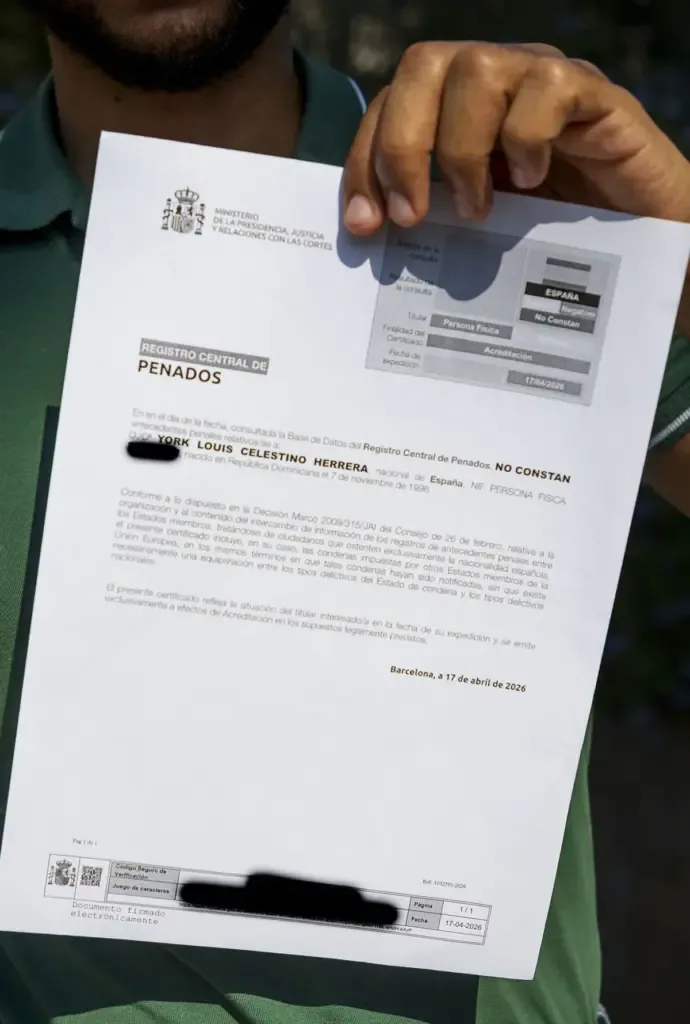
The problem is who to appeal to: York is not criminally charged in Spain, as far as is known, nor is there a public U.S. federal charge against him. The Mossos, he says, also verified that there was no international arrest warrant. Washington has not taken him before a judge: it has sanctioned him administratively.
There is something Kafkaesque about trying to prove your innocence when no one has handed you the file you must defend yourself against. Before whom does York appear? What evidence destroys an accusation known only by a phrase from the Treasury? “How can someone prove they are not a terrorist to someone who says they are without providing evidence?” says lawyer Yeni Batista. “I cannot prove a negative fact.”
There are two hypotheses. The first is York’s: identity theft. Someone could have gotten hold of his data and constructed a professional identity in his name. OFAC keeps information from an old Dominican passport of his, and York believed from the start that this could be the entry point.
The second is that someone tried to turn him, with his real identity and his real computer, into the front of another programmer. And thanks to him, we know someone proposed it.
In 2023, the Hispanic-Dominican received a proposal from an individual using the identifiers of TigerDeveloper: between 50 and 100 dollars a month in exchange for using his identity, his Upwork profile, and a computer connected to the Internet from which the other developer would do the work remotely. The same user who spread that offer in a programmers’ community also provided, within courses and training materials, the executable link of a free version from which he installed AnyDesk, a legitimate program that allows controlling a computer from another location and is, in fact, used for this type of operation.
York maintains that he never accepted that proposal but it is possible that he unknowingly entered an ecosystem designed to obtain identities, accounts, and computers usable from abroad. Because Tiger’s proposal fits scandalously precisely with the system that the U.S. authorities themselves attribute to North Korean tech worker networks: authentic identity of a third party, real professional profile, computer physically in another country, remote access, and another person working from outside. And an uncomfortable coincidence: two years later, York received an email with the subject “Tiger” and a disturbing phrase: “Louis, AnyDesk is off.”
CRYING IN THE SHOWER
Yun Song Guk and Hoang Minh Quang add up to dozens of transactions barely exceeding 70,000 dollars. The Hispanic is just another part of that architecture and Washington does not attribute any amount to him. His money is from another league: a TigerDeveloper offer of 50 or 100 dollars a month, a 30-dollar assignment on Upwork, smaller payments via Payoneer, and four movements on Binance for 240 digital dollars explainable without the North Korean plot.
From York’s current account, Pyongyang’s foreign currency machinery fits in a holey pocket. Even if the U.S. is right, it’s hard to see it as more than a peripheral piece. That does not exonerate him. But since he learned of the sanction, York has emptied his drawers and opened the door to anyone who wants to rummage through them.
And at the bottom of those drawers is a biography less cinematic than the accusation: born in La Vega (Dominican Republic), 29 years old, he stepped on Spain in 2013 and returned in 2015, at 17, to do moving jobs and work as an electrician; then he studied computer science in his country and settled here in 2021.
Since then he has been dedicated to web development in a large international technology services company. Before Kim Jong-un absurdly burst into his life, his big projects were less geopolitical: save money, buy a house, and get married. His company does believe him. That is why he keeps the job, although he receives the paycheck in his father’s account.
“It has been a torment,” says his partner. “Once I found him crying in the shower like a child. We went from having plans to get married to having plans to break up. There are days I don’t even want to get out of bed. We had planned to save to buy an apartment and now we don’t even have enough to eat.”
Read more Shooting with three fatalities in Isla Cristina: «I have the scare stuck in my body»