




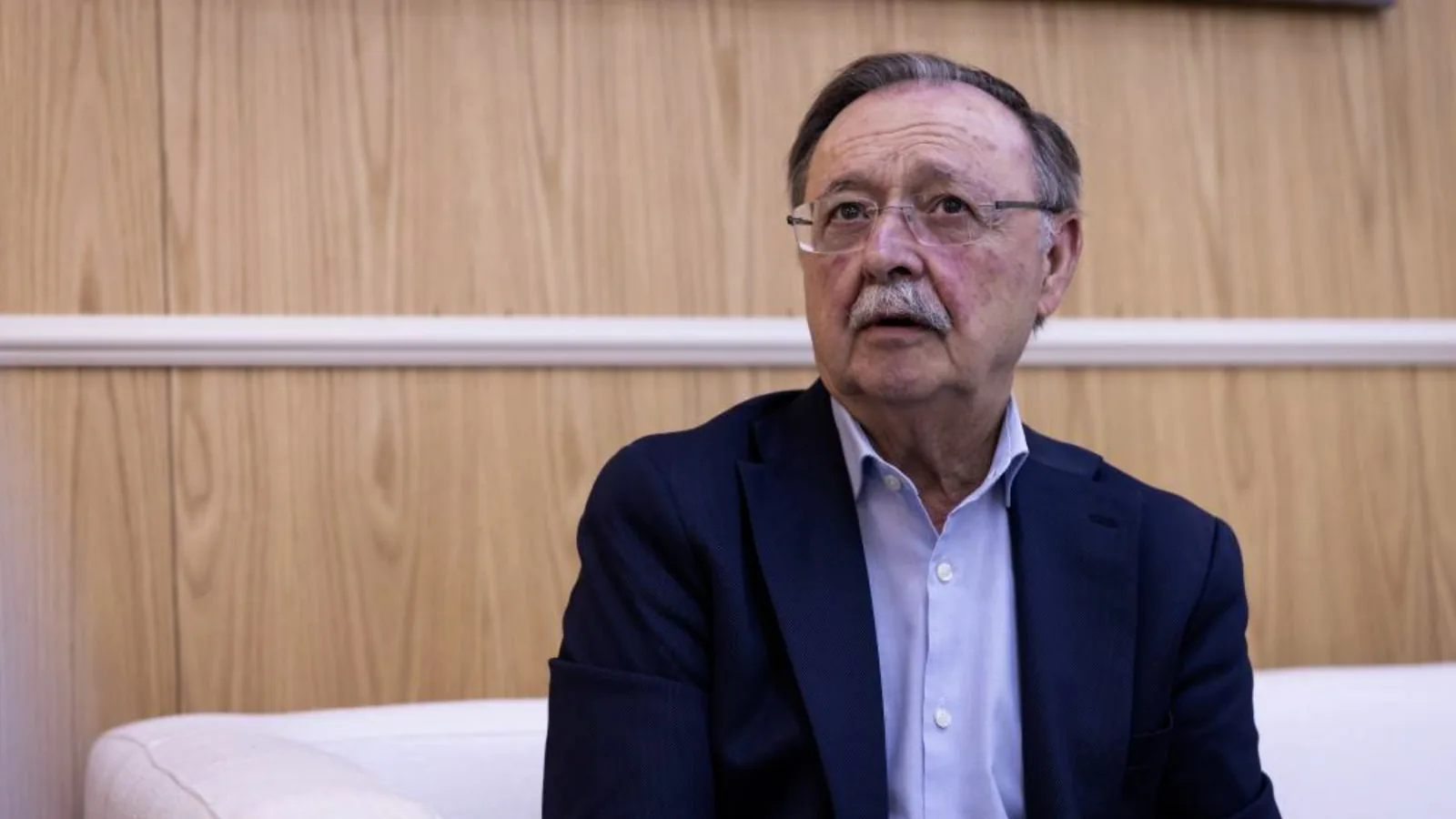
At 73 years old, 25 of which he has been president of Ceuta, after relying on both the right and the left to govern (twice with the PSOE), and having even tried unsuccessfully to retire, according to hints from the PP – the party asked him for one more effort and he has always claimed to be ‘very’ much of the party -, Juan Jesús Vivas, “Juan” to everyone, is giving new meaning these days to the expression ‘to give your all’ for his fellow citizens.
Read more Front page of EL MUNDO Monday, August 24, 2026
The man has a face mapped out by those eczema outbreaks that “flare up,” say those who know him, when stress tightens. And the stress that this grandfather of two grandchildren has been enduring since more than 80,000 people crossed illegally from Morocco to Spain right at his border, the Tarajal – he believes “the figure is around 90,000, because if 73,000 returned and more than 10,000 remain here…” – is “tremendous,” he admits.
To summarize: on a planet where migration is a central issue, with the West clashing over how we manage the matter and the issue as the primary electoral polarizer, the greatest European crisis of recent years falls on the shoulders, with all its catalog of anxieties, of a 73-year-old grandfather, as moderate as can be, with not a few health gaps – heart disease and prostate cancer fortunately in remission – who has been managing “a complete madness” for 26 days, whom the central government has been “toying with” all this time – this is admitted ‘sotto voce’ even in the PSOE – and who grants EL MUNDO an exclusive first long interview, without time, in his office at City Hall.
It is Saturday, but as if it were Tuesday: the man has been there since seven in the morning, managing alone “a national security crisis,” which is what all this is for him, an “attack on national sovereignty, perhaps the greatest in the last 50 years.” He goes further: “This is like if they set up the Green March [the peaceful demonstration with which Morocco occupied the then Spanish Sahara in 1975], but the people don’t leave, they stay there, and the Government does nothing.”
Because they are there, and Vivas knows it well. It’s not just that the city is, he says, “on the brink of a very serious health crisis,” as doctors working on the ground admit, and “on the edge of an explosive security problem, because any spark can ignite a confrontation, and the people, although behavior has been excellent, are very tired. Both the Ceutans and those who have entered, mind you” – police sources constantly fear the moment when the migrants who arrived from the other side, completely desperate, run out of money and may begin looting -.
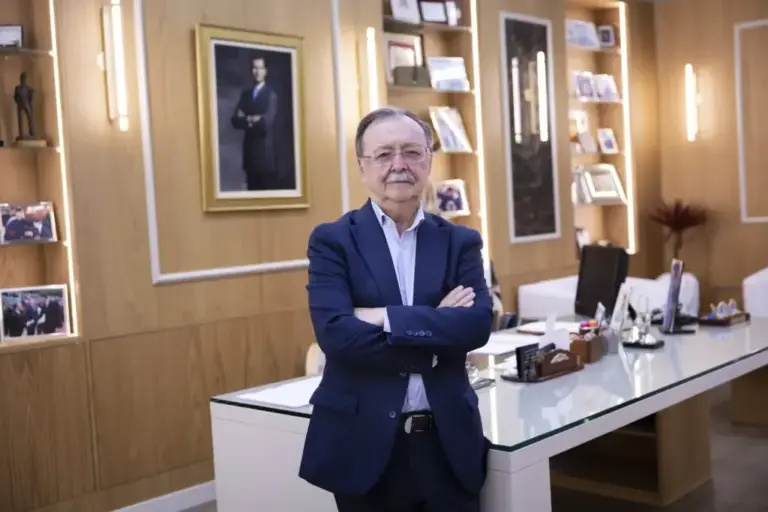
It’s not just that Ceuta is crowded with uncontrolled Maghreb teenagers, and that Ceutan women and girls barely go out on the street for 25 days, and the pepper sprays against rape have “run out,” as he himself says – the photographer of this newspaper experiences the atmosphere firsthand in the barely 10-minute walk from the ferry to City Hall -.
It’s that the kids take photos with Vivas himself when they catch him on the street, in the barely 100 meters that separate his home from City Hall – he has stopped, for obvious reasons, his daily morning walks -. And he, always affable, talks with them, from his graying mustache and the astute look behind his glasses.
“One wouldn’t stop talking to me, pa-pa-pa-pa,” he says, “and since I only know a little dariya [referring to Moroccan Arabic] I asked someone to translate for me. What he was telling me was: ‘I have a cousin in Lérida, can’t they send me there, please?'”
Ceutans also talk to him, and somehow these days they return to Vivas the political capital he has skillfully woven over the last 25 years, committed to the coexistence of creeds, origins, and races in a city that was also built from human floods from the other side of the border, and where almost as much Arabic as Spanish is spoken… “But there’s a lot of legend about that, eh?” he defends, “although here no one is asked where they come from, here we don’t look at whether surnames are Basque or from anywhere else: here in Ceuta the feeling of belonging to Spain is shared and unites us all.”
People, in any case, tell him things: “A lady, this very morning when I was coming, told me: ‘I haven’t voted for you for years, but go ahead, you’re doing very well’.”
This is the Gordian knot of this story as far as Vivas is concerned: a moderate, and stubborn in his moderation – “you must never lose your manners,” he says -, managing the most extreme crisis of these extreme times, on the most extreme issue possible. A moderate, a vestige of another politics, forced to act in crazy times, “when moderation is not just undervalued, it doesn’t even exist, that’s true,” he concedes.
Ceuta had just come from those extremes when he began to govern, a bit by chance, thanks to a motion of no confidence in 2001.
The party of the irascible Jesús Gil, probably 25 years ahead of its real ‘momentum’, was then promoting the frontal “Spanish-ization” of the city. Vivas, son of a municipal official and graduate in Economics from Málaga, only had to do the math: it is estimated that about 40% of Ceuta’s population is Muslim. One could only govern from encounter and agreement, which fit like a glove with his temperament. “Coexistence is existential here, that’s why no one can give us lessons on what is or isn’t racism,” he repeats.
He glances sideways at the narrative that the Government tried to sell in the early days: that Vivas, who has always claimed his “good relationship” with Pedro Sánchez, had radicalized, that he had ‘voxified’, when in reality Vox has not been able to capitalize on an almost written moment for that party thanks to the calm astuteness of the Ceutan president.
“They tried to sell that I had radicalized, but they didn’t succeed because moderation is not incompatible with coherence, and with having clear priorities. And here in Ceuta there are three pillars that must be above party labels,” he repeats: “Sovereignty and the territorial integrity of Spain, which Morocco must always have clear, no matter what it does afterward; coexistence among the different cultures of the city, without which there is no city, and equality with the rest of Spaniards, even though we have complicated challenges here that don’t exist elsewhere. We need more State here.” Ceuta’s economy suffers a 22% unemployment rate in a Spain below 10%, another striking extreme governed, again, by a very tempered politician.
The Government has announced an economic plan for Ceuta – with the visit of the economic vice president, Carlos Cuerpo – but we arrive at the epicenter of what is happening in the autonomous city, filled everywhere with uncontrolled Maghreb migrants, with its seams about to burst after almost a month – “almost a month!”, exclaims Vivas – and without a clear response from Madrid.
“But the thing is,” the president/mayor reaches the only moment in the conversation when he hyperventilates, “do you see it normal that at this point they don’t even know how many [migrants] there are, they haven’t even done a registry? How do you swallow that? That I have to count them, as they have asked me, by the meals given every day… Man, for God’s sake, what madness is this.”
The feeling of “abandonment” is “very big and very painful,” says Vivas, again positioned, with his instinct, exactly where 99% of Ceutans stand. “We are patient and welcoming, but this is not a migratory crisis and that’s why I got angry with what the Minister of Health said [Mónica García said that “associating immigration with diseases is xenophobic”]. Here we have organized a morgue for the eighty-something dead we have had, which seems no one remembers anymore, and we have mourned them, and we understand the humanitarian aspect, and that all these people have actually been used… But this is a national security crisis, and it will be seen on Tuesday [tomorrow] when the single command [Minister Ángel Víctor Torres] is appointed and it will have to be justified like that.”
Vivas asked from the beginning that the Government appoint a single person responsible for the situation, “and they took 23 days to do it… How is that possible?”. Sánchez came to Ceuta the first day “and then the narrative projected from Moncloa was that these people had returned and Ceuta was recovering normality. But, how could they say that?”. What followed, he says, was a “parade of ministers,” up to eight, “without taking this seriously and as what it is: an attack on territorial sovereignty. If today they put 90,000 here, who assures us that tomorrow they won’t put 200,000 and take Ceuta down?”, he says.
At this point, Vivas is as stunned as all the police sources consulted: “I don’t understand what the Government is doing, what their count is. I don’t understand. This could explode at any moment and they are acting with extreme slowness. At times I have been surprised by the lack of information they handle, honestly, although I must be very cautious with what I say. But Ceuta is suffering a lot and the response is completely insufficient, even a blind man can see that.”
Another in his situation would use the fluorescent marker in every sentence – if not the hand grenade – but Vivas measures every millimeter. From Police and Civil Guard insist, this newspaper has gathered, that the Government’s paralysis is not understood, or the refusal to use the Army, capable of building infrastructures “in days,” says Vivas: “There are 180,000 police and civil guards in Spain, and with the eclipse 12,000 were mobilized. Here… where do we have them? And let it be known that my gratitude to the agents and commanders here is absolute, total. But it’s a matter of political will. I don’t understand it.”
An example: of the four centers announced to house migrants only one has been built so far, and the NGO that manages it admitted to this newspaper this Saturday that everything was “very slow.”
Another example: yesterday Sunday, almost a month after the Great Jump, officials from the Asylum and Refuge Office had still not arrived in Ceuta to help process the files of those who arrived, to speed up the essential procedures and return a minimum normality to the city.
“But the thing is,” says Vivas, “that is essential both for the Ceutans, to whom I owe myself, and for the arrivals, who seem to matter more to the Government… And they are doing nothing, they remain there abandoned with no one doing anything, with our services overwhelmed and our population overwhelmed, in the greatest emergency Ceuta has ever experienced, two weeks before schools start. We are 20 square kilometers, this is controlled in hours, and it has been out of control for almost four weeks. It’s amazing, I really don’t understand anything. I ask for a clear normalization plan.”
Could Moncloa, slyly, want this fire to feed the far right ahead of the next general elections, in that strategy of ‘either-us-or-fascism’? “But this is going very badly for them, everyone sees it, when the stability of your country is at risk party labels decline…”. Even the PSOE of Ceuta has criticized the inaction from Madrid.
That, the Government, is the wall against which Vivas lives, embedded. He speaks of the sword with extreme caution. The sword is Morocco, and unusually, at this point, with his city plunged into 25 days of chaos and whatever else, the Ceutan president doesn’t even raise his tone, nor openly accuses the Alaouite autocracy of promoting the jump: “I can’t think they didn’t know, that they had no information about what was going to happen, that they have nothing to do with it by action or omission.” Ceuta is a small horn of land north of the Moroccan country, which has never recognized this autonomous city nor Melilla as Spanish, and which with a breath could almost throw its 83,000 inhabitants into the sea.
“What would be enough,” says Vivas, “is for Morocco to be clear that Spanish sovereignty in Ceuta and Melilla is not in doubt, that this is Spain and Europe, that for something the European Parliament’s declaration after the 2021 jump [in which 10,000 people entered] was exemplary in that sense, and gave us great satisfaction. But the Spanish Government is not making this clear to Morocco. More: Spain’s territorial security, on our border, is in Morocco’s hands, as has been demonstrated. And that cannot be. The first thing is that they understand we are neighboring countries, that they cannot enter our house as and when they want, nor use their own population to attack us. And then, if they want to have a good neighborly relationship, better. And if not, well nothing. But Ceuta’s economic stability cannot be in Morocco’s hands.”
This is the dramatic dimension of the mayor of a small city that turns out to be on the edge of another world: “Europe has to move too. Just as we have ceded powers in budget stability and taxation in times of crisis, there has to be a common migration policy. It’s obvious and it would give us a lot of breathing room,” he says.
Vivas, who has received these days Juan Roig, president of Mercadona – visiting to support his employees – and expects in the coming weeks “those from Telefónica and CaixaBank, as I have been told,” took his litany, before the strange paralysis of the Government, to Marivent. And he says that with Felipe VI he felt “comforted,” but also that “His Majesty told me he wanted to come… but so far it hasn’t been possible.” Again Moncloa interferes in the agenda of the head of state, finally a citizen’s handkerchief of tears both in the Dana of Valencia and in the train accident in Adamuz. “The King told me he would come, and I hope he can,” he concludes, again elegantly avoiding the puddle.
Vivas is, in the end, with his 83,000 neighbors hanging on his arm, one of Spain’s sentinels down there, looking at the traditional “Moor.” That’s why his account of the days before the Great Jump is almost a thriller.
“We already saw strange things 10 days before, a notable effervescence, like the boldest were jumping, some corpses arrived floating… In a week 1,500 arrived, we realized that in a month, with that projection, we would be at the figures of the May 2021 jump. We suddenly went from 180 minors hosted to 800. It wasn’t normal and I went to the Government Delegation. I told them a single command had to be appointed, that something was happening. They looked at me strangely,” he says.
“On Monday the 27th [three days before the Great Jump] I started calling everyone in Madrid, people I talk to regularly and with whom I have gotten along very well until now. I called Moncloa, Interior, Foreign Affairs, Childhood… I told them something was happening, but obviously I couldn’t imagine what was coming. At the State Security Secretariat they even told me I was exaggerating. They told me, in these words: ‘Juan, this is what happens every summer, you don’t have to worry because there hasn’t been a moment of such good relations with Morocco as this’.”
Hours later, “when everything was already overflowing,” members of the local Government “went to the same border, where thousands of people were jumping… It was incredible. It was just hours later. And shortly after the border on the Moroccan side was open and everyone who wanted crossed on foot. As if they were walking in their own home, nothing more. Spain had no deployment there. No one.”
Vivas, already in the role of mere citizen, tells impressed how “six or seven workers from one of the best hotels in Castillejos [in Morocco, on the other side of the border], one I can’t afford when I go, imagine the situation they have there,” crossed.
We arrive at the ‘berlanguian’ moment that never fails in these situations: a Moroccan official “one of those who checks passports when we cross” got up from her desk and, seeing the occasion, also crossed into Spain. Besides the thousands of ragged people filling the streets of Ceuta, quite a few migrants hid in those first moments in apartments, paying rent – most returned in the first days, seeing that the Ceutans did not facilitate their stay, but some remain -.
“We can’t solve Morocco’s problems, but I also think that a country that wants to show itself to the world as modern and organizer of a World Cup can’t allow this, no matter how bad its economic situation is,” says Vivas briefly, who looks at the clock.
Now it’s time for a meeting with neighborhood groups, a little later a lieutenant general of the device… “You see how we are,” says the 73-year-old grandfather.
On August 1, hours after the jump, with more migrants in the city than Ceuta has inhabitants, his second grandchild was born in Fuengirola. He still hasn’t been able to visit him. “As soon as I can I’ll go… At least that reminds me that life goes on,” he finishes.
“School starts in 15 days, what do we do?”
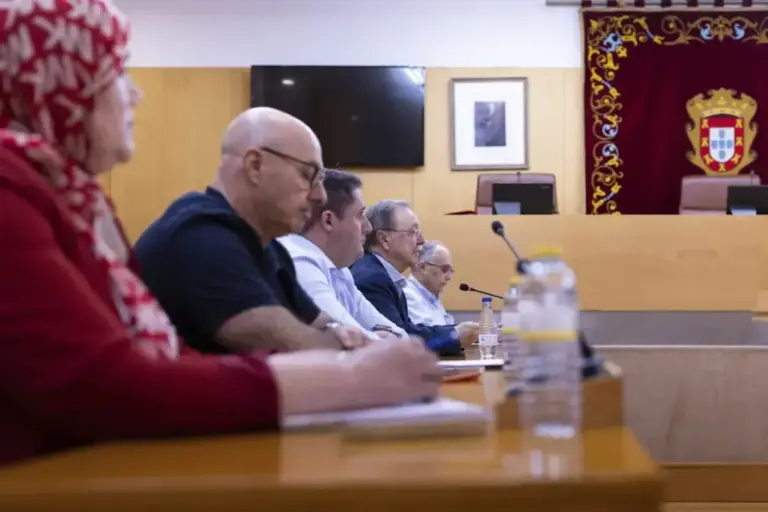
“They hide in rented apartments, what can we do?”. “At least we should ensure that we can take the children to playgrounds, because they have been stuck at home for 25 days and it’s a pressure cooker.” “President, schools start in 15 days, what are we going to do?”. After EL MUNDO’s visit, Juan Jesús Vivas meets with Ceuta’s neighborhood groups, who expose their miseries to him. “There have been two occupied schools, but they have already been cleared and we guarantee that the school year will start, whatever it takes,” he says. And he repeats what he told this newspaper: “I have asked the Government for a time frame to solve this, a plan. It’s what’s necessary.”
Read more Matthew Brennan wins in Manosque and Pogacar fights to avoid losing the red leader’s jersey