







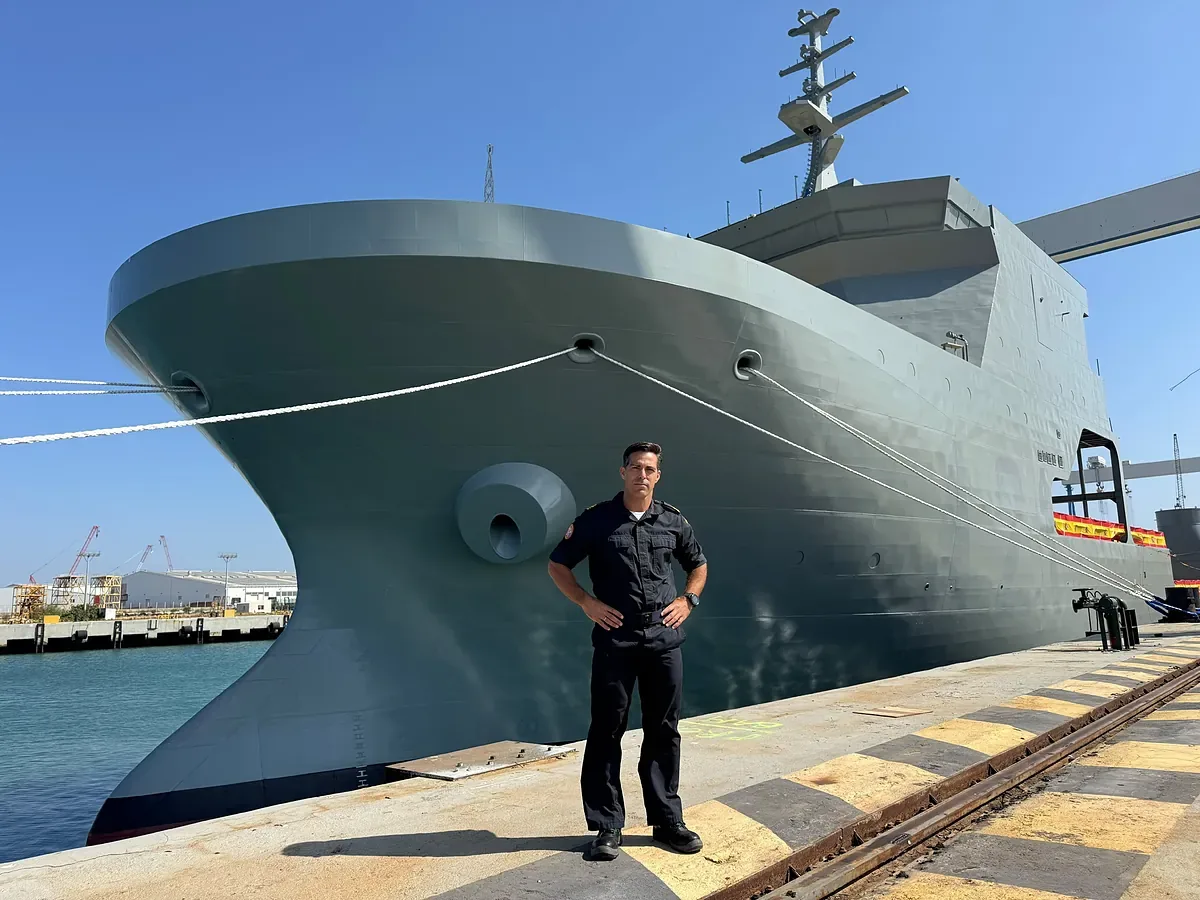
Poseidon, as the god of the sea, that is the name with which the Navy baptized its new maritime action ship (BAM), a warship with an innovative underwater intervention configuration that this week reached a major programmatic milestone: its launch and christening. A vessel destined to replace the Neptune and to watch over the safety of the submarines of the S-80 class and NATO. Although it is already in the water, the ship is still in the adjustment and testing phase and will not be fully integrated into the Navy’s capabilities until next year. A new vessel that is part of the capabilities of the Atlantic Alliance and is commanded by Commander Carlos García Barrios.
Read more The Spanish subjects of Sofia Bridge
This lieutenant commander came from an Army family, but when he decided on a military life, he chose the Navy to be close to the sea. Raised in Jerez de la Frontera, after several years at the Naval School of Marín, he received a diving baptism and realized that was his calling. He specialized his path in that direction, eventually becoming part of several diving units. Now, out of the water, he will lead missions with his ship to rescue divers and the crew of submarines.
The officer speaks exclusively to EL MUNDO in the final months of adjustments and milestones of the ship to fully integrate into the Navy. He began his assignment on the ship last January, and there are still people to join until reaching the full crew complement. The Poseidon is not only meant to rescue but also to protect the seabed, through which cables with information and essential mechanisms pass so that citizens can live a life like the current one. “We have systems on board that the Neptune already had, but in the case of the Poseidon, they are of a greater depth, greater precision, and more updated technology,” he comments.
“The precision capabilities of the ship greatly improve the capabilities the Navy will have. Both for submarine rescue, which is the main role for which the BAM was created, and all those associated with underwater intervention: diving, hyperbaric treatments, search and location of objects, operating unmanned vehicles… also everything related to the seabed,” explains the commander, who anticipates that the Poseidon will be “a key piece” in protecting that environment that “affects the services of our society.”
Among the ship’s capabilities, it is equipped with two remotely operated vehicles (ROV), one capable of descending up to one thousand meters and another up to six thousand. “These are practically maximum depths operated worldwide, which places the ship at the forefront,” explains the officer. Additionally, the ship has an autonomous underwater vehicle (AUV), which can descend up to six thousand meters, but unlike the others, it does not have to be connected to the ship: “It is released preprogrammed, and even so, you can communicate with it through other types of acoustic waves. You can use it for exploration, search, location… It can provide that information in real time. And, moreover, when it is recovered, you have everything collected with very high quality,” details the officer.
With a crew of 54 people, the ship also features the novelty of adapting part of its personnel to the mission they will carry out, because it is a versatile ship with several capabilities. It is also equipped with extra accommodation for submarine and diver rescue. Because that is its main function. Therefore, at the stern, an area has been reserved to embark a minisubmarine, a capability that few ships of this class have. It is a smaller submersible designed to rescue the crews of distressed submarines. An indispensable capability. This service would allow the NATO minisubmarine to be embarked and the interoperability of the Poseidon with other alliance submarines, fulfilling the promised capabilities. If a NATO submersible needed to be rescued, the protocol is activated to find the nearest ship, and the minisubmarine is sent by plane to embark and proceed with the rescue.
“When a submarine is lost, a search protocol is initiated and in less than 24 hours a ship should go out to rescue it,” he explains. The Poseidon has the capacity to ventilate “almost indefinitely” the crew of a submarine. “Hoses are connected to another system on the ship that pumps air in and another that takes it out.” Also, with one of the robots the ship has, they can “supply provisions, medicines…”.
With 45 crew members already on the Poseidon, after yesterday’s christening, the sailors prepare to pass the final tests. “Acceptance of equipment in port, and then at sea. Once they have passed that, the ship will be delivered.” They expect that it will be during next year when the ship finally becomes part of the Navy’s capabilities and part of NATO’s force. “It is a very capable warship to operate on any naval platform focused on underwater intervention,” summarizes the lieutenant commander.