




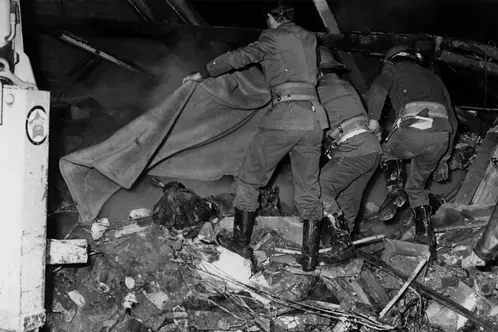
It was exactly 17:36 hours on November 3, 1984, according to a clock that was rescued from the rubble. More than four decades later, the residents of Mondéjar (Guadalajara) still remember perfectly what they were doing at the precise moment the tragedy that shook the town the most, which had about 2,300 inhabitants at the time, occurred.
Read more A sergeant injured and four Moroccans arrested after a second ambush against soldiers in Ceuta
“I was working in a bar and suddenly the windows started to move because of the explosion. ‘What happened? What happened? What happened?'”, says one of the locals near the Plaza Mayor who helped with the rescue efforts. “I was at home watching a movie on TV, Tarzan, I will never forget it, when it sounded like a bomb,” says another local who was just a child then. “I was coming back from a wedding in Madrid and when I returned I found all the disaster,” they recall at the town’s gas station.
The gas station is now located at the entrance of Mondéjar if you access the town from Madrid, but back then it was at the other end of the village, no more than 50 meters from where the explosion occurred, so in the first moments of confusion many neighbors thought the service station had blown up.
In the previous months, several air accidents had occurred in Spain, including two very serious ones at Barajas airport that resulted in 93 and 181 deaths, which led some to run toward the place where the smoke was coming from, convinced they would find another crashed plane.
Upon arriving at the explosion site, they found that the blast had occurred on the plot where, minutes before, the two adjoining chalets where brothers A. and L. and their families lived were located. As a sign of the brutality of the detonation, El Caso reported that only one wall remained standing of the two houses and that the metal garage doors had been thrown more than 200 meters away.
Moreover, as if it were a mascletá, mini chained explosions continued to occur. They came from metal cans, dozens of metal cans, which exploded one after another and were thrown from the rubble. Later it was revealed that these were hair lacquer containers, about 8,000 cans, and that they had been the trigger for the detonation.
“At times the aerosols were thrown at high speed through the air, as if they were projectiles, so firefighters, civil guards, and Civil Protection personnel who had come to the rescue work, as well as many neighbors, had to keep moving away continuously to avoid being hit and injured by the aerosols,” Abc reported the next day.
Such a scenario did not allow for optimism, but the truth is that of the 11 people who were on the property at the time of the explosion, two survived.
The list of victims and their relationships was as follows. In one of the chalets lived the couple composed of A., 32 years old, an electrician by profession, and P. (30) and their only son, A. J., only four years old. The wife was originally from Villar del Olmo, a town that, although only 15 kilometers from Mondéjar, does not belong to Guadalajara but to the Madrid community.
From Villar del Olmo precisely came the friends who were visiting them that afternoon: A. G. (44) and his wife, M. T., and two of their three children, C. (12) and Ó. (14). Of all those mentioned, only the mother and the youngest son were rescued alive from the rubble, but she died shortly after being admitted to the Hospital de la Paz.
In the second chalet lived the other brother, L., also an electrician by profession, with his wife, M. T. (42), and their three children: L. (13), J. (11), and V. (8). Of these, the father, who was not in the house at the time, and the youngest son, who was rescued at 04:15 in the morning, almost eleven hours after the explosion, survived.
“When he appeared we all started shouting,” recalls one of the neighbors who witnessed the happy moment, “because we no longer expected anyone to be alive; the excavator was already removing the rubble and he emerged from among the debris.”
Read more Luis Simón: «The problem for Spain is that Morocco becomes a more valuable partner for the US»
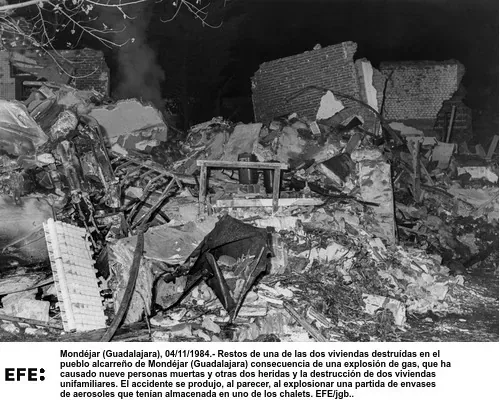
This witness did not remember that it was raining heavily that night, that the area turned into a mud pit, or that the little survivor appeared wet and exhausted. At least that is how El Caso recorded it, which began the chronicle dedicated to the event with him: “‘Dad, it’s raining, I’m cold’. V., eight years old, had just been rescued from the rubble after being buried for eleven hours due to the horrific explosion […] The boy, who suffered some minor bruises, was taken in his father’s arms, repeatedly saying he was cold.”
Some media estimated the number of lacquer cans stored on the plot at “eight tons” while others spoke of “8,000 containers”. Logic suggests the latter makes more sense, given how complicated it would be to store 8,000 kilos of lacquer in the chalets. Regardless of the amount, it was concluded that the sprays must have had some defect that prevented their commercialization – it was speculated that the valves did not work – and that the victims had obtained them intending to empty the liquid they contained and sell the containers for scrap.
“I understand that, unfortunately, those who could give the exact version have died, and we think these sprays were not fit for sale and someone among the deceased had been offered them, perhaps the factory, for destruction to sell the containers as scrap,” declared the civil governor of the province – the equivalent of a current government subdelegate – Eduardo Moreno Díez the next day.
In the following days, the puzzle of what happened was pieced together, and the media, citing judicial sources, converged on the same theory. The guest, A. G., had been working for 16 years at the company Productos Cosméticos, S. A., headquartered in Torrejón de Ardoz (Madrid), where the lacquer cans had been manufactured, as stamped on the containers. He must have been the one who took them out of the factory.
Together with his friend and chalet owner, A., he was handling the lacquer cans that afternoon in one of the garages, which occupied the lower part of the houses. With a sharp object – believed to be a nail – they were piercing the containers and pouring the flammable liquid they contained into a drum, unaware that the vapors or gases from the lacquers they were emptying were accumulating in the room. The fact that they were wearing protective gloves when their bodies were rescued supported the conclusion that they were working.
The immediate cause of the explosion was less clear. It was strange that they had lit a cigarette, since, working in the cosmetics factory and being an electrician, they should have been aware of the danger of the product they were handling. It was also suggested that a spark could have jumped when piercing one of the cans, when the automatic clock that activated the heating around that time turned on, or when the light switch was operated because it was already dark.
They were in the garage while the nine family members accompanying them were upstairs, in front of the television. Since private television did not yet exist and there were only two channels, they must have been watching Tarzan’s Treasure, the third installment of the saga being broadcast at that time on TVE’s first channel.
It has been said before that only two children survived the event, C. and V. The trail of the first is followed in Villar del Olmo – where his family lived then and where today the event is a distant memory- and in Madrid. When we finally find a relative, they tell us that neither he nor his older brother, who also survived because he was not at the place, want to talk about the explosion in which they lost their parents and a brother.
The other survivor, V., who lost his mother and two brothers and was left in the care of his father, L., the only family member not at home, also does not want to revisit the memories, he tells us, especially now that his father has just passed away and he is particularly sensitive.
Legally, the case did not have much progress, although the families fought until in 2008 – 24 years after the event – the Supreme Court definitively closed the victims’ claims, who sought compensation from the lacquer manufacturer, Productos Cosméticos S.A., and the insurer Comercial Unión.
Thus, the Supreme Court ruling states that the criminal case was dismissed in October 1985 – one year after the explosion – and that “four months before the 15 years since the death of nine people due to the explosion of several thousand containers [in August 1999]”, when the crime had expired, the victims’ families filed a lawsuit claiming they had not acted earlier because they were unaware of the case dismissal. The Supreme Court upheld the statute of limitations and definitively closed the case.