


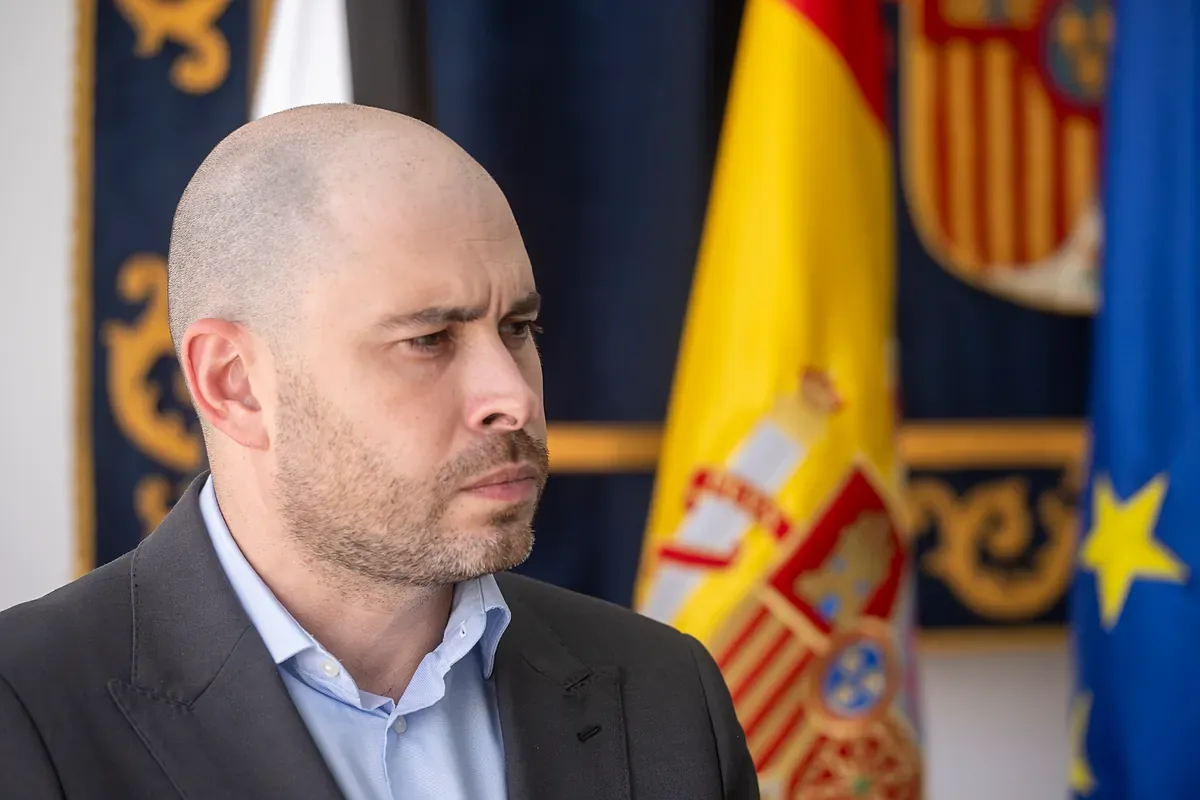
The 704 kilometers that separate Ceuta from La Moncloa somehow cushion the resentment of the Ceutan society towards President Pedro Sánchez. However, his pawn on the ground does not have it so easy: the Government delegate in the Autonomous City, Miguel Ángel Pérez Triano, is the lightning rod that absorbs all the tension from the neighbors, whose invectives alternate the words “traitor” and “resignation” interchangeably.
Read more A Moroccan minister claims Ceuta and insists: “We will not give up an inch of territory”
They blame him, admonish him, reprimand him. They fervently demand his resignation and confront him on the street, as happened last Tuesday. Since the avalanche of 80,000 people over the city, Triano – as he is called – has requested to be escorted on more than one occasion. “He will have to leave Ceuta,” says a woman in front of the Delegation. “I don’t even know how he dares to go out on the street. He has sold us out! A ca-ba-lla,” says the waiter at the VIPS on the city’s main artery, stretching the syllables of the Ceutan nickname to emphasize the “betrayal” of someone “who is supposed to be one of us.”
Government delegate since February 2026, Triano is the scapegoat of a city that feels that Sánchez’s Government has let go of their hand in the middle of this crisis and they do not forgive that he has aligned with Moncloa instead of with his people. Among his own, the socialists, they defend his good work “as a manager” and remember that he was chosen as secretary general of the party in Ceuta to revitalize the party after factionalism took over during a period of intense internal conflicts.
The intention was for him to run in the 2027 elections. “Forget it, it’s too big for him,” dismiss neighbors in front of the kiosk. Already in O’Donnell, the neighborhood where he has always lived, according to the florists operating at the foot of his home-office (the Delegation itself), they consider that he has turned his back on his people. In front of the Military Hospital, the owner of the bakery, on whose walls three youngsters who arrived by swimming during the assault are stationed, considers that “he has no charisma, no spark”: “He will last two days,” she predicts angrily.
Sources who knew him closely say he has an affable, even shy character. “He comes from a working-class background and is very empathetic: he has a lot of caballa feeling. He was always involved with the neighborhood and really enjoyed his work: he was a preschool and Physical Education teacher,” they reveal.
Besides studying and working as a teacher, Miguel Ángel is very fond of football. A neighbor who studied with him assures that he made his first steps in a local Ceuta team. Academically, however, the label was different: “The class fool,” according to the florist who attends us at the foot of the Delegation. His niece also went to class with him. The rumors that proliferate in this city, where everyone knows everything, even claim that “he didn’t even have the ministers’ phone numbers when all this happened” and that “it took hours to answer.”
“The hostility against him is brutal,” lament the PSOE of Ceuta. “It seems as if he is Pedro Sánchez’s son. The people have shot him down. But with a legitimate rage, on the other hand, since we have the city invaded,” highlights a senior official of the socialist leadership in the city. Emotionally, he has his phases, they indicate. It is not easy to have your entire city against you. But in the party, they excuse him by remembering that “he had only been in office for five months” when everything happened. “It has been an experience, you see: with all the ministerial shuffle, the Government, Moncloa calling to say something or not say it, Interior…,” they reveal.
Triano, orphaned of his father from an early age, was secretary of the socialist youth for “many years,” although socialist sources cannot specify the exact time interval. That is how he began to build a career in the politics of his city, perhaps one of his great interests. He shares his passion for politics with his wife, who comes from a well-known socialist family in Ceuta: the Miaja, a saga that started with the former mayor of the Autonomous City for the PSOE between 1987 and 1991, Fructuoso.
The insults have reached his family who, that said, “are wonderful personally,” says a citizen who worked for him, “but now he has a political position and owes himself to those who put him there,” he points out. “Now, clinging to the chair with Ceuta as it is… I don’t know anymore.”