







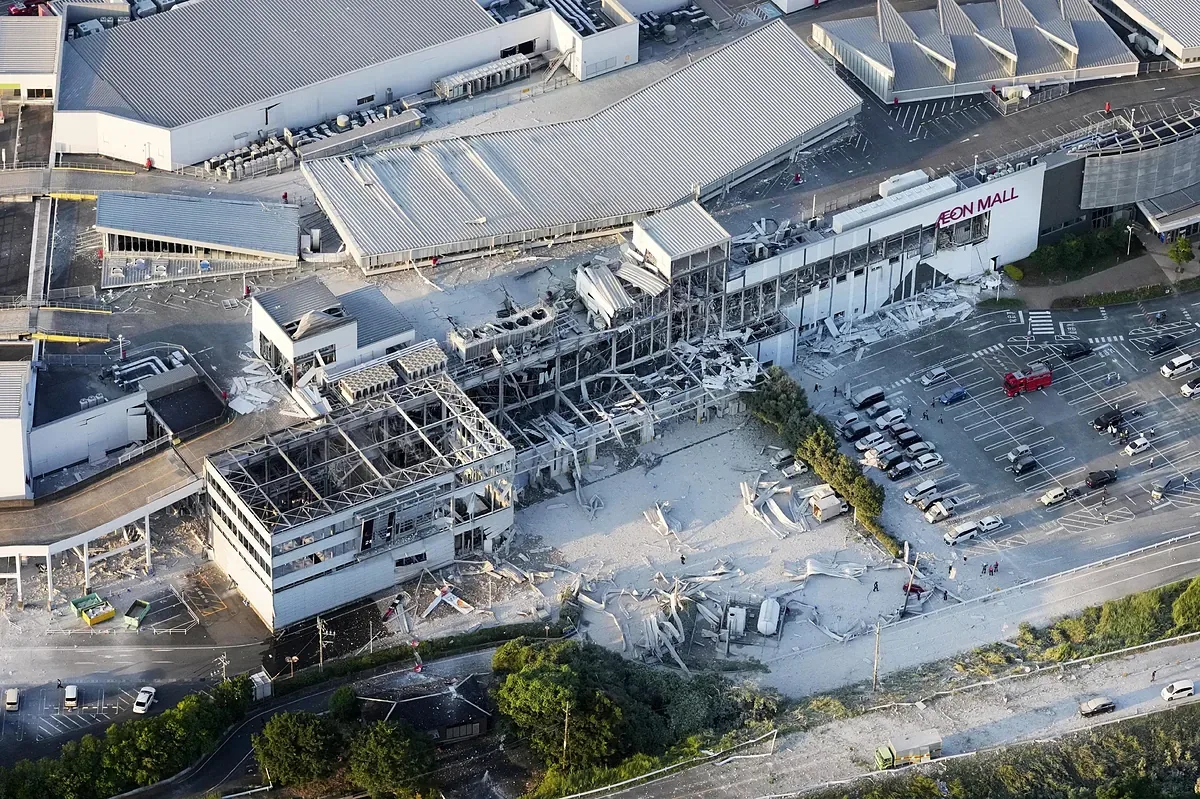
In a matter of seconds, dozens of people were trapped inside a shopping mall in southwestern Japan when the second floor of the building collapsed following a powerful magnitude 7.1 earthquake that shook Kumamoto Prefecture on the island of Kyushu this Tuesday. The TBS television network reported that there is a “considerable” number of deaths inside.
While rescue teams tried to make their way through the rubble, outside there were multiple fires, power outages, and cracked roads, in a new day that reminded the Japanese that living with earthquakes is part of their daily life.
Public broadcaster NHK showed images of smoke coming from the Aeon Mall commercial complex shortly after the quake. Witnesses reported hearing an explosion before the second floor collapsed. Police sources have reported that between 20 and 30 shopping mall employees have not been contacted and may be trapped after the collapse.
Local media reported that most customers were rescued after the earthquake and that about fifty injured people have been taken to hospitals. It was also reported that several workers remain missing at a paper factory in the region after a chimney collapsed.
A government official told the media that “they do not know if it was the cause of the explosion, but there were gas leaks. The main gas valve has been shut off.”
The earthquake occurred at 16:27 local time. The Japan Meteorological Agency (JMA) recorded the maximum level of seven on the Japanese seismic scale Shindo, a system that does not measure the energy released by the earthquake but the intensity of the shaking felt by people and the potential destructive impact on buildings and infrastructure. The United States Geological Survey, meanwhile, downgraded the magnitude to 6.8.
Prime Minister Sanae Takaichi said the government was still assessing the extent of the disaster. “There are power outages and fires in some areas, and roads and bridges have been damaged, as well as some buildings collapsing,” she said. Takaichi explained that 3,600 military personnel were sent to Kumamoto to assist in rescue efforts.
The electric company Kyushu Electric Power reported that around 45,000 homes and establishments were left without power in the region.
Images broadcast by NHK showed urban fires, bridges with structural damage, a derailed freight train, and numerous cracks in the asphalt. The collapse of at least a dozen homes was also confirmed.
Kumamoto police reported at night that one person was found dead among the rubble of a house. Reports from across the prefecture indicate that many people remain missing.
According to the Japan Meteorological Agency, more than 60 aftershocks with magnitudes ranging from 1 to 4 occurred after the initial earthquake. In the afternoon, about 300,000 people were ordered to head to evacuation centers.
Authorities initially issued a tsunami risk alert with waves up to one meter high. However, after confirming that the earthquake occurred inland and no significant changes in sea level were detected, the Meteorological Agency lifted the warning shortly before six in the evening.
It was also reported that no anomalies were detected in the nuclear power plants in the area. Kyushu Electric confirmed that the three reactors still in operation continued to function normally, a particularly relevant message in a country where any major earthquake inevitably reopens memories of the Fukushima nuclear accident.
One of the NHK journalists reporting live from the area, still wearing a protective helmet, described a situation of enormous tension even half an hour after the quake. “The shaking was so strong that I couldn’t stand. Even now the building keeps shaking and it’s hard to stay steady,” he said as aftershocks continued to be felt.
The affected region is well aware of the devastating impact of major earthquakes. In 2016, Kumamoto suffered two violent quakes of magnitudes 6.5 and 7.3 separated by just two days, which left 273 dead and more than 2,800 injured, as well as thousands of buildings destroyed. That tragedy remains very present in the collective memory of the local population and explains the speed with which thousands of people evacuated homes, offices, and businesses as soon as the first shakes began today.
Japan is among the countries with the highest seismic activity on the planet. Located at the convergence of four major tectonic plates in the so-called Pacific Ring of Fire, it accounts for approximately 18% of the earthquakes recorded worldwide. Hundreds of seismic movements occur each year, most of low intensity thanks to strict earthquake-resistant building regulations and a population accustomed from childhood to participate in evacuation drills.
However, major earthquakes remain a constant threat. The most traumatic memory continues to be the devastating magnitude 9.0 submarine earthquake that struck the northeast of the country in March 2011. The subsequent tsunami wiped out entire communities, caused the death or disappearance of about 18,500 people, and triggered the Fukushima nuclear accident, the worst atomic crisis since Chernobyl.
That catastrophe forever changed the relationship of the Japanese with the land they walk on. Since then, the country has invested billions in reinforcing buildings and infrastructure, perfecting one of the most advanced early warning systems in the world, and making citizen preparedness a routine that starts at school.