




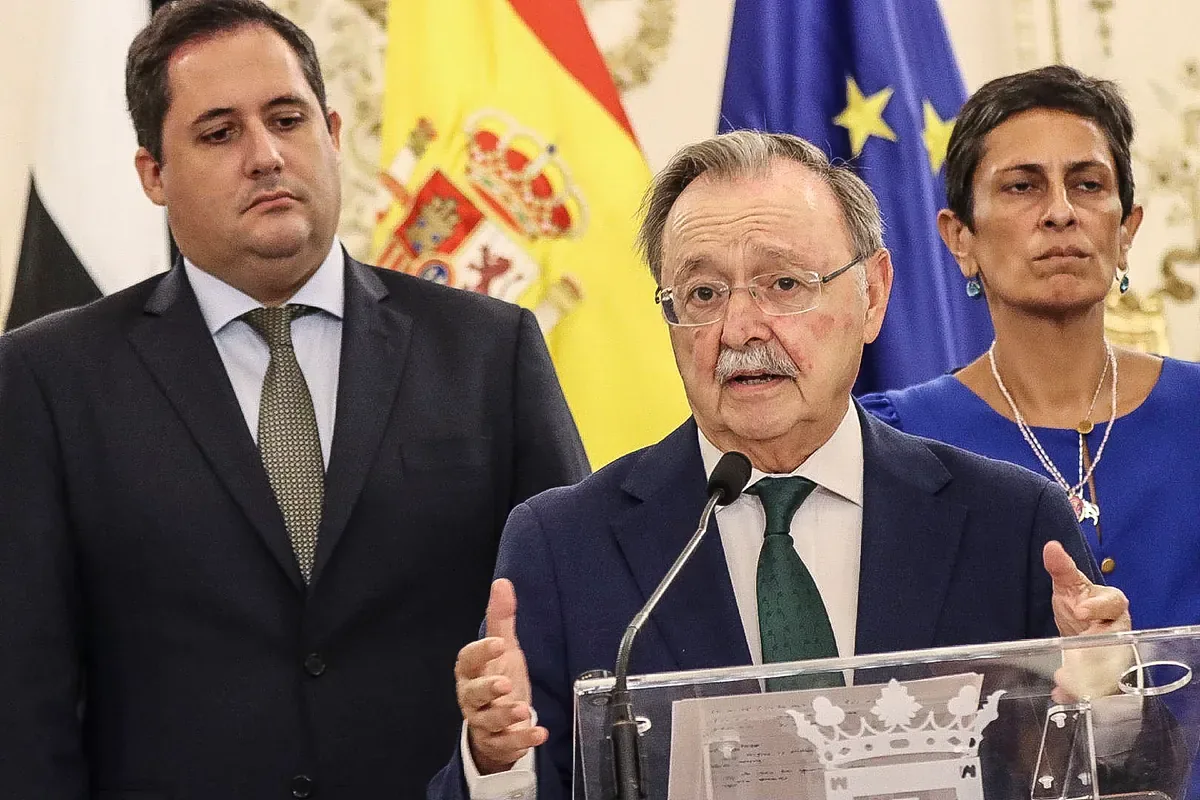
The president of Ceuta, Juan Vivas, warned this Monday that he will go to the Judiciary to convey to its top officials the situation the city is going through after the massive entry of immigrants on July 30 and 31, due to the Government’s “passivity” in responding to the crisis.
Read more Final stretch of a lost term
In a press conference after the meeting of the Ceuta Executive, Vivas explained that he will request to be received by the president of the Supreme Court, María Isabel Perelló, and by the president of the Constitutional Court, Cándido Conde-Pumpido, to convey to them that Ceuta “is in danger”.
He clarified that he does not intend to interfere with the independence of the Judiciary, but to bring the situation of the city to its top officials.
Vivas insisted that the situation in the autonomous city remains far from normal and that he still does not know how many of the 80,000 people who entered irregularly remain in Ceuta and how many return or expulsion proceedings have been initiated.
The president of Ceuta denounced a “lack of adequate response” from the Government of Spain towards “a part of Spain that has been attacked in its territorial integrity” and recalled that the Prime Minister himself, Pedro Sánchez, described Ceuta as a territory in a “high risk” situation.
He accused Pedro Sánchez’s Executive of having tried to “whitewash reality” during the first days of August by stating that the city had recovered normality in 48 hours and that only about 2,500 people remained of the nearly 80,000 who had entered.
“Normality can only be achieved through the return to Morocco of all those who, illegally, disturbed the order and entered our city,” he maintained.
Nor, he added, does the Ceuta government know what measures will be taken to “shield” the border or to economically and emotionally reactivate the city.
Read more A Congress paralyzed with fewer laws than ever while Sánchez breaks decree records
Vivas defended that the State has sufficient means and capabilities to return to Morocco, within legality, the adults who entered on July 30 and 31 and believes it can be done within 30 days.
According to his estimates, about fifty officials dedicated to processing files could handle about fifteen each per day, which would mean 750 files daily. Working five days a week would be 3,750 files weekly and about 15,000 per month. “This is not an impossible mission. This rather seems like a lack of will,” he concluded.
For what he considers a lack of action by the Government, Vivas suggested it could be due to “ineptitude,” “irresponsibility” by not giving importance to the fact that “our territorial integrity is being violated” or “not to upset” Morocco, “to maintain what is considered pseudo good relations”.
He called for the State to act with “firmness and decisiveness” against a “hypothetical plan” by Morocco aimed at “successively striking Ceuta until the definitive fall of Ceuta”.
The president of Ceuta demanded a change of attitude from both the Spanish Government and Morocco and trusted that the neighboring country will collaborate “sincerely” in the repatriation of adults and minors.
Vivas assured that, despite what he considers a feeling of abandonment, Ceuta “will not surrender” and that, in addition to the Judiciary, he will go to other institutions such as the General Courts, the autonomous communities, the Spanish Federation of Municipalities and Provinces, or business and union organizations to convey the situation of Ceuta.
Read more A whole life outside Social Security: “I am 69 years old and I am forced to keep working”


