


The final of the next Football World Cup will be played on July 21, 2030. It is very far away, almost four years without the almost, but before that, in 2027, the place where that match will be played must be decided. And that decision, in the hands of the always controversial FIFA, will be another context, perhaps the next one, in which Spain and Morocco stage the tension inherent in their relations. Without the human drama of the current migration crisis, the roles of both in that sporting scenario do not vary much from those they have been playing these days.
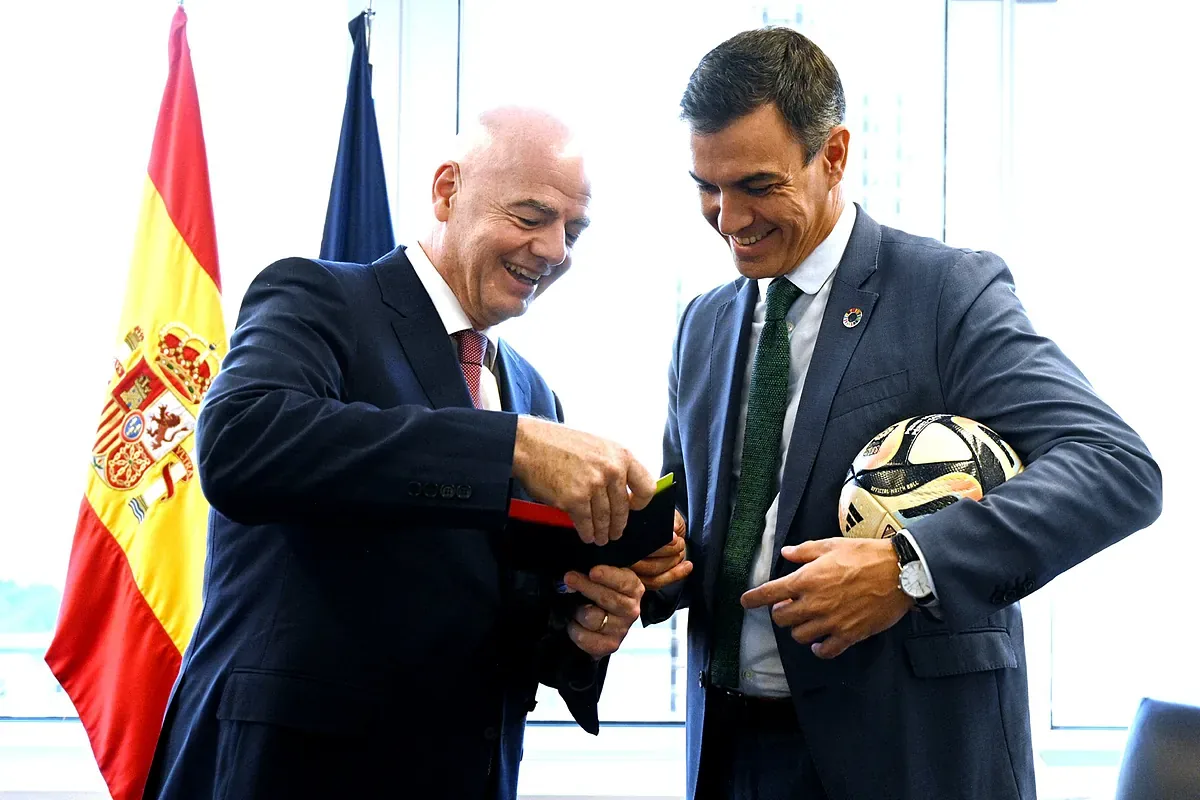
Before that, a brief summary. The 2030 World Cup, its organization, is born in the mind of Luis Rubiales. It is 2018 and the kiss to Jenni Hermoso (2023) that will end him is still far away. At that time, September of that 2018, his relations with Pedro Sánchez are good, Rubiales boasts of being a socialist cardholder, and both receive Gianni Infantino, president of FIFA, at the Moncloa Palace. Portugal is already in that original idea, but Morocco is not. On a visit to Rabat in November of that same year, it is Sánchez himself who publicly invites the Alaouite kingdom to join the project (to the surprise of Portugal, which had not been informed). And there, it seems, the matter stays.
Much later, on June 4, 2021, only Spain and Portugal officially present the candidacy in an event attended by King Felipe VI, the president of Portugal, Marcelo Rebelo de Sousa, and the presidents of both governments, Pedro Sánchez and António Costa. It is not until March 2023 that Morocco joins the project (replacing a brief and wandering intention to integrate Ukraine as a result of the political solidarity immediately after the Russian invasion).
September 20, 2023
That very late incorporation, in principle, should have made clear Morocco’s status as a guest. Its entry occurs shortly before two important events. The disqualification of Rubiales by FIFA (August 23) and a meeting between Sánchez and Infantino in New York on September 20, 15 days before the surprise announcement by the world football governing body that the 2030 World Cup is awarded to the candidacy.
But the Spanish Federation, promoter and visible head of everything, enters a mismanagement that lasts more than two years. The communication with FIFA suffers and Morocco, the guest, begins to take on prominence in the relationship between Infantino and the candidacy. It does not aim to change the day-to-day of the project much and puts all its interest in one match: the final.
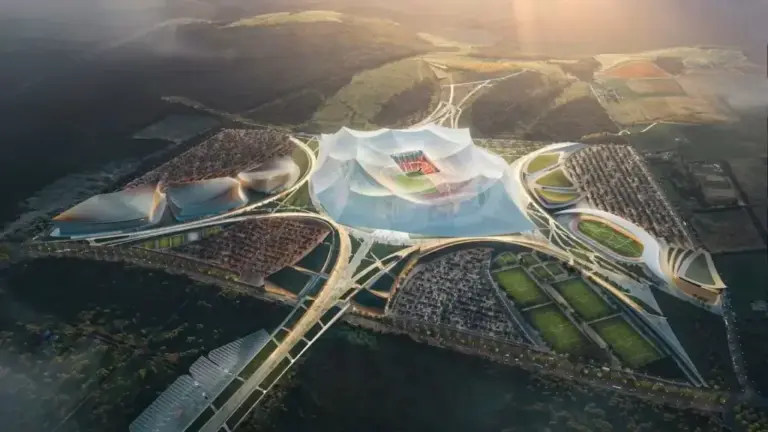
There is a tacit pact between Infantino himself and Florentino Pérez for the final to be at the Santiago Bernabéu, the main stadium of the capital of the country promoting the candidacy, something that seems quite reasonable. However, Morocco begins to deploy all its diplomacy and offers a mega project in which it is involved and with which it intends to demonstrate something far beyond a simple public work. It is the Grand Hassan II Stadium in Casablanca, a venue aspiring to be the largest football field in the world, with a capacity for 115,000 spectators and which will be completed by the end of next year.
This controversy will be the focus of attention in the coming months. Following the pattern under which relations between Morocco and Spain develop in other much more significant areas, while the country of Mohamed VI chooses to remain silent in public and maneuver in private, the Government and the Spanish Federation try to keep smiling, both publicly and privately, through low-profile statements to avoid a direct confrontation in which neither Sánchez nor Rafael Louzán, president of the Federation, are sure of the outcome.
Florentino as the great asset
In fact, although no one will admit it publicly, the greatest asset for the final to remain in Spain is still Florentino’s presence in the presidential chair of Real Madrid when the time comes to make the decision.
None of this cocktail, of this Moroccan threat over the World Cup promoted by Spain, would be understood without one last aspect. It is FIFA, only FIFA and its lax regulations, for anything, that will decide where the World Cup final is played on July 21, 2030. And in that laxity fit all the movements, public and non-public, of anyone who wants to benefit from an organization immersed these days in the brawl of selling no more and no less than the World Cup itself to private investors.
Perhaps a clue as to what will happen with the darn final can be obtained much earlier. Specifically on March 18 of next year. That day the 77th FIFA Congress is held in which Infantino runs for re-election. The meeting of the 211 Federations of the world will be in Rabat.
Read more Some Moroccans who stormed Ceuta arrive at the beaches of the Campo de Gibraltar