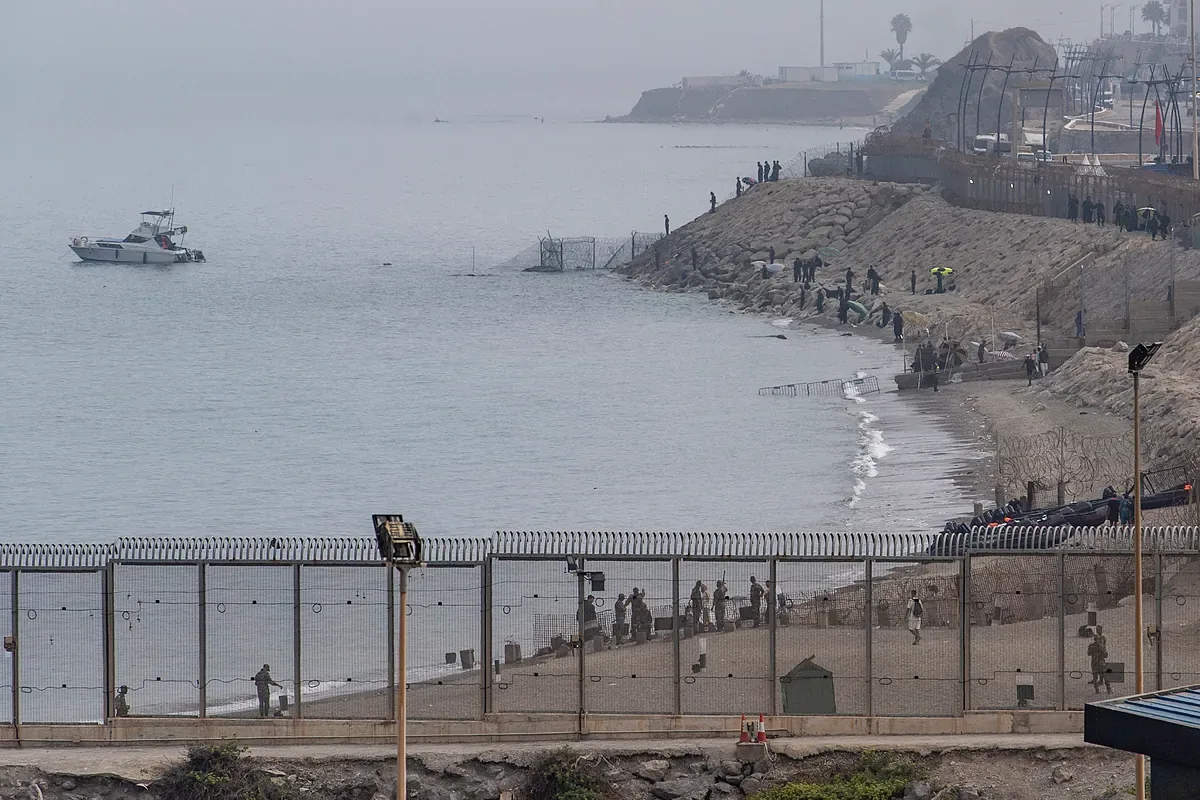




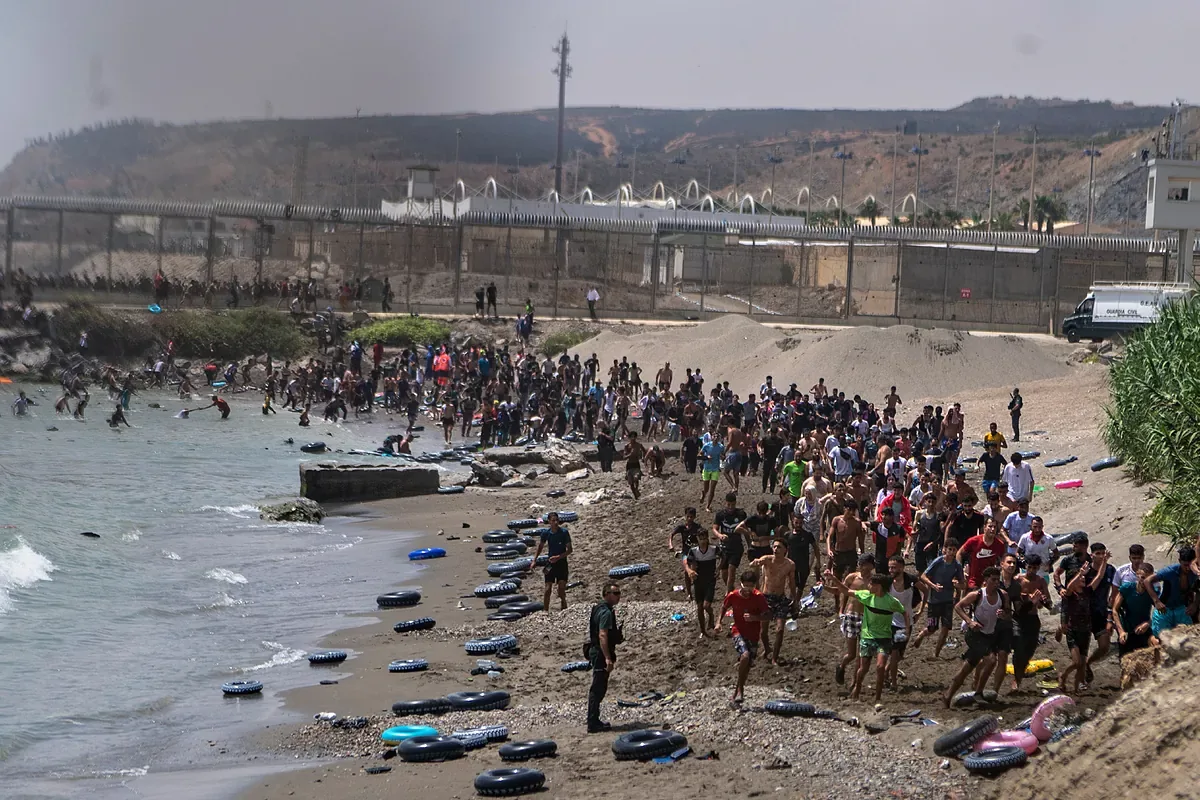
The Government “is going to use all the levers of the State to guarantee the security of the people of Ceuta,” assured the president after his visit to the autonomous city. But the statement came just a few hours after those “levers of the State” had failed to guarantee security on Spanish soil. When 72,000 people irregularly entered Ceuta from Morocco, it was, in Pedro Sánchez’s words, a “violation of the territorial integrity of Spain.” And no one could stop it, despite it being the fourth largest economy in Europe, with a billion-dollar defense budget and a border defined and recognized worldwide.
“There are many things that happen and there does not necessarily have to be responsibility,” said the Interior Minister, Fernando Grande-Marlaska, after the collapse experienced in Ceuta, overwhelmed by seeing its population double in just a few hours. “Things” that, however, have exposed cracks in the State’s mechanisms, the worst legacy for the future.
Accompanied, moreover, by a clash within the European Union in which the Spanish Government has been questioned by the 27 and faced at the highest level with a key partner: Italy. The reproach of Sánchez’s migration policy presented by 22 countries, combined with the escalation of the clash from political to institutional with Giorgia Meloni, paints a less favorable horizon for Spain to recover from the crisis. All while the lack of answers about how it could happen keeps alive, inside and outside, the doubt of whether it will happen again.
The Executive has made an effort not to demand responsibility from those in charge of securing the border. Marlaska stated that “there was no report” warning of the avalanche of people coming, but at the same time praised his “confidence” in the work of the CNI and any other Spanish Intelligence service. And the Government also insisted on exonerating Morocco from what happened, despite the fact that other times Rabat did stop the massive exodus. Although Moncloa has not wanted to assign blame, it has not hidden that, in Ceuta, Intelligence failed as well as the trust Spain believed it could have in its neighbor.
The president of the autonomous city, Juan Jesús Vivas, has been insisting that he warned the Government that the flow of immigrants crossing the border was increasing in the days prior to the avalanche. But the Executive has wanted to differentiate that phenomenon – migratory – and what happened on July 30 – an “attack on territorial integrity.” Of this, of anything similar to what happened, there was no warning. That is: none of the State’s “levers” warned the Government that 72,000 people were heading to the border at the same time.
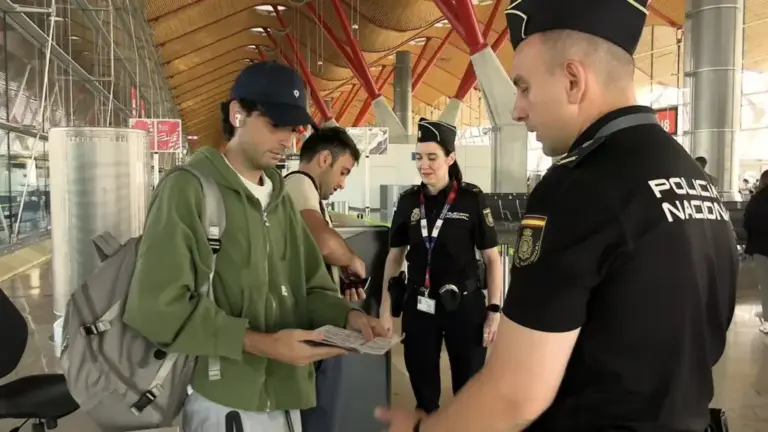
Italy’s traveler controls started only in Madrid and Barcelona and have extended to five airports
- Editorial: EL MUNDO Madrid
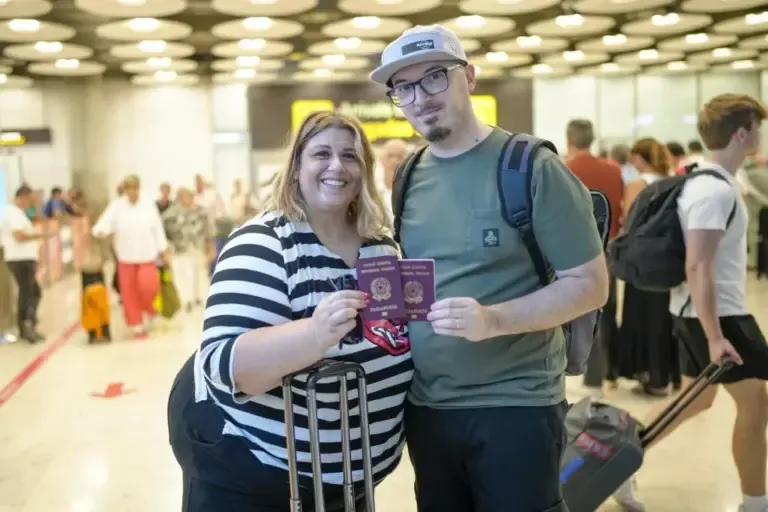
First travelers from Italy affected by controls in Barajas after Sánchez’s clash with Meloni: “It’s ridiculous, only for political reasons”
- Editorial: DANIEL GÓMEZ-FONTECHA Madrid
Marlaska’s pointing to the CNI – although without demanding responsibility – triggered an internal clash in the Government when the Defense Minister, Margarita Robles, hinted that there are also intelligence services dependent on the Interior Ministry. But, in any case, she did not deny that the Intelligence under her portfolio, the CNI, did not foresee and warn of the avalanche. Thus, no one denies, for now, that Intelligence failed.
All despite it not being the first time in recent years that Spain has seen its security threatened by a massive incursion of people into its territory. It happened in 2021, on a much smaller scale – 14,000 people entered Ceuta from Morocco – and that time the ambassador from Rabat made it clear that the neighboring country had indeed been involved: “There are acts that have consequences and must be assumed,” she said to Europa Press, in a veiled reference to Spain’s hosting of the Polisario Front leader. The State was also pressured through a massive gathering when, in 2019, Tsunami Democràtic gathered thousands of people via social networks to block El Prat airport. With due differences, two precedents of a conflict with the State that materialized through human action against national security.

Clash with Europe
Now, although Marlaska acknowledged – and Robles did not deny – the Intelligence error, no one from the Government’s majority wing has even suggested the hypothesis that something may have also failed in the relationship with Rabat, despite it being pointed out from Sumar to Vox, and the recent history leaves, at least, room for doubt. If in 2021 the entry of thousands of people into Ceuta somehow had the connivance of Morocco, it was not so a year later, when in June 2022 Rabat repelled an assault on the Melilla fence that ended in tragedy, with 37 dead. The neighboring country also stopped a massive crossing attempt through Ceuta in September 2024. In both cases, after Spain changed its stance on the Western Sahara – assuming the Moroccan claim. The Ceuta president said in an interview with this newspaper that he believed that turn was in exchange for “mutual respect” with Rabat. But, on July 30, the massive crossing happened without Morocco stopping it.
Rabat did try to stop two massive crossings after the Sahara turn
Adding to the disbelief that the neighboring country did not warn that such a contingent of people was heading to the border is the fact that there is evidence of messages on social networks encouraging that action, and that Moroccan Intelligence also did not communicate it to Spain – Marlaska said no warning of what was coming reached “the highest levels.” “It is impossible that Morocco knew nothing,” wrote Más Madrid spokesperson Tesh Sidi on social media. The coalition for which she is a deputy, Sumar – a member of the Government – as well as Vox, have directly pointed to Rabat as the origin of what happened, something the Executive has not done and the PP has avoided firmly supporting. But avoiding pointing to Rabat while talking about an “attack on the territorial integrity of Spain” raises many questions. “Anything other than reconsidering relations with Rabat will be interpreted as a weak position,” Sidi also wrote. For Santiago Abascal, Morocco “dared to do this” because “it knew there would be no response, no kind of retaliation.”
The crisis worsens the previous one: five times more entries than in 2021
All this, the implicitly acknowledged failure in national Intelligence services and the lack of questioning of the neighboring country, makes the security collapse that Ceuta – and therefore Spain – experienced on July 30 leave a more complicated future legacy. Increased, moreover, by the stance adopted by the European majority: 22 countries pointed to the immigrant regularization promoted by the Government as a policy that weakens the defense of community borders – referring to a possible pull effect. The clash with Europe, to which Sánchez responded by calling the reaction “selfish,” also does not paint an easier horizon for Spain, despite the EU Interior Ministers’ meeting this week helping to calm the waters – except with Italy, as the mutual suspension of Schengen raised the confrontation between the president and Giorgia Meloni the day before yesterday.
“It has been the last straw,” sources from the PP say about what happened in Ceuta, and they predict “very complicated months” ahead for Sánchez because, they believe, “he no longer has partners in Europe.” They also maintain that the head of the Executive will feel “a lot of pressure” to control the border. A border that, they remind, is the southern limit of the entire continent.
The collapse in State security, whether behind it is an intelligence failure or an excess of confidence in the relationship with Morocco, left in Ceuta the largest irregular entry of people suffered on Spanish territory since the Green March. An “invasion,” says the opposition, which as a national crisis also has another relevant nuance: it is the first to worsen its predecessor, since the 14,000 people who arrived in 2021 are at least 72,000 now. The solution applied then – the Spanish turn on the Sahara, as far as is known – does not seem to have been enough to stop the avalanche this time.
The phrases
“No report”. The Interior Minister, Fernando Grande-Marlaska, has insisted all week that the Intelligence services did not warn that an irregular entry of such magnitude was going to occur.
“Reliable partner”. The minister has also emphasized these days that Morocco “is not a threat to Ceuta or the rest of Spain.” “It is an absolutely reliable partner,” he assured, saying that Rabat responded to the crisis “by cooperating.”
Read more Real Madrid defeats Ferencvaros in Bernardo Silva’s debut