

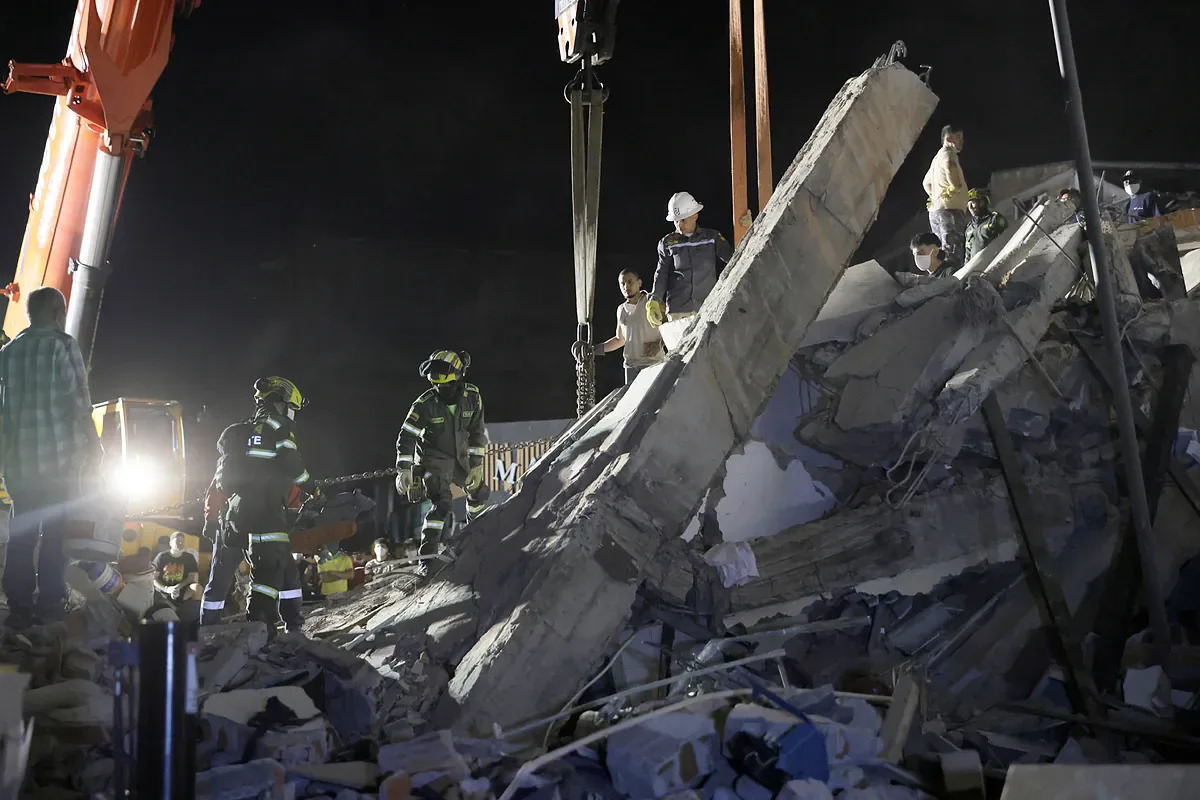
Rescuers and volunteers in Colombia remove debris by hand in a race against time to find survivors of the strongest earthquake in the last decade, which has so far left 132 dead, 570 injured and dozens of collapsed buildings (61 fallen buildings, 18 destroyed health centers, and 52 affected educational institutions).
Early in the morning, the main cities in the west of the country experienced moments of panic, with thousands of people in the streets while buildings collapsed or suffered severe damage, AFP journalists confirmed. The magnitude 7.4 earthquake occurred at 07:34 local time (12:34 GMT), according to the Colombian and United States geological services.
In Pereira, the most affected city so far, most of the city is without electricity while dozens of volunteers search with flashlights for signs of life under the ruins of buildings.
Canary Islands show solidarity with Colombia and enable an information phone line for Canarians in the country
The president of the Canary Islands, Fernando Clavijo, has shown the archipelago’s solidarity with the victims and their families who suffered the earthquake in Colombia this Monday, also enabling an information phone line for Canarians in the country.
Clavijo indicated on his ‘X’ profile, reported by Europa Press, that the Canary Islands have “close social and cultural ties” with Colombia, a country where “thousands of compatriots” reside. He also expressed his hope that rescue efforts will allow finding as many people alive as possible.
“The earth has shaken again in Colombia, a country with which the islands maintain close social and cultural ties. Thousands of compatriots live here. Our solidarity with the victims and their families, as well as our hope that rescue efforts will allow finding as many people alive as possible,” he stated.
The EU activates consular assistance and satellite aid after the earthquake in Colombia
The European Union (EU) has activated its consular assistance system and its Copernicus satellite service to help Colombia after the magnitude 7.4 earthquake that has already left more than one hundred dead, said the head of the community diplomacy, Kaja Kallas, this Tuesday.
“The EU has mobilized Copernicus, our satellite service, to support rescue and relief operations. We are providing funding to support the response, among other means through the Red Cross,” Kallas said in a message via social media.
She also said that the EU has activated the consular assistance mechanism in EU crisis situations “to help EU citizens affected by the disaster.”
Latvia and Estonia send condolences for the Colombia earthquake.
The governments of Latvia and Estonia expressed late Monday their condolences to Colombia after the strong earthquake that shook the South American country hours earlier and the reports that indicated more than 100 dead and widespread damage in several cities.
“Sincere condolences to President Abelardo de la Espriella and all those affected by the strong earthquake in Colombia. We wish a speedy recovery to all the injured,” wrote Latvian President Edgars Rinkvis on X.
Foreign Minister, Baiba Brae, for her part, declared herself “deeply shocked by the devastating earthquake in Colombia.”
“My deepest condolences to the families and loved ones of the victims, and my best wishes for a speedy recovery to all the injured. Latvia stands in solidarity with the people of Colombia,” she added.
Estonia’s Foreign Minister, Margus Tsahkna, also expressed his condolences on X.
Navarra offers itself to the Government to “collaborate” in aid to Colombia after the earthquake
The president of Navarra, María Chivite, has expressed her condolences after the magnitude 7.4 earthquake on the Richter scale recorded this Monday in Colombia and has shown the regional government’s willingness to “collaborate.”
She indicated this through a message published on the social network ‘X’. “Terrible news coming from Colombia due to the earthquake suffered. My condolences to the Colombian people,” Chivite states.
In her post, the president of Navarra also sends her “special support and affection to the Colombian community in Navarra.” “We at @gob_na are at your disposal to collaborate in whatever we can,” she adds.
More than 160 dead, according to Reuters
Rescue efforts continued this Tuesday for the second consecutive day in western Colombia, where emergency teams were digging through collapsed buildings and homes reduced to rubble, while fears grow that the death toll from the most powerful earthquake recorded in the country in decades may rise. The magnitude 7.4 earthquake shook the heart of Colombia’s coffee region early Monday and caused at least 164 deaths.
The earthquake reduced multi-story buildings to rubble in cities such as Pereira and Cali, and caused the collapse of one of the towers of a historic cathedral in the city of Manizales.
Emergency teams, supported by police, soldiers, and volunteers, worked throughout the night with excavators and sometimes with their own hands, searching for survivors under the rubble. In Cali, a city of about 2.2 million inhabitants, at least 85 people died. Dozens of buildings were dangerously tilted or completely destroyed, forcing residents to take to the streets.
The story of a “devastated” Colombia by the earthquake: “It sounded very hard, we felt as if horses were galloping under the house”
Manizales is one of the cities most affected by the magnitude 7.4 earthquake that shook Colombia this Monday. The city remains in a state of shock, with damaged buildings, collapsed structures, and emergency teams deployed at various points while the extent of the tragedy is still being assessed.
Read more A man confronts Bendodo (PP) during a press conference in Barcelona
The earthquake, with its epicenter in the northwest of the country, has left nearly a hundred dead and dozens injured and missing. The earthquake was felt with special intensity in southwestern Colombia and caused damage in Manizales, Cali, and other municipalities in the departments of Caldas, Risaralda, Chocó, and Valle del Cauca.
In Manizales, about twenty structures have been partially or totally destroyed and more than fifty are at risk of collapse. Testimonies from the city describe the violence of a shake that surprised residents in their homes, workplaces, and streets.
“Horrible, horrible”, recounts to EL MUNDO Estefanía Sierra, a Manizales native living in Bogotá but who was visiting her city when the earthquake struck. “We felt it as if there were horses galloping under the house, as if the earth was moving. It sounded very hard, the windows were shaking, and even the bathroom water splashed out. The movement was very intense.”
Milton César Ocampos, a professional tour guide in the country and a Manizales resident, describes how he experienced those first seconds: “It felt very strong, very strong. Things on the floor fell, they moved very strongly, everything was roaring.” His building held, but he admits the earthquake scared him. “I’m not usually afraid of tremors, but this one did scare me.”
Read the information by Lucas Pérez and Pablo Scarpellini.
First test for De la Espriella
The earthquake represents the first major test for Abelardo de la Espriella, who was sworn in on Friday. De la Espriella is a divisive figure due to his promise of a total offensive against criminal groups.
The United States Department of State announced it would provide 15.5 million dollars for emergency shelters, food, and other aid. Governments across Latin America also prepared to help.
The earthquake left many in the Andean nation uneasy after two consecutive earthquakes devastated neighboring Venezuela in late June, destroying hundreds of buildings and killing more than 6,300 people.
Rescuers search for earthquake survivors
In Cali, Colombia’s third-largest city, rescuers tirelessly attend to the most affected neighborhoods.
“Getting here was impressive, it looked like the end of the world, cars and motorcycles going the wrong way looking for their loved ones,” said rescuer Nelson Moreno, who arrived searching for a friend under two collapsed five-story towers. His friend’s father and the woman’s baby are injured but survived.
“Now we need flashlights and goggles” because of the dust, to continue work at night, he added, surrounded by hundreds of volunteers with dogs at the site. Rescuers form human chains to remove building debris, using picks and basic tools. Every so often they shout “silence” to hear signs of life from those trapped.
According to a report from the president, besides the victims, there are 61 collapsed buildings, 18 damaged health centers, and 52 affected educational institutions. In Cali alone, there are 188 missing, he reported.
A six-year-old boy, son of a Colombian mayor, among those who died due to the earthquake
A six-year-old boy, son of Leonel Valencia, mayor of the municipality of Bahía Solano, in the department of Chocó (west), died this Monday in the magnitude 7.4 earthquake that shook much of Colombia and has left at least 132 dead.
The boy, named Mateo Valencia Valencia, died after the building where he was located collapsed as a result of the earthquake, which had its epicenter in the town of San José del Palmar, also in Chocó and more than 300 kilometers from Bahía Solano, in the Pacific region.
“Today we lost Mateo, son of the mayor of Bahía Solano, Leonel Valencia. With him and his entire family, we are in this painful moment, with all our hearts,” said the governor of Chocó, Nubia Carolina Córdoba-Curi, who detailed that the death toll in that department has reached 13.
Iván Cepeda calls for unity and announces Historic Pact support for earthquake victims
The former Colombian left-wing presidential candidate Iván Cepeda called on Monday for unity and solidarity with the victims of the earthquake that shook much of Colombia and shared the measures with which the Historic Pact, the party of former president Gustavo Petro, will join the emergency response.
“Colombia needs us united: unity, solidarity, and strength. Life first,” Cepeda expressed on his X account while sharing a statement from the National Directorate and the Historic Pact congressional caucus.
The party, which since last Friday moved to the opposition after the inauguration of far-right Abelardo de la Espriella as president, announced a national solidarity campaign and assured it will coordinate its actions with authorities and agencies responsible for emergency response.
At least 132 people have died in cities affected by the earthquake
Pereira, Cali, Quibdó, Manizales, and Armenia are among the cities hardest hit by the earthquake, which forced the government of President Abelardo de la Espriella, who took office just three days ago, to declare a “national disaster” situation.
At least 132 people died and more than 570 were injured by the magnitude 7.4 earthquake that shook much of Colombia this Monday.
The figure only includes the balance from the country’s capitals, so it does not include the dead and injured recorded in surrounding municipalities and localities, where building collapses and damage to hospitals, airports, public services, and transportation systems were also reported.