





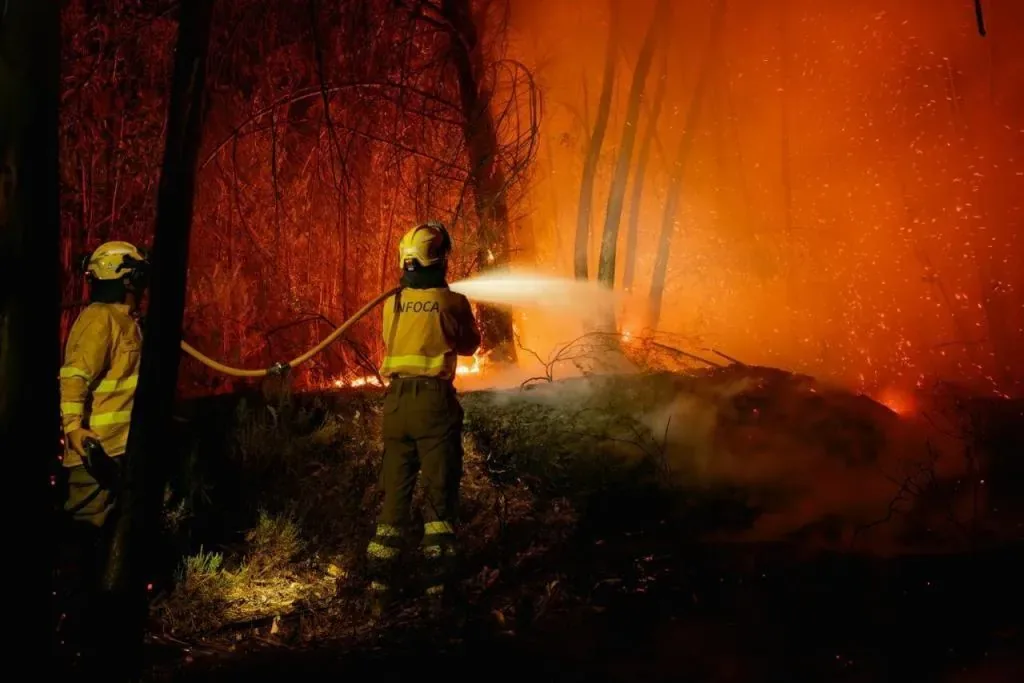
A dense mass of eucalyptus feeds daily the Niebla fire (Huelva) which has been ravaging tens of thousands of hectares for more than a week and threatening the surrounding populations in the provinces of Huelva and Seville. This Friday, the director of the Andalusian Emergency Agency (EMA), Alejandro García Hernández, explained how the “essential oils” that give the eucalyptus leaf its characteristic smell have become a highly effective fuel that greatly increases the calorific power of the fire.
The flames have already covered an area of about 38,000 hectares and, although the 875 personnel working on the ground have managed to stop its advance on almost all fronts, the fire continues moving eastward, towards Aznalcóllar, already within the province of Seville and through the area known as Pata del Caballo, where there is a dense forest mass.
The entire area affected by the fire is basically made up of scrubland, pines, holm oaks, and eucalyptus. In addition, there are no nearby cultivated areas which, in other fires, have acted as effective firebreaks. This circumstance explains the enormous extent the disaster is taking, which may surpass the burned area in the same zone during the 2004 Berrocal forest fire.
According to the EMA director’s explanation this Friday, the laminated bark of the eucalyptus also contains those essential oils and, when it detaches and is carried by air currents, it falls many meters away and has a great capacity to generate new fire spots. “Wind-driven fires generate new spots in the direction the gusts push; but convective fires project new spots in any direction,” he adds.
Eucalyptus wood is highly flammable. In fact, in Australia it is known as the ‘gasoline tree’. This has caused the temperatures reached in the heart of the fire to be very high, generating convective clouds that, in turn, help to launch burning leaves and pieces of bark in all directions. The tops of the eucalyptus trees are also highly flammable, “so we have a perfect cocktail.” All this explains why the fire has experienced “jumps” of more than three kilometers and has even advanced against the wind direction.
The environmentalist Juan Romero, a great expert on the region, has been denouncing for years how the high presence of eucalyptus and pines with which this mountain range was reforested decades ago had turned the area into “a powder keg.” “Eucalyptus leaves act like cluster bombs,” he explained earlier this week in a conversation with EL MUNDO.
On the other hand, the director of Extinction at Infoca, Alejandro Molina, considers that the difficulties presented by this fire would not be solved with a greater presence of resources, which are already very numerous (875 personnel and 33 aerial means). “In the Sierra Bermeja fire (Málaga, 2021), we learned that sometimes less is more.” In the case of the Niebla fire, the thermal inversion that occurs in the area every morning generates a “smoke plug” that prevents aerial means from flying until it dissipates as the day progresses and the atmospheric temperature rises.
But convective clouds also generate additional difficulties. In fact, ground brigades cannot get too close to the fire when the thermal radiation generated in the heart of the fire is so high. Only at night, when the temperature drops, has it been possible to partially “attack” the flames.
“We have been experiencing sustained extreme conditions every day for seven days,” also explained the Emergency Minister, Antonio Sanz, who highlights how the wind has blown in all directions, shifting as the day progresses until drawing “a complete circle,” with gusts of up to 50 and 60 kilometers per hour.
However, he points out that the situation of the first days, when it was determined that “there was no capacity for extinction,” has already been overcome, as demonstrated by the fact that the advancing spots from the west and north have been “strangled.”