




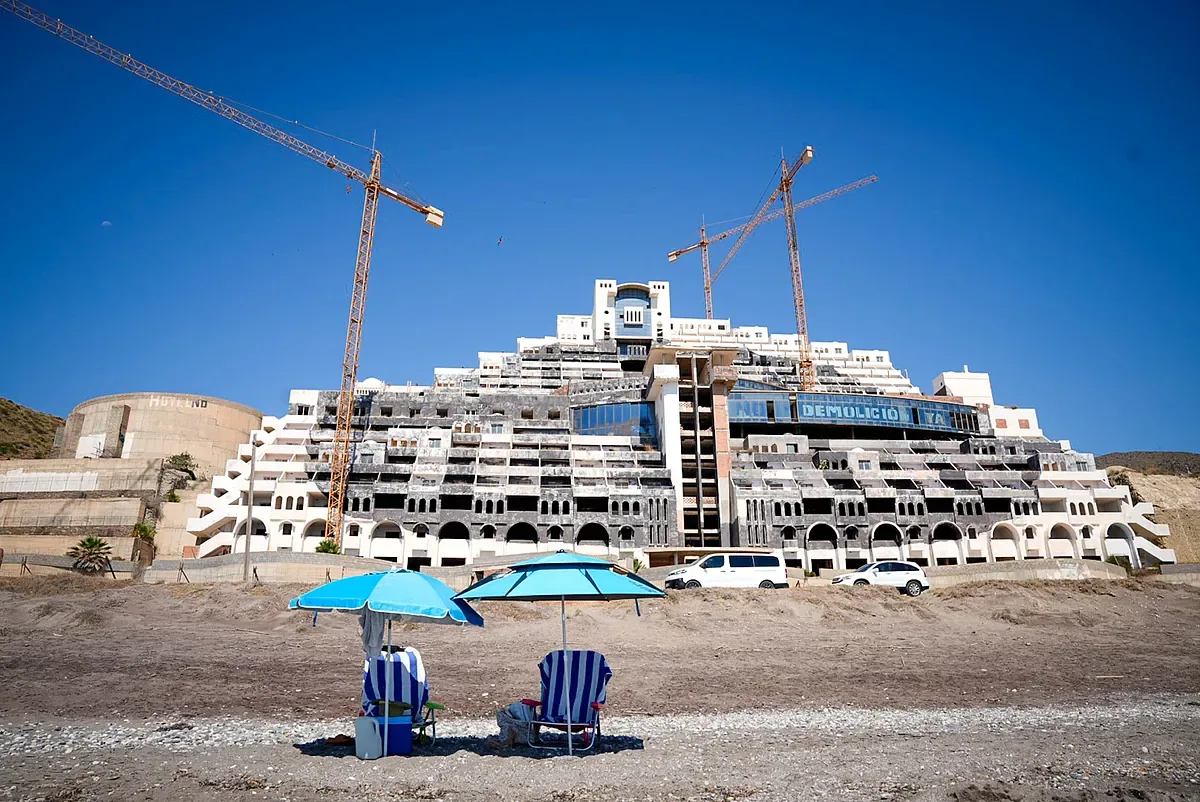
How do you tear down 42,000 square meters of concrete from the illegal hotel? What is done with the 60,000 cubic meters of waste that the demolition will generate? Who will pay for the work to fully restore the surroundings of the Algarrobico beach in Carboneras (Almería)? The long and tedious legal process that ended up ruling against the controversial urban development project in this corner of Cabo de Gata, a symbol of urban abuse on the coast, has given the administrations plenty of time to define the complex operation that must be launched to make the structure disappear and fully recover the environment. But precisely because of the time elapsed during the wait, the cost estimates—which were once estimated at 7.1 million euros in a report prepared by Tragsa—have become outdated.
What remains in effect unless the parties say otherwise is the task allocation negotiated in 2011 between the central government and the Junta de Andalucía, which assigns demolition and waste removal to the former and environmental restoration of the surroundings to the latter.
According to the report prepared by Tragsa in 2012 at the request of what was then called the Ministry of Agriculture, Food and Environment (headed by Miguel Arias Cañete), the largest budget item would be demolition and waste treatment, with a quantified cost of 3.9 million euros. Preliminary studies and project drafting would cost 304,920 euros, while project management and health and safety work would take 217,800 euros. The cost of environmental restoration of the El Algarrobico area would be 1.5 million euros. These calculations were made considering that the hotel has 43,840 square meters of built surface and 142,480 cubic meters of apparent volume. Based on these values, it is estimated that the volume of construction and demolition waste, including the foundation, is about 60,000 cubic meters.
The environmental restoration work (which falls under the responsibility of the Junta de Andalucía according to the 2011 agreement) will begin once demolition and waste management (which are the responsibility of the central government) are completed. Restoration will be carried out on the land that has been altered, both by the direct construction of the hotel and by earth movements or by the road layout.
For this purpose, three distinct zones have been established: zone A, occupied by the hotel and covering 3.28 hectares; zone B, affected by earth movements; and zone C, partially affected by earth movements and roads.
The restoration process will be carried out in four stages: in the first (in zones A and B), a “geoform harmonious with the landscape and creation of the final relief” will be designed. The second stage is the preparation, distribution over the terrain, and stabilization of the substrate. These first two stages of environmental restoration have a budget of 1 million euros. The third stage, for which an investment of 319,000 euros is planned, consists of the short-term development of a vegetative cover sufficiently protective to prevent erosion of the recently installed substrate, trying to promote biodiversity using native species of the area. Finally, the fourth stage of environmental restoration would include irrigation of plantings and sowings, control of aggressive and invasive species that could compromise the regeneration of the natural ecosystem, as well as control of possible erosion processes starting on slopes. The cost of these control and maintenance tasks is estimated at 84,000 euros.
Research and training project
Since this study was prepared in 2012 until today, the cost of demolition work may have increased by up to 50%, taking into account the rise in energy prices, labor, and waste management.
Read more France is considering curbing the revaluation of high pensions to reduce the deficit
But Tragsa’s was not the only report offering a technical proposal on how the work should be carried out. The environmental organization Greenpeace, which has been an active agent throughout the process, also commissioned a study to turn the demolition of the Algarrobico into “an opportunity.”
Published in June of the same year, the project prepared by architects and urban planners from the organization n’UNDO started from a budget (7.3 million euros) similar to that calculated by Tragsa on behalf of the administrations, but with a proposal focused on turning a symbol of environmental destruction into an opportunity for research and training of professionals in waste management and landscape restoration.
Instead of classic demolition, which would mean dumping almost 40,000 cubic meters of unselected waste in local landfills, Greenpeace’s work proposes recycling up to 98% of the demolition material. “The project proposes turning the Algarrobico beach hotel into a recovery center for the environment, where over two years more than 60 activities will be generated in different areas: congresses, exhibitions, courses, and research,” the authors state. The operation would generate 380 jobs, 530 hours of courses, 150 trained people, 39,200 m3 of recovered material, 71 tons of CO2 not emitted, and, above all, a recovered beach. “The image of the Algarrobico will be changed, which today is an example of illegality and malpractice, becoming a reference project that proposes a replicable and sustainable model,” says the n’UNDO study.
Both the technical proposal from Tragsa and that of Greenpeace need a price review but remain valid in defining and detailing the operation. What is less clear is when the administrations could take possession of the land to give the order to start demolition. The exasperating caution that both the Junta and the Government have shown in taking this step is related to the million-euro claim that the hotel’s promoting company, Azata del Sol, has been making since the project was halted in February 2006, more than 20 years ago. Both the Andalusia Advisory Council and the National Court have denied Azata the right to compensation because the company was aware of the complexity of the land delimitation process that compromised land use and the doubts about the legality of the building permit granted. And yet, it went ahead with construction. But the company insists it will fight again in court, and experience shows that, regarding the Algarrobico, there is always a legal loophole that justifies a new delay. In fact, the Government proposed in 2025 a partial expropriation process, which the promoter has also appealed.
Expelled councilors
Even so, the PSOE of Almería surprised last week by demanding the Andalusian Government immediately start the demolition, expressly ignoring not only the agreement on the division of functions between administrations but also that the administrative route to resolve the conflict is not entirely clear. It has been precisely the PSOE of Carboneras (Almería) that has most vigorously contributed to preventing this very complex mess from being completely undone, to the point that several councilors have been expelled from the party for repeatedly obstructing the annulment of the building permit repeatedly demanded by the Andalusia Superior Court of Justice (TSJA). And it was also a socialist mayor who granted that permit in 2003, backing, with the approval of the socialist government of the Junta at that time, the full urbanization of a virgin beach in the Cabo de Gata-Níjar Natural Park.
Read more Repsol’s largest wind farm opens an accounting hole of almost 300 million