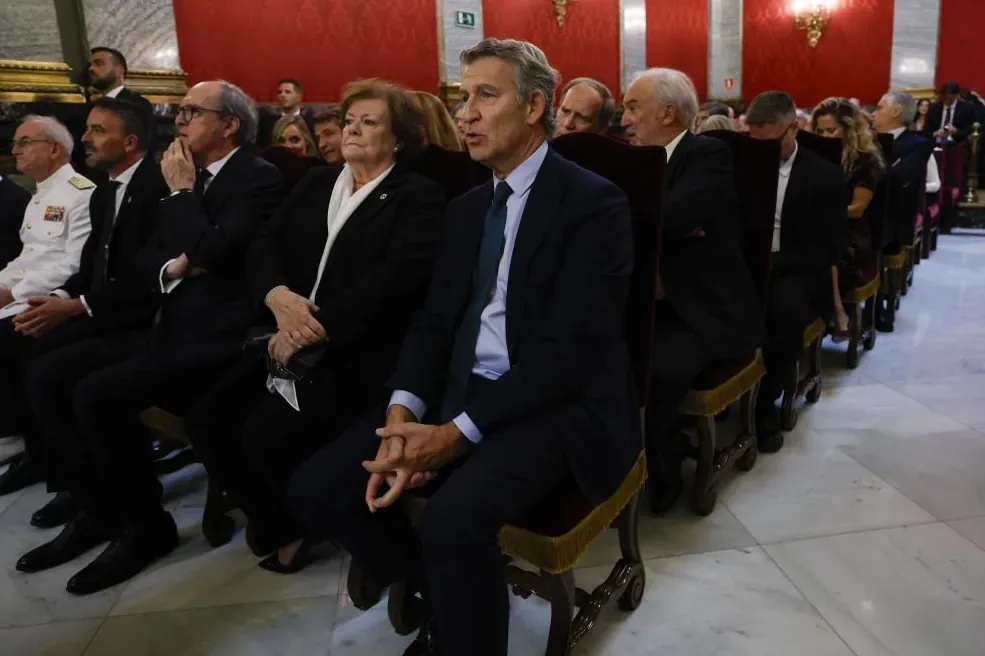



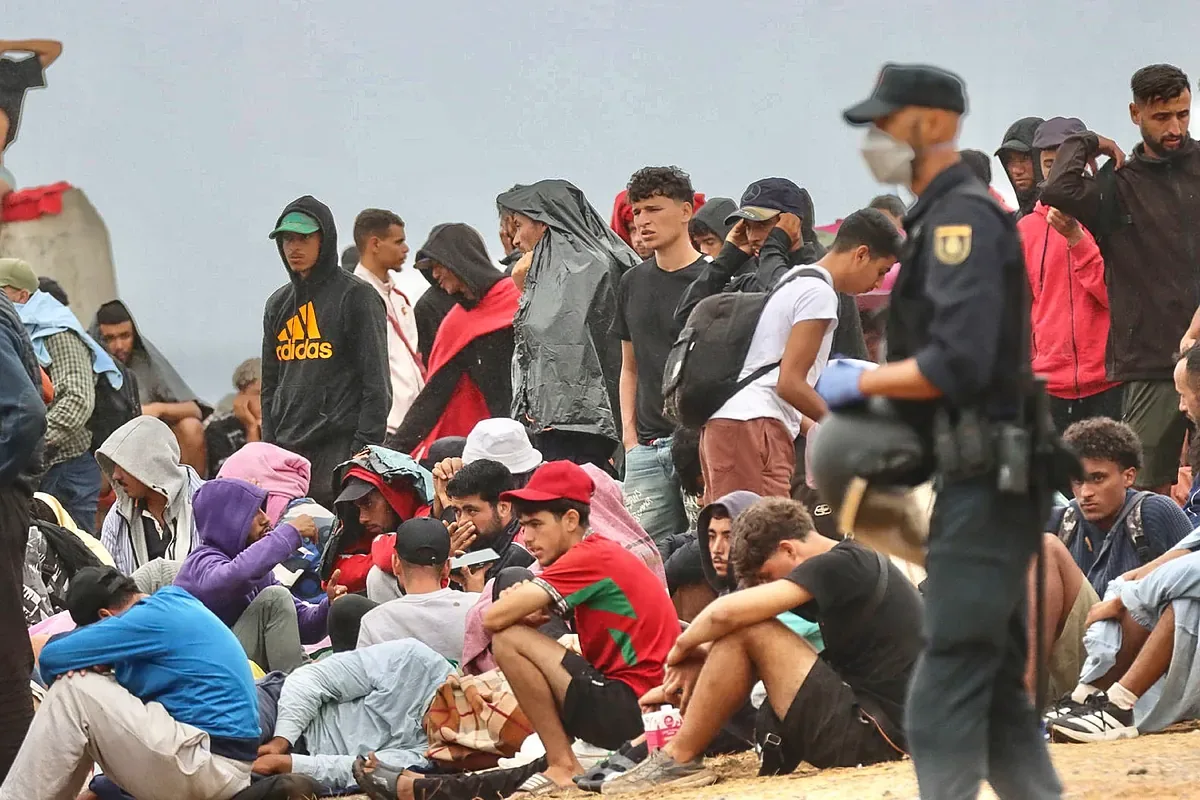
Pressure from the Government and its environment on the King at a time when criticism of the Executive is intensifying due to the situation of the humanitarian crisis in Ceuta. The deputy spokesperson of Sumar and IU leader, Enrique Santiago, has reproached Felipe VI for not having called the King of Morocco, Mohamed VI, yet. “He is already late,” he criticized.
The reproach from one of the main spokespeople of the Government’s minority partner comes after El País published this Friday that a Government minister suggested to the King that he call Mohamed VI due to the migratory crisis “to thank him,” a detail that Moncloa does not confirm. The official messages publicly conveyed these days by both the president, Pedro Sánchez, and the ministers – except for Defense, Margarita Robles – have praised Morocco’s “collaboration” in the returns during the first hours of the avalanche and described it as “an absolutely reliable partner.”
Asked about all this in an interview on Telecinco, Santiago criticized Felipe VI for not having made that call much earlier. “Obviously, it is something that should have been done from the very beginning as neighboring countries with a consolidated relationship,” he said. And he pointed out that for him it is a “surprise” that “he still hasn’t done what he had to do in this crisis.”
“If we have a head of state whom we do not vote for, then obviously he should do his job as head of state,” emphasized the IU parliamentary spokesperson. That is why he stressed that he hopes he “fulfills his obligations” and makes that call.
And what should he say in that call? Well, Santiago, as IU has been vehemently defending, should use a critical and reproachful tone towards Morocco. Because unlike what the PSOE maintains, for him what has occurred is a “hybrid attack” on Spain.
So Santiago said that the King has to “get in touch with the head of state of the country that attacked us, which carried out a hybrid attack in which the clear victims have been the city of Ceuta, all the people of Ceuta, and the 80,000 people, migrants, asylum seekers, persecuted persons, unaccompanied minors, who have been used to carry out that hybrid attack.”
Felipe VI’s trip to Ceuta
Another difference between Sumar and the PSOE. The IU parliamentary spokesperson wants the King to visit Ceuta. “He should travel, there is no doubt about it,” he said. “Of course, the head of state can visit any territory of the state and has the obligation to visit a territory such as Ceuta.”
Regarding a possible visit of Felipe VI to the autonomous city, which he himself conveyed to the president of the autonomous city, Juan Jesús Vivas, as a “personal commitment,” the central government points out that no “obstacle is placed, quite the opposite,” for it to happen, although “when appropriate” and with “absolute coordination in this regard.” Likewise, they indicate that no “recommendation or explicit directive” has been given for the monarch not to go to Ceuta.
In his statements, Enrique Santiago extends the call to travel to Ceuta to “all state authorities who have something to contribute”: It is not, the IU spokesperson specified, that they “just pass through” for the mere fact of having presence, but “to contribute to solving this problem and to give reassurance to Ceuta’s society” and demonstrate that they have not been “abandoned.”
On the part of the Government’s majority partner, the socialist minister Óscar Puente has led a campaign this month against the King, calling it an “absolute ignominy” that he posed with journalist Javier Negre, when both coincided at the inauguration of the new president of Colombia, Abelardo de la Espriella. The head of the Transport portfolio even said that the head of state he has in mind “would not touch with a stick” the owner of EDATV and that “his image is contaminated” while “the image of the person he photographs with is cleansed.”
Transfer of all migrants to the peninsula
On the other hand, regarding the humanitarian situation faced by the approximately 10,000 migrants who still remain in the city (these are estimates, as there are no official figures), Santiago has advocated that these people be transferred to the peninsula, because Ceuta cannot be where they get trapped.
“There are conditions on the peninsula so that this is not a problem. The decrease in arrivals to the Canary Islands this year has made it possible that right now there are more than 10,000 reception places for foreign persons available on the peninsula,” he emphasized. These places for migrants in general, he added, are managed by the State.
In this regard, Santiago stressed that “because people are transferred to the peninsula, no pull effect will be caused.”