
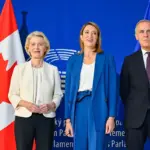

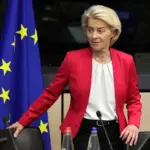
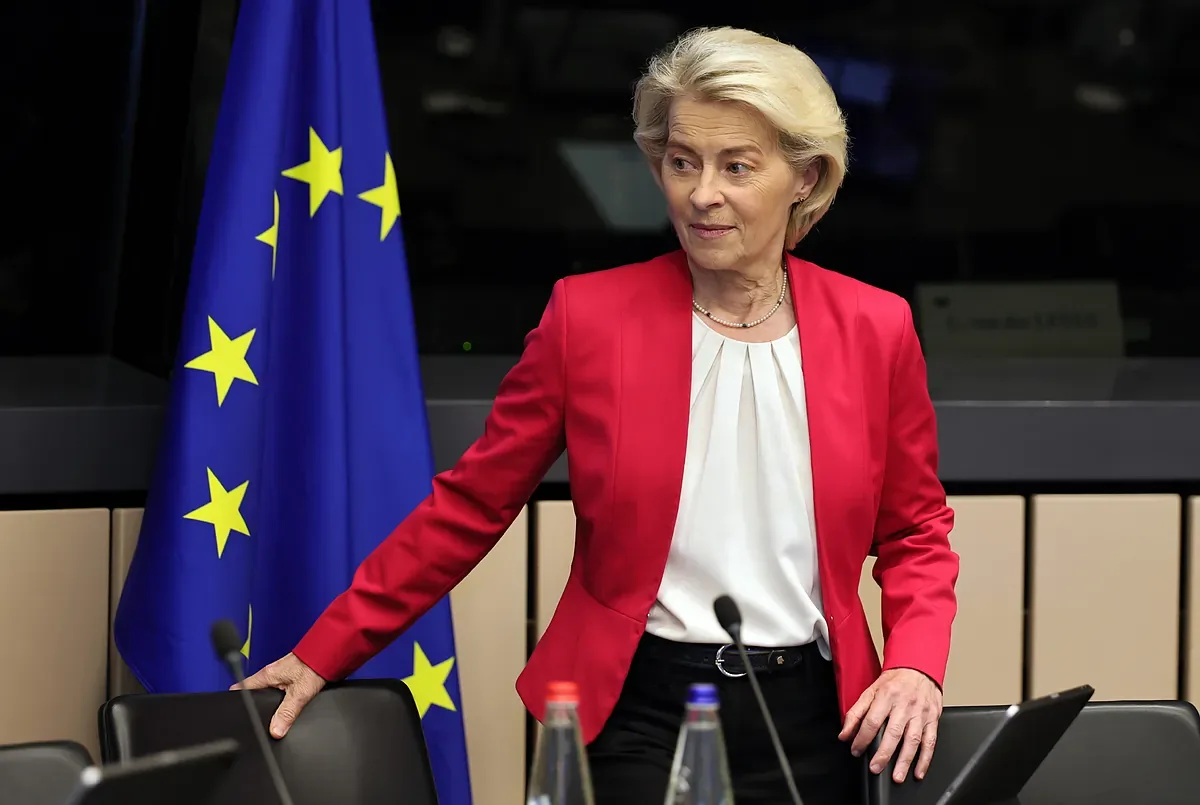
Ursula von der Leyen wanted to address “directly the Spanish people” in her speech on the State of the European Union. The President of the European Commission dedicated part of her intervention, undoubtedly one of the most important of the year and with which the new political course officially begins, to the Ceuta crisis. And she wanted to make it clear that the autonomous city is part of Spain and, therefore, of the EU.
“All our external borders are European borders. The border of Ceuta is a European border. Because Ceuta is Spain. Ceuta is Europe. And Europe will be by your side,” Von der Leyen said.
This defense and this link between Ceuta and Europe is something that both the president of the autonomous city, Juan Jesús Vivas, and the leader of the Popular Party, Alberto Núñez Feijóo, have demanded on numerous occasions. And the President of the Commission introduced in her speech a clear, concrete, and moderately extensive reference to the issue, because in the face of this crisis Von der Leyen has presented a new action: “A European Emergency Response Framework” that will give more flexibility and leniency to countries in aspects such as returns.
“The point is that the only solution is a European solution. And that solution is the Pact on Migration and Asylum. After years of work, we finally have a common European framework. A framework that assigns responsibilities to everyone and demands solidarity from all. And now it must be fully applied,” the senior German official continued.
“But the events of this summer,” she added, “show that our tools must evolve, especially to deal with emergency situations. Europe needs to have the necessary means to protect its borders at all times. Especially in scenarios where mass movements of people are deliberately provoked and used as a weapon.”
And this is where that “new European Emergency Response Framework” fits in, which according to her explanation “will only be activated when a set of strictly defined criteria are met,” and which “will allow temporary and strictly limited flexibility regarding usual procedures.” More leniency in processes and in the application of measures. More leeway.
“Europe’s message is clear: we will always respect our values and our fundamental rights. But we will never make concessions when it comes to protecting our borders. It is we, the Europeans, who decide who enters our Union and under what circumstances. Not the traffickers or smugglers,” she emphasized.
There is no direct reference to Morocco as responsible for the action, something that was not expected either. And Von der Leyen does emphasize that the Ceuta crisis, as well as that of the “coasts of Crete,” have in common that “vulnerable people are being exploited.” “By unscrupulous traffickers and smugglers. By our adversaries. That is why we have proposed a sanctions regime to hit criminals where it hurts most,” she adds.
The Ceuta crisis, in any case, continues to focus much of the attention of European institutions. Yesterday the Parliament debated the resolution on the crisis that will be voted on tomorrow, with the socialists threatening to block it and the European People’s Party forced to seek alternative partners to try to approve a statement. And also this Tuesday it became known that the Moroccan government is trying to influence this vote. The representation of Morocco before the EU and NATO sent an email on Monday to a group of MEPs pointing out that “in light of the regrettable events of July 30, 2026, the Moroccan authorities are working to determine the causes and the actors behind this situation.” As if it were something totally unrelated to their responsibility.
“Morocco has committed to readmit all affected persons, including Moroccan citizens, unaccompanied minors, and nationals of third countries” and the “Spanish government has publicly declared that the information it has does not allow holding Morocco responsible for these events,” the email continued, which was revealed by the PNV MEP, Oihane Agirregoitia, and to which this newspaper had access. And it ended by asking “what interest would Morocco have in provoking a serious crisis with Spain and the European Union?”.