




It was the first time the door had been left slightly ajar to an interest rate hike, but the European Central Bank (ECB), true to its policy of sending clear and precise messages to the market, has decided not to act and to delay its decision until September in an unusually volatile context. More so than usual in recent years, marked by Donald Trump’s erratic second presidency at the head of the US. Since Christine Lagarde announced on June 11 the first increase in official rates in the last three years, the announcement of the peace agreement in the Middle East occurred 24 hours later, on June 19 talks began and on July 7 the Republican leader decided to walk away from the table… until today. A month and a half later, tensions are escalating and all attention is focused on the reopening of the Strait of Hormuz.
The direct consequence of its indefinite closure since the end of February is an oil barrel that today once again climbs more than 4.5% and is already above 100 dollars. These are two-month highs in an escalation that has not ceased since the attacks resumed. European crude is trading, again, 36% more expensive than it did before the start of the war; but this time gas is particularly worrying, having been contained in recent months. Its price soared to 64 euros per megawatt/hour in the early hours of Thursday and is at two-and-a-half-year highs, which could pose a problem for countries like Germany and the rest of Eastern Europe heading into next winter.
The ECB’s Governing Council has unanimously approved keeping the three euro area reference rates stable. The deposit facility remains at 2.25%, the main refinancing rate used to set the cost of bank loans is at 2.4%, and the marginal lending facility rate is at 2.65%. Euribor, the reference used to set mortgage prices, continues to climb in July and closed yesterday above 2.91%, in the high zone of last March.
But there is a fundamental point in the ECB’s decision to wait, and that is that energy prices still remain within the estimates that the central bank contemplated in its latest economic projections last June, when the start of peace talks had not yet been announced. “The outlook for energy prices, although highly volatile, is currently at a level close to the baseline scenario of the Eurosystem experts’ June projections and clearly above the levels recorded before the start of the conflict in the Middle East,” the ECB states in its note today. These estimates indicated that the price of a barrel of European Brent would be around 97 dollars by the end of this year, and natural gas would be at 45.6 euros MGW/h.
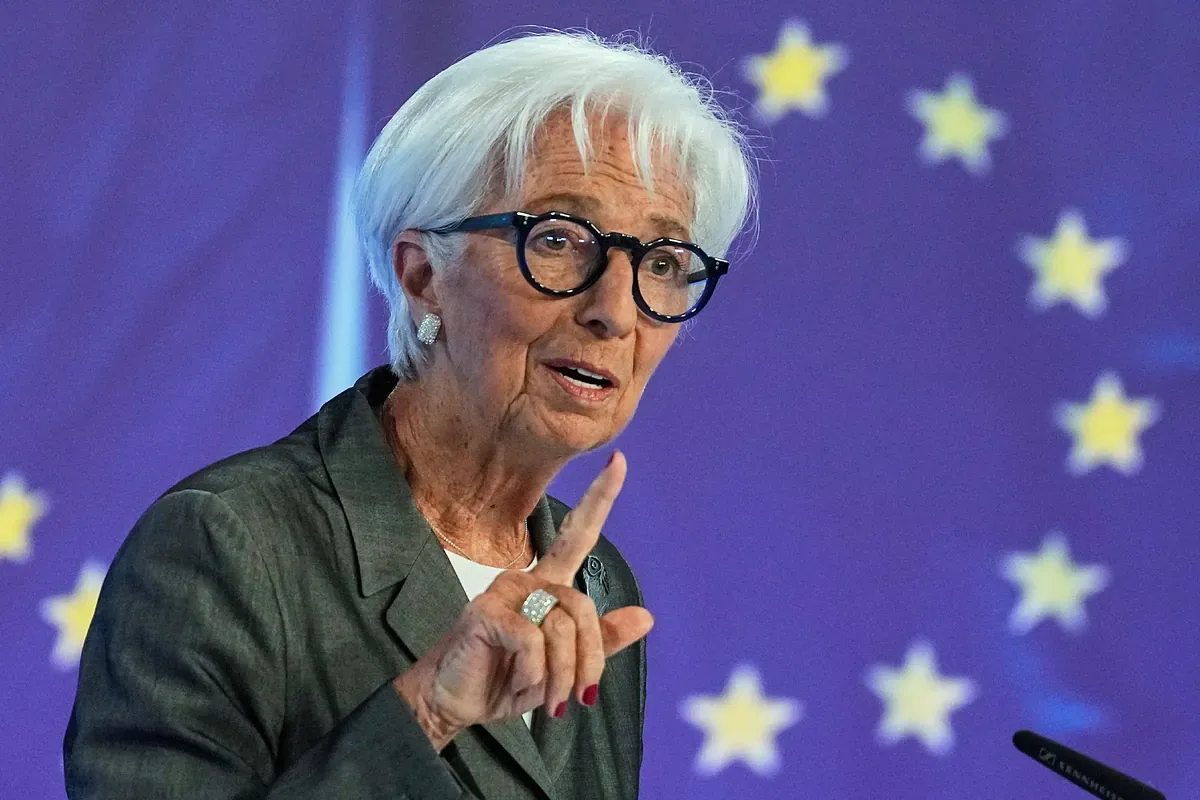
One of the keys lies in the second-round effects, not yet seen, assures the president of the body, and in how energy prices will behave in the coming months. June closed with a slight containment in its rise. Energy CPI rose 8.5% compared to 10.8% in May and after five consecutive months of sharp increases since the start of the war in Iran. The ECB expects electricity and gas prices, which it says it is watching with special attention, to remain high until the second half of 2027. “The geopolitical situation remains fragile after recent weeks. This could mean a greater and more prolonged impact on their prices,” Lagarde said during the press conference.
“We have spent the last two days evaluating all available data to assess where we stand against the decision we made in June. Looking at what has happened since then,” analyzed the central bank president. First, “inflation was below estimates, with a better economic performance; but then came the MoU (‘memorandum of understanding’), which preceded the ceasefire and was the start of the oil price fall, faster than we anticipated. Although it was short-lived and we reached the second part,” which has had a “serious” impact on the commodity market.
Read more Borges whispers to Zapatero to resist
The institution has once again repeated its usual discourse, this time even more so: its decisions depend on data and its evolution. September will be the next meeting and by then, despite the market taking another rate hike for granted, Lagarde wanted to emphasize the importance of analyzing the data that will be available: two more CPI references, PMIs, consumer sentiment, GDP growth, etc. “We are scrutinizing very closely all the effects [of the war] on the economy,” she asserted.
From Banca March, their analysts take a new hike for granted before the end of the year and focus on electricity prices, which “will be especially relevant to assess the extent of inflationary pressures. To date, the price of electricity in Germany has accumulated an increase of 37% since the start of the conflict, a significant rise but still very far from the levels recorded after the invasion of Ukraine, when it soared by 263% during the subsequent five months,” they comment.
“Our central scenario still contemplates a rate hike in September and, if the Federal Reserve also resumes monetary tightening, we foresee a new increase by the ECB to place the deposit rate at 2.75% before the end of the year,” assure Allianz Global Investors, who expect Lagarde to insist in her speech on “high uncertainty derived from the geopolitical context” which “limits visibility on the evolution of monetary policy and that both upside risks for inflation and downside risks for growth remain relevant.”
Another rumor that has been in the market for months is the possible early departure of Christine Lagarde from the presidency of the ECB. Her mandate officially ends in October 2027, but various voices suggest that the EU would be looking to force the change before the general elections in France, in April 2027, where Marine Le Pen’s far-right could win. To prevent her from interfering in the re-election of Lagarde’s successor given her known anti-Europeanism, it would not be ruled out that the president would facilitate an orderly transition ahead of time. Asked about this during the press conference, however, Lagarde wanted to put an end to the speculations. “When there are clouds on the horizon, the captain stays on the ship, and this captain is going to stay on the ship.”