



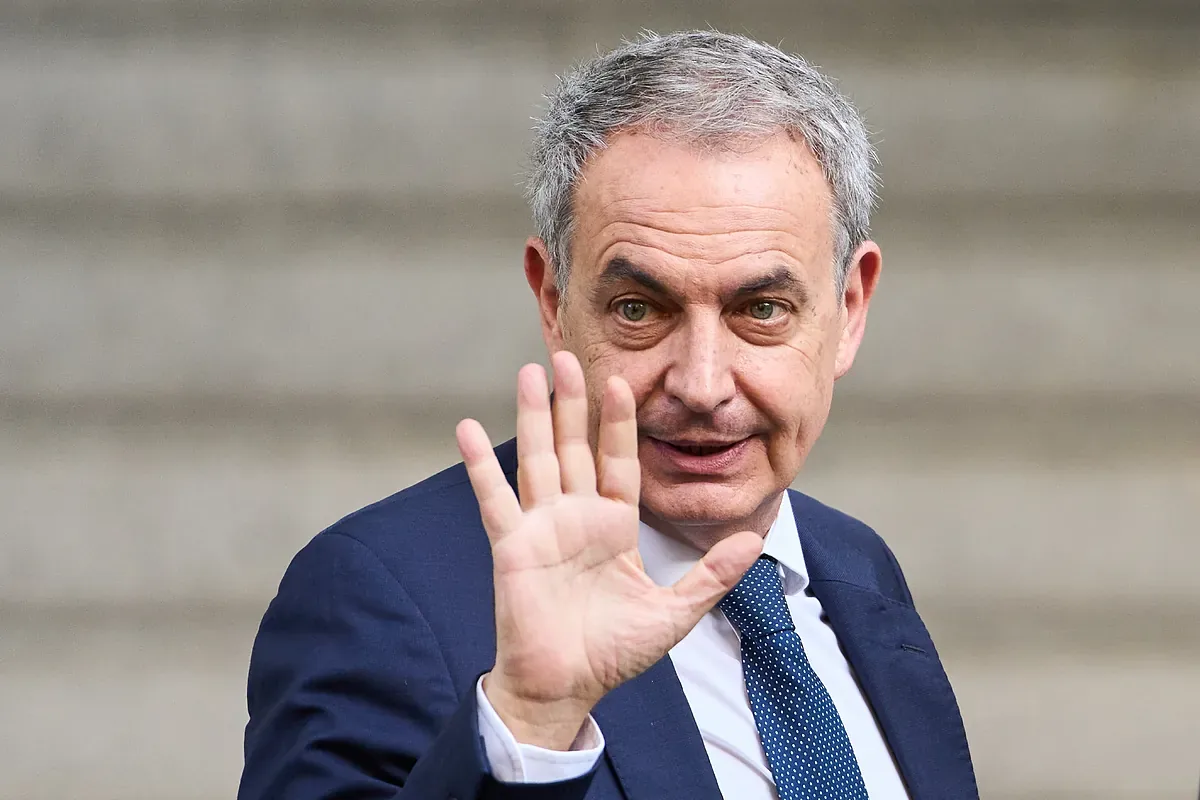
José Luis Rodríguez Zapatero has recounted in recent days that he has always had a hidden vocation as a journalist. He imagines himself in the shoes of one of the reporters covering his case and has a clear idea of the headline for the piece yet to be written, which he would gladly sign in another life for a national newspaper. From his house arrest, where he reads and rereads Jorge Luis Borges‘s text “Borges and I,” which explains that “it is to the other Borges that things happen,” and delves into World War II to distract himself, he says the days feel endless. He explains that it’s like his favorite author, who believes all this is a bad dream happening to someone else. Because the Zapatero who appears in court documents and opens the news broadcasts is a stranger. And so he lives day by day, “trying to free himself” from his new skin, moving from “the mythologies of the slum to games with time.”
He confesses that he has gone through moments where he saw everything lost, comforting himself by thinking that he has been “fortunate in life, which has treated him like a privileged person.” And others where he sees the process very clearly as the ‘X’ of who the authority he supposedly influenced to secure the rescue of Plus Ultra is not cleared. That’s how these summary proceedings are, his lawyer has told him, in whom he trusts “increasingly” and who calms his emotional carousel by indicating that this race for El Pardo is the longest of all. A marathon where you feel bad and then, without knowing why, you recover.
The investigative journalist Zapatero would have written a chronicle titled The Innocence of the Innocent, and based on that idea, he explains to his small circle of trust that everything that has happened to him in the case that keeps him as the first former president investigated in democracy is the result of his naivety. “A story based on innocence,” in short. An involuntary misfortune. A twist of fate.
As he explained in his TVE interview, which he has postponed at the last minute on several occasions because he didn’t feel strong enough, what’s wrong with a former president earning a living? What’s objectionable about setting up a consultancy? What’s criminal about asking Santander to lend a hand to a Plus Ultra he claimed not to know? Or what can be censored about accepting an empress’s trousseau, as Antonio Lucas would say, if it’s not going to have “use and destination” and “was just there”?
What’s negative about helping your daughters? Or opening doors for your close friend to enter Venezuela with direct access to Delcy and do business at the highest level? And, above all, what can be prosecutable in all this if, after all, everything was declared to the Treasury? Because, after all, he never had awareness of the crime. “How am I going to commit an illegality with my ID!” he has exclaimed countless times since EL MUNDO uncovered his hidden operations last January, when he saw himself stripped of his image as a disinterested mediator and that of a commission agent emerged.
He didn’t bat an eyelid when this newspaper informed him that it would publish the 1% commission contract and claimed, in February, to have no idea. He cheered up over the weekend, when Plus Ultra and Julito‘s circle, what nerve these informers have, told him he could sleep soundly. Until Borges came face to face with the other Borges. With the one who suffers a betrayal that if true he would never commit and if false would not leave him in peace with himself. And since then, “I live, I let myself live, so that the other can build his literature and that literature justifies him.” Because at this point, like the Argentine writer, Zapatero is “destined to be lost” and “only some instant of me can survive in the other.”