


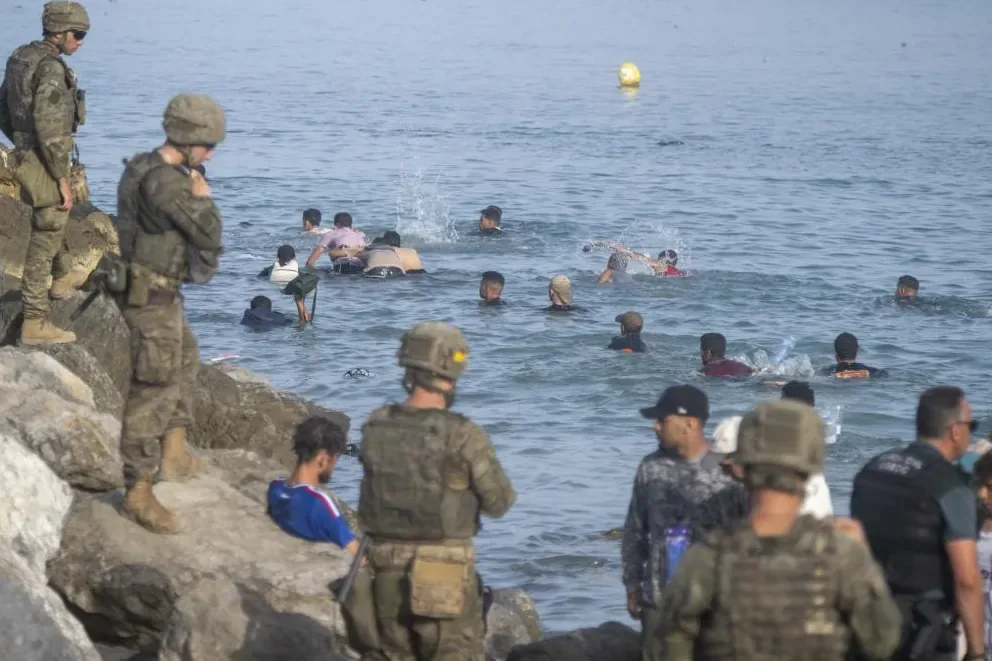
In a confined space, a riot is a threat similar to that of an army. The Baltic countries have known this for a few years. In 2021, just over 4,100 people were enough to put an entire country in a state of emergency. Lithuania, with less than three million inhabitants, had recorded only 81 irregular entries during the previous year; in July alone it received almost 2,900. Its reception system was so small that schools and military camps had to be converted into makeshift centers. The one in Rudninkai, built next to a village of about 480 neighbors, housed nearly 800 immigrants. The figure is far from the 72,000 entries recorded in Ceuta in less than 48 hours, almost as many as the city’s population, although it follows the same arithmetic: the arrival becomes unmanageable when concentrated in a tiny territory without the capacity to absorb it. The local population is left with a feeling of loss of control, and political management is subjected to a blackmail between solving a local problem or avoiding an international scandal.
The first lesson is that no one will have things clear if the government does not. “We must realize when the border becomes our vulnerability,” explains Margarita Seselgyte, Lithuanian political scientist and one of the most useful Baltic voices to talk about hybrid war. Indeed, what happened in 2021 was not a spontaneous wave either: the Baltic governments called it by its name and pointed to the author: the Belarusian dictator, Alexander Lukashenko, intended to punish the EU for the sanctions imposed after the electoral fraud and repression of 2020. His regime facilitated visas, multiplied flights from the Middle East, and allowed Belarusian agencies to sell packages promising easy access to Europe. Travelers were housed in Minsk, transported by buses to the border, and pushed towards Lithuania. Minsk denied having organized the operation and assured that the sanctions had left it with no reason to continue protecting the European border, although Lukashenko had publicly threatened to let immigrants pass. Rabat also denies having deliberately relaxed its controls in Ceuta and attributes what happened to rumors and mafias.
More than 4,100 people were enough to overwhelm Lithuania in 2021
Hybrid war is always a political challenge. Just as a foreign military intervention can change the government in the capital, the uncontrolled entry of people into a Baltic country of 2.8 million inhabitants could bring down the government coalition in Vilnius, known for its support of Ukraine and its denunciation of Belarusian abuses.
“If it is hybrid war, it is no longer peace, and another legal framework must be used and things called by their name,” says Seselgyte. When Lithuania began to reject newcomers, the pressure shifted to Latvia—a country of less than two million inhabitants—and to a handful of border crossings and villages in eastern Poland. “We used border rejections and that measure was criticized, but we had to apply measures for a special situation,” she recalls.
Poland, Lithuania, and Latvia declared states of emergency, deployed soldiers, restricted access for journalists and humanitarian organizations, and carried out pushbacks without individually examining asylum requests. Poland closed 183 border localities. Latvia authorized guards, police, and military to prevent crossings even by force. Lithuania turned irregular arrival into grounds for automatically confining immigrants and even extended that detention up to a year. There was no general exception for minors, but Latvia allowed five children and six adults to enter after a precautionary measure from the European Court of Human Rights.
Read more The black market for bets on Xi Jinping’s next purge
They authorized the military to prevent any crossing using force
That policy worked in the short term: it drastically reduced the number of people who managed to enter, although it also shifted the pressure from Lithuania to Latvia and Poland and left thousands trapped between two border devices. Pushbacks and fences contained the crossing, but the decisive move took place far from the border. At that time the EU negotiated with the countries of origin and transit to dismantle the air bridge created by Minsk.
Airlines cut routes and the EU sanctioned the operators involved. By December 2021, crossings had practically returned to their previous levels: the physical closure served to buy time, but it was diplomatic action on the logistics chain that dried up the arrival of new migrants.
The EU negotiated to dismantle the air bridge created by Minsk
The cost was considerable: the EU Court of Justice ruled that Lithuania could not deny access to asylum or detain a person solely for having entered irregularly; Polish courts declared several pushbacks illegal, and the most representative cases against Poland, Lithuania, and Latvia remain pending in Strasbourg.
The strategy eases but does not cease. Russia has since used induced mass migration to punish Finland for joining NATO. And in Latvia the flow continues, even using tunnels underground. But in the Baltic capitals there is a feeling that, although hybrid tricks are too cheap, unity is stronger.
Read more Trump evaluates the ideological loyalty of NATO allies to consider whether to cut troops