





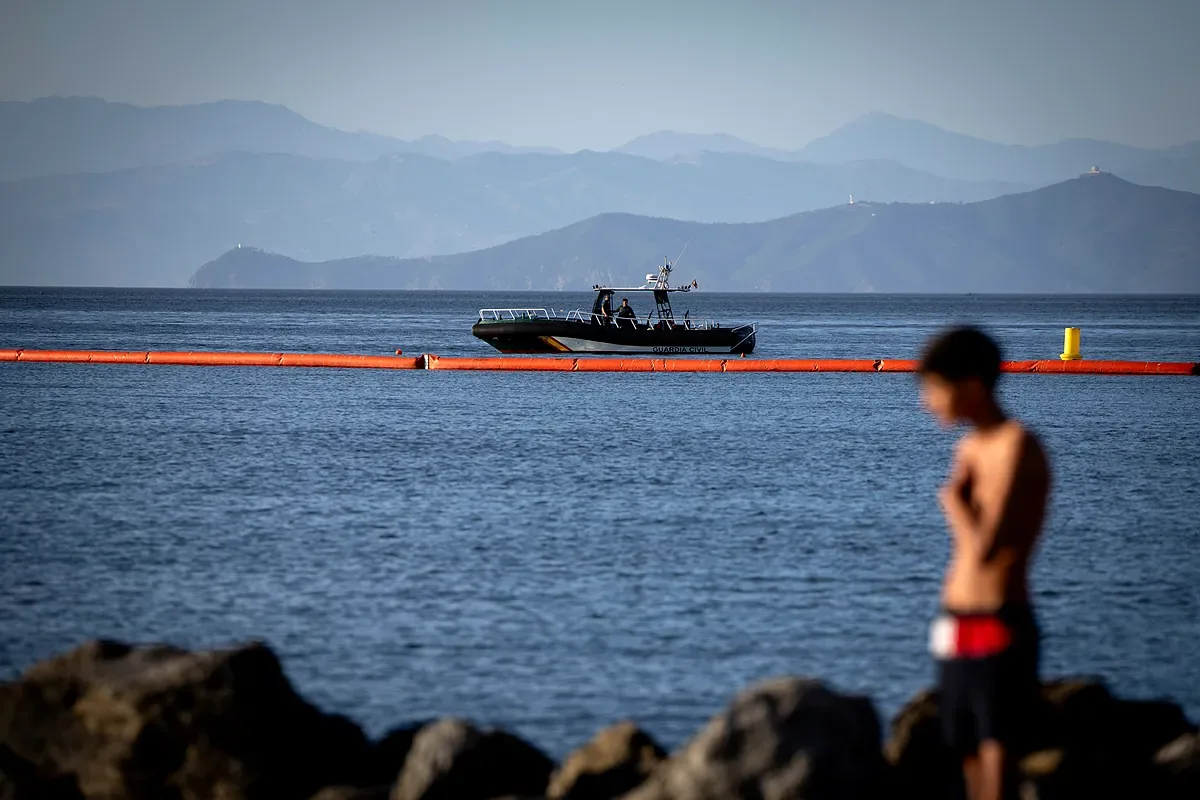
Aside from the spectacular Moroccan deployment, the Ceuta border yesterday had a barrier that did not exist during the massive assault at the end of July, and it was actually two: one physical and one legal. The first, the obstacle presented by the floating barrier installed by the Civil Guard in early August; the second, that by having to overcome it, the swimmer or diver automatically becomes a migrant liable to be returned to Morocco immediately, without further administrative procedures.
The presence of the obstacle means that the conditions are now met to apply to those who arrive irregularly in Ceuta by sea the tenth additional provision of the Immigration Law, which establishes a “special regime” for the two autonomous cities. “Foreigners detected at the border line of the territorial demarcation of Ceuta or Melilla while attempting to overcome the border containment elements to cross the border irregularly may be rejected in order to prevent their illegal entry into Spain,” the provision states.
In a ruling notified on July 8, the Supreme Court established that “the tenth additional provision of the Immigration Law cannot be applied to people who are intercepted at sea while attempting to enter Ceuta and Melilla by swimming; and therefore, these people should not be subject to the border rejection procedure, but to the return procedure.”
The reason given by the High Court was that those arriving by sea are not required to overcome any of the containment elements referred to in the Immigration Law. It specified that “such containment elements cannot be equated with technological border control devices – such as drones, thermal cameras, or sensors – which, in principle (and unless proven otherwise), do not perform a material containment function, but rather surveillance, detection, and alert, allowing the detection of people’s presence, but not physically preventing crossing the border line, nor detaining those who try.”
Read more PP and Vox already win in 38 provinces and dilute Sánchez’s bloc to rule in only eight
The ruling itself offered two solutions if the return at hot pursuit was also to be applied in these cases. The Government chose the fastest and simplest: to place a physical barrier. “Since the tenth additional provision refers to border containment elements and not exclusively to land containment elements nor specifically to fences, nothing would prevent that, if containment elements were established at sea to protect the border line, the said tenth additional provision could be applied to those attempting to cross the border irregularly by overcoming those maritime containment elements,” states the Supreme Court ruling, considered one of the elements that prompted the massive entry on July 30 and 31.
The other solution available to the Executive was slower and, above all, politically complex: reforming the additional provision of the Immigration Law, which, being an organic law, would have required political agreements to achieve an absolute majority.