


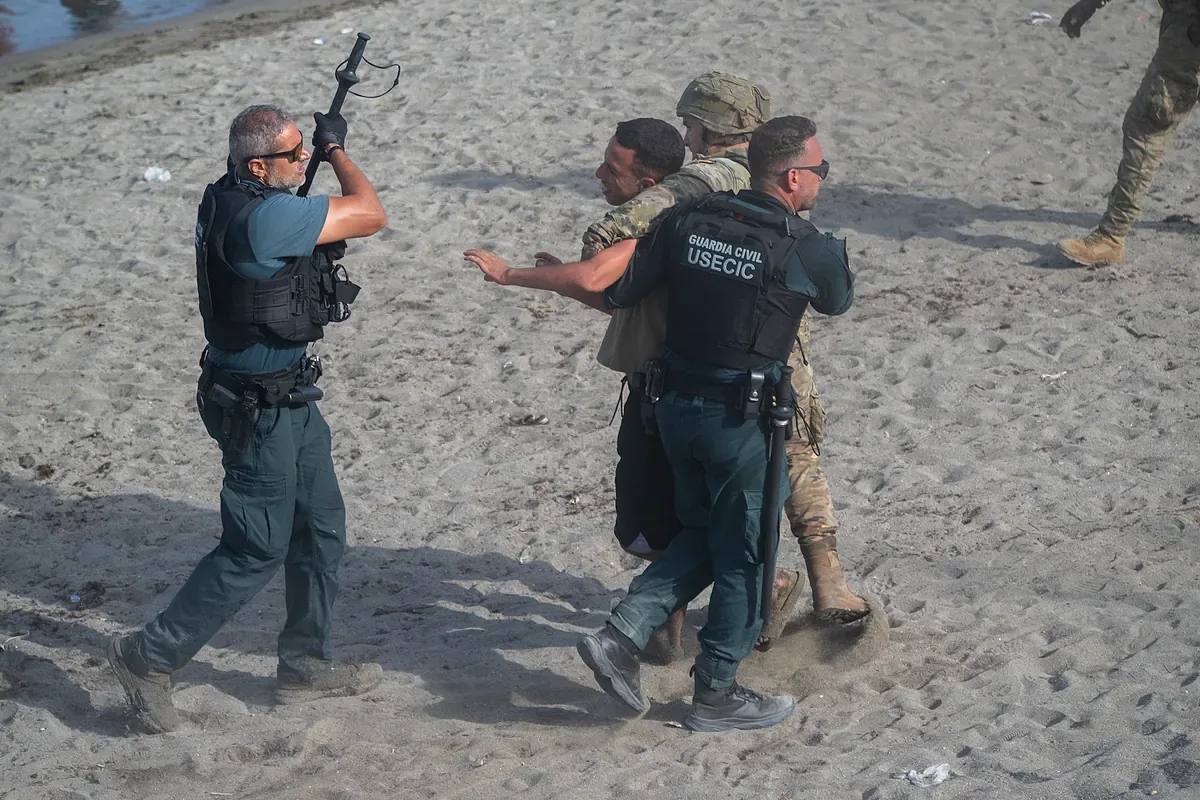
There is a point in Juan’s speech, after 20 years working as a civil guard in El Tarajal and with a voice, on the other end of the phone, that very well expresses the harshness of his job, that puts in black and white the strange, paradoxical limit in which life is lived on this border between the Third World and the first: “You have to try to prevent them from entering, you are there to maintain legality and legality is respecting the border, the limit… But, as soon as they have entered and you intercept them, your priority is to save their lives. You give them water, dry clothes, blankets, you call the Red Cross to treat them. The first thing is to protect them from the cold: they all arrive with hypothermia“.
Read more Fear in the Government of an increase in social tension due to the Ceuta crisis
On one side of the line, migrants must be contained. But, as soon as they manage to overcome that shield, they go from being adversaries – or elements to be contained in any case – to allies, and everything consists of protecting them: “It is like that, you have to prevent them from entering, but as soon as they enter what prevails is their protection”. In fact, at another point in the conversation, Juan emphasizes this: “You have saved a person’s life, and that is… Well, what it is to save someone’s life. A very serious thing”.
Perhaps that is the best feeling this border civil guard expresses in a chat with EL MUNDO. Perhaps the worst: “Frustration over what has happened? Well, it is more… It is seeing that we are useless when we are here, that our work is useless. That some enter and stay, others are returned and try again… And nothing changes. We bring no solution, what we do is useless. The solution can only be political so that these people do not do what they do”.
Juan (the name is not real), a little over 60 years old and who started working in El Tarajal, a post he requested – “and where I want to retire” -, about 20 years ago, felt the avalanche of July 30 and 31 “like a party”. Not his, obviously, but of the 80,000 Maghrebis and Sub-Saharans who crossed: “It is not the same when they cross violently, sometimes they throw urine or feces at you, and other times they have attacked colleagues with the hooks they use to jump the fence… Than what happened those days: for them it was like a party, they came happy… It is not the same”.
By sea, however, the funeral arrived: “I believe there were no deaths by crushing, I understand that all died by drowning [83 people on the Spanish side, the Armed Institute has certified]. In these cases, it is the crowding that somehow contributes to their death… Many do not know how to swim, and when you are drowning you grab onto whatever is closest, which there was another person…”.
Juan analyzes coldly, but as one who sees something happening in his own home, the scenes that shook the planet a little over a month ago: “Many people entered holding onto the stones of the breakwater, without having to swim, but many others entered far from the breakwater. Our boats were full, it was madness. If they come swimming from far away, yes they need special physical condition, but if they reach the breakwater, it is almost not necessary: they cross holding on”.
The guard has lived through the years, “until Covid”, when about “20,000 people and about 8,000 cars” crossed the border daily from Morocco and back to that country, in a kind of clandestine but allowed trade by the neighboring country: “They called it subsistence customs. Morocco did not control anything that entered because it assumed it was so that the population of Castillejos and those areas could live”. The pandemic closed the border “and from then on everything was controlled more“, when it reopened two years later.
When it started “there were many attempts to jump the fence, but fewer swimming than there are now, when there are many swimmers. The two days before July 30, 300 people came, it was clear that something could happen, but those of us who are there on the ground are sometimes the ones with the least information“.
Read more A third of Ceuta’s inhabitants have thought about leaving since the beginning of the crisis
Do you feel abandoned, alone in the face of danger? “It is true that many things are missing: better material means, more people working on a serious containment protocol… Much is missing for that to be done well, and it is all political will”.
When asked if Morocco is the one who really controls the border, he answers with another question, dryly: “Isn’t it clear, after what has happened?”.
But, returning to that two-faced condition – guardian of the border but savior if the migrant crosses it -, Juan tells how they have been asking for years to be able to match the DNA of the drowned in El Tarajal with that of the relatives who are looking for them: “Those who die and whose identity is not known are buried with a number, nothing more but photos, fingerprints and DNA samples are taken, and there are NGOs that come many times looking for them, with their relatives by the arm. We have been trying for years to be able to match that DNA, but the Foreign Ministries of Spain and Morocco have not agreed“.
Do you put yourself in the place of the migrants you have to repel and, moments later, care for? “Let’s see, emigrating to get a better life is very legitimate. My mother emigrated, in the 50s, to Germany. My son has emigrated to France. But it can be done legally. Every year thousands of Moroccans go to Huelva, with a work permit, to pick strawberries, and then return. It can be organized, and it should be done”.
Juan admits that it “frustrates” him that his work is useless, “but I put it aside”, he adds. On the day in question “the deployment was the normal one every day, no more no less. Then, when it started to get out of hand, reinforcements were brought, but before nothing“.
It is not that he has Muslim friends in Ceuta, “it is that I have lived in blocks where everyone was Muslim, and I work every day with many guards and police who are, and I hang out after work in the small, white bar next to the border, with many who are Muslim, and there we share everything… But it is that this is not about“, he adds, “Muslims or not [45% of Ceuta’s population is Muslim], but about putting the means so that people do not do what they do, and put themselves in danger as they do. And only politics can fix that“, he concludes.