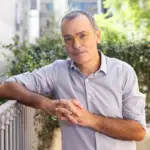


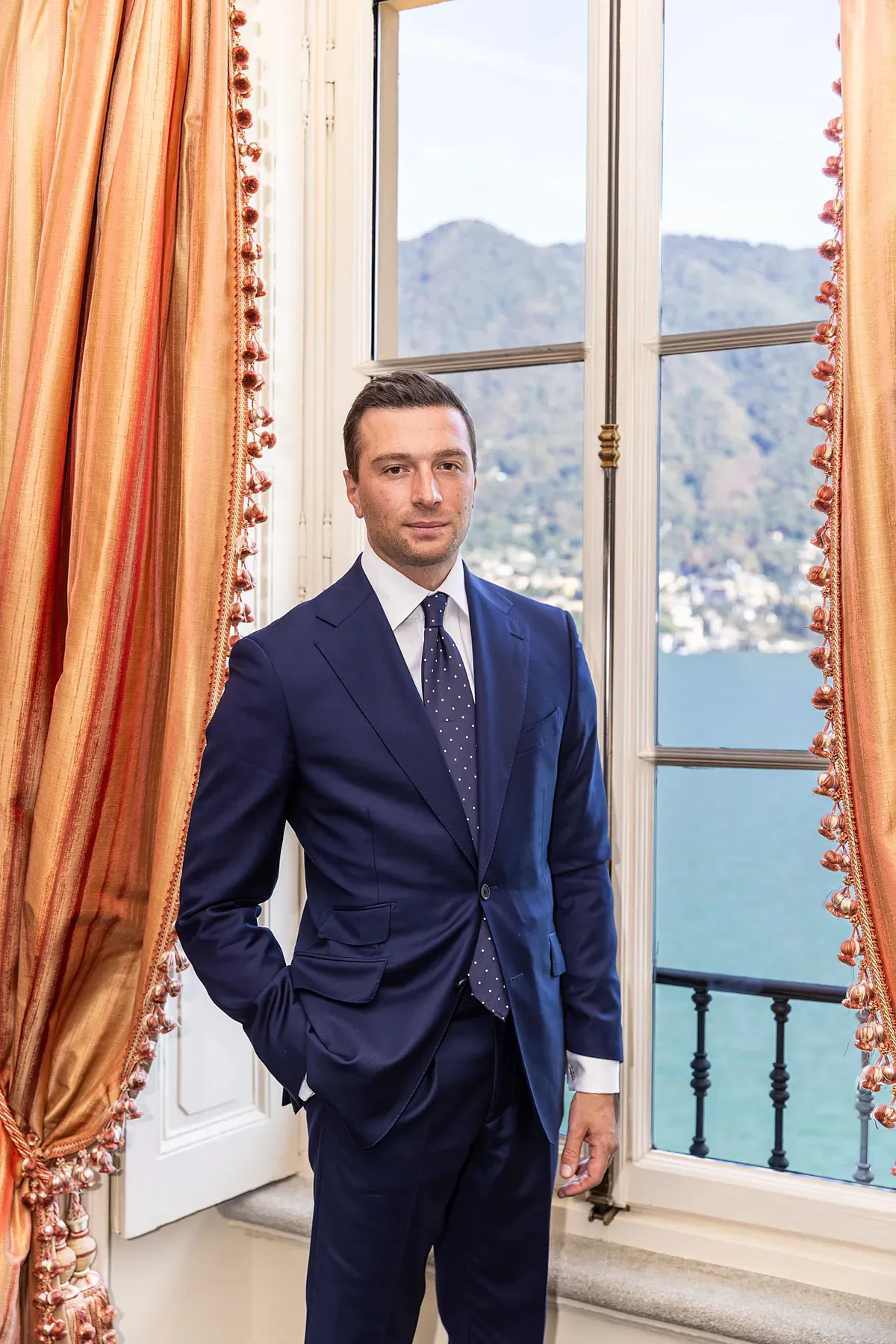
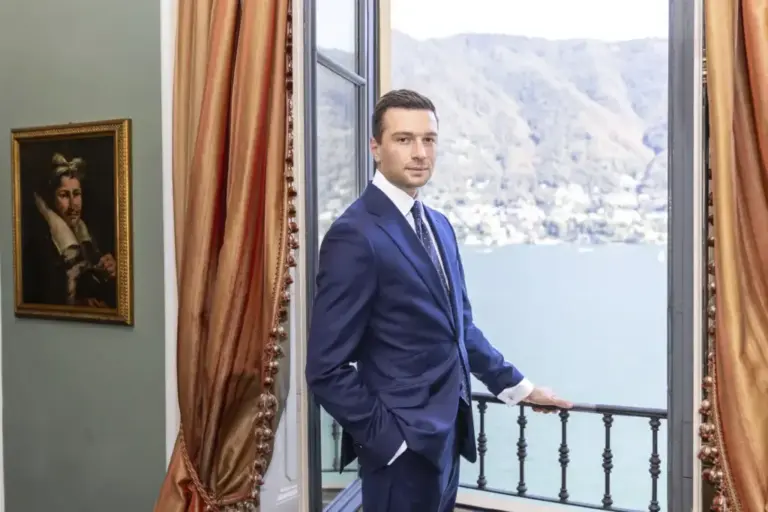
Jordan Bardella (Drancy, 1995) is the young phenomenon of French politics since he led the National Rally to an extraordinary result in the legislative elections. He is now preparing to govern France in 2027 as prime minister: the candidacy for the Presidency of the Republic is reserved for Marine Le Pen since the Justice lifted the veto against her. In this interview with EL MUNDO, he advocates for a right-wing alliance and warns, in the face of the “invasion” of Ceuta, that there are States that use immigration as a “blackmail weapon” and calls to “examine the responsibility” of Morocco.
Read more A third of Ceuta’s inhabitants have thought about leaving since the beginning of the crisis
- He said here: “In Europe, I want to change everything without breaking anything.” What would it mean for the European Union if the National Rally governed France?
- France has long ceased to defend its interests on the European stage, despite being one of the countries that contribute the most to the Union’s budget. Today the EU no longer creates the conditions for the power of the continent and European nations, but rather those of its weakening and economic decline. We are, indeed, in favor of changing everything without destroying anything; that is, changing the functioning of the EU from within, allowing our nations to recover certain sovereignties: for example, control over energy prices; the possibility to control our borders, or to simplify the rules applied to companies. And we are committed against the Green Pact, which creates the conditions for a pact of decline for European industry and agriculture.
- You are here convincing investors and international leaders that the National Rally has economic credibility to govern France. What concrete guarantees must your party offer to earn that trust?
- First of all, we will apply a golden rule that will enshrine in the French Constitution the medium-term prohibition of presenting completely unbalanced budgets that weaken our economy. It will be supported by a plan to reduce unproductive public spending by 125 billion and will be accompanied by tax cuts to reactivate growth. We believe that to heal the French economy, it is not enough to reduce public spending: a major competitiveness shock is needed to allow France to regain its independence and power. And this economic policy will rely above all on fewer regulations, lower taxes on production, and an extremely competitive energy price to boost industry, but also the deployment of artificial intelligence.
- Giorgia Meloni has shown that a nationalist right-wing party can come to power, calm the markets, and cooperate with Brussels. Is Giorgia Meloni your main political reference in Europe today?
- Giorgia Meloni is a source of inspiration in an essential aspect: she has shown that a patriotic movement can come to power, calm economic agents, and govern with stability. But I do not want to be a copy of Giorgia Meloni. I want to build a French model, adapted to the history and interests of France. Stability is the key idea. I believe the best economic policy is, above all, the one that creates long-term stability and predictability. And that has precisely been the position of Giorgia Meloni’s government, which to date is the longest-lasting in all of Italian political history. Italy’s approach to the European Union is somewhat different from ours, because France is one of the largest net contributors to the Union’s budget: we provide more public funds than we receive. That political reality should give us an advantage in negotiations and allow France to better defend its interests. And the message that will be sent if we win the elections with Marine Le Pen and I am head of government will be that France has returned to Europe.
- But how can a powerful Europe, a more integrated single market, and a common defense be built without sharing more political power?
- I reject the false dilemma between a powerless Europe and a federal Europe. We need a stronger Europe vis-à-vis the United States, China, or Russia, but that strength must arise from cooperation between nations, not from the disappearance of nations. I am in favor of a Europe based on growth and also on protecting our borders. The deeper the European Union has gone, the weaker it has become. And every time it arrogates new competences or intervenes in something, it usually ends very badly. That is what happened with agriculture: it ended badly for French agriculture. And also with immigration: since the 2015 refugee crisis, we have received a massive influx of hundreds of thousands of people. We need Europe to listen to the will of the peoples, respect the identity of nations, and abandon a commercial naivety that enormously weakens us against great powers like the United States and China. Europe’s destiny is not to be an economic vassal of the United States nor an industrial colony of China; on the contrary, it must be able to work united on the great projects of the 21st century, such as space or artificial intelligence.
- Europe today has three major right-wing political families. Is your goal that one day they form a common majority?
- It already is. Since the 2024 European elections, we have been working on a new balance within the European Parliament, where the united right acts jointly and the patriots are decisive. We voted together on a very important resolution, also promoted in our group by the work of Vox MEPs, condemning the Venezuelan regime. Since then, we have named that coalition of right-wing and patriots the “Venezuela formation.” We repeated that same majority a few months ago against the Green Pact, with the Omnibus directive, and a few weeks ago with the Return Regulation, which approved, for the first time in the Union’s history, one of the toughest rules against illegal immigration. We will continue working hand in hand for the interest of our countries and our nations. I am glad that we have managed to pull part of the EPP away from the influence that the left had exercised over that party for years. And I am glad to work in the Patriots group alongside Santiago Abascal’s MEPs, who is a great Spanish patriot and whom I hope will one day lead his country.
- AfD could achieve a historic victory today. Marine Le Pen broke with that party after statements by one of its leaders sympathizing with the Nazis. Can AfD become a legitimate democratic ally again?
- The positions of part of AfD led us to a political break. We have a strategy and sometimes fundamentally different convictions. But the vote of the citizens must be respected. I do not know what result will come out of those elections, but it is certain that the pressure exerted by AfD is causing in Germany an awareness of the problem represented by massive and disorderly immigration, to the point of forcing the Merz government to reinstate border controls. I think that anger and that vote expressed by the German people must also be heard.
- You initially welcomed Donald Trump’s return, but later criticized European “vassalage” to the US. Do you think Trump is still a model for the European right or has he also become a problem for Europe?
- No, neither one nor the other. It must be understood that Donald Trump defends the interests of the United States and that he must face European nations that also defend and protect their interests. We are entering an era that only respects power relations and deeply despises naivety. Those who are naive or reject the very idea of sovereignty and independence will be crushed in the coming era. A great power can be at the same time a partner, friend, and competitor. The US will continue to be a friend country of France, but we do not need a model. And I deeply regret that the US president has been inconsiderate and chosen to reprimand Giorgia Meloni.
- You said Europe cannot finance the war in Ukraine forever and that a ceasefire with Russia must be sought. What would be an acceptable price for peace?
- It is necessary that the Western family first agrees around a table to come united to the negotiation with President Putin. Ukraine needs security guarantees and we have proposed the deployment of a gray zone and United Nations soldiers, blue helmets at the border, to guarantee peace and allow Ukraine to keep its territorial sovereignty. But this war has caused hundreds of thousands of victims. The priority must be peace, peace, and peace. I find it irresponsible to continue proposing and sending money we no longer have without linking it to guarantees. And the Americans at least had the foresight to guarantee that money through a counterpart: the exploitation of Ukraine’s rare earths.
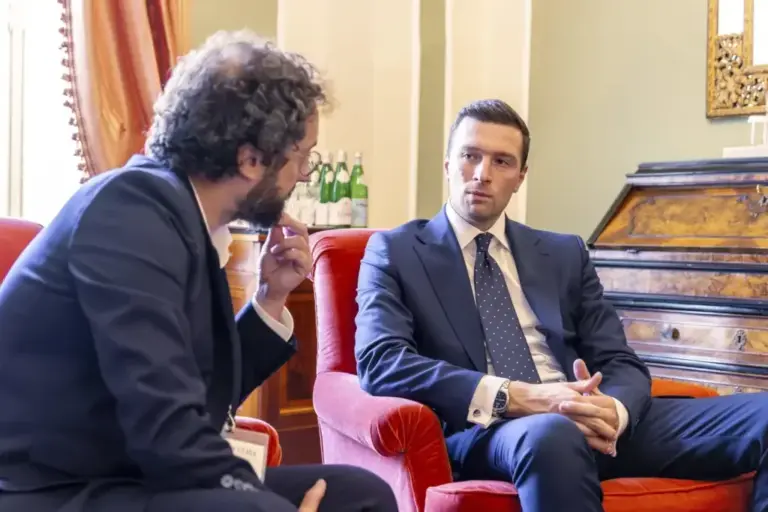
- You describe immigration as an “existential threat” to France. But you yourself come from an immigrant family, partly of Algerian origin. Where do you draw the line between immigration that helped build France and the “existential threat”?
- I belong to a generation from immigration that, when it arrived in France, did everything possible to become fully French, participate in the nation and national culture, embrace the country’s values, starting with the language, and work. Today, however, many people arriving in Europe and France are exempted from that effort. That situation is unsustainable. We receive hundreds of thousands of people every year, of whom only 10% have a work contract, and there are 900,000 foreigners in irregular situations on French territory. The migration situation is out of control today. I believe it constitutes a huge challenge for Europe because it unbalances the foundations of our society: security, peaceful coexistence, and obviously, our culture and identity. If we come to power, we will organize a referendum on immigration with a constitutional dimension, reaffirming the primacy of French law over European law in migration matters. And we also need Frontex to do what it was created for: protect European borders, and be authorized to carry out hot returns.
- When the Ceuta border was stormed, you warned that those images summarized “the future of Europe,” but the most serious possibility is that it was not simply a migration crisis, but a hybrid attack against a European border. Do you share that diagnosis?
- Above all, I was deeply impressed, like many people, starting with the Spanish people, by the terrible images of Ceuta, which show the complete flooding of a border of a European Union country and the pressure exerted on one of the entry gates to a Union country. Those images will be the future of Europe if we do not regain control right now. Immigration is barely at the beginning of the beginning. The first border is precisely at Europe’s gates: in Lampedusa, on the Spanish coasts, between Greece and Turkey, between Belarus and Poland. Tomorrow we will have to protect Europe’s gates with very clear means and finance walls, something we achieved in the European Parliament a few months ago. It is the only possibility to protect ourselves from migratory flows. And we also need cooperation with the countries of origin and, in this case, with Morocco.
- What role do you think Morocco is playing in this crisis? The Spanish Police considers it decisive.
- The responsibility of the Moroccan authorities must be examined. I saw it a few months ago between Poland and Belarus. Immigration is used as a diplomatic blackmail weapon by States that want to destabilize European societies or appropriate European territories. Therefore, good immigration control will require, above all, sometimes very firm talks with the countries of origin.
- You also attributed direct responsibility to Pedro Sánchez and even called for suspending Spain from the Schengen area, as Giorgia Meloni did. If you had then led the French government, what would you have done?
- The same. That the socialist government applies a policy favorable to immigration and massively regularizes tens of thousands of illegal immigrants is its right, and it must only be accountable to Spanish voters. But we, given the proximity of our borders, do not want Spain to be a gateway for illegal immigration to France. If tomorrow we lead the French state, we will push for a reform of the Schengen area in Europe so that free movement becomes a European project again; that is, so that it is reserved exclusively for nationals of Union countries. Specifically: someone (a Syrian, for example) who obtained a residence permit in Spain could not move freely through all Union countries. This reform is very important and I am convinced we can achieve it.
- From Ceuta, immigrants cannot travel freely to the Peninsula.
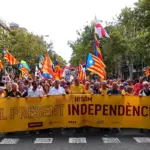
- Technically. But that is the world of cartoons. In real life, first, Spain massively regularizes and, from the moment you set foot in Spain and obtain a residence permit, or even without obtaining it, you can move throughout the EU. This situation is not normal. And when, in a territory of 84,000 inhabitants, there are 70,000 immigrants, that is no longer a border crossing: it is a migratory invasion.
- If the PP and Vox add up to a majority in the next elections in Spain, what role should Santiago Abascal play?
- That is for him to say. But Vox today embodies a great hope for the Spanish people. It is the only political movement capable, at the same time, of protecting the identity of the Spanish people, defending the sovereignty and territorial unity of Spain, and defending the Spanish people. Vox progresses because all other Spanish parties have failed. I feel great respect, friendship, and consideration for Santiago Abascal, who is a tireless political fighter. And I hope that one day it will not be Vox that has to stand alongside the PP, but the PP alongside Vox.
- Marine Le Pen has taken the former National Front to the gates of power. Is Jordan Bardella’s mission to continue lepenism or transform it into a different and broader right-wing movement?
- My ambition is for the National Rally to become the common home of all who love France and do not want to see it disappear. It must be able to reach out to the orphans of the right and to those who no longer recognize themselves in The Republicans. It is about bringing together the working classes, the middle classes, the business elite, and all those who want France to recover. In this presidential election, we will be the voice and the party of those who believe that France still has a destiny, an identity, ways of life, traditions, and know-how that we must defend and project. And, as I said before, I know that a victory in France would obviously have consequences for all of Europe.
- You have stated that you will be prime minister, but you also admit that Marine Le Pen has sensitivities that differ from yours. On what important political issues do you think differently from her today?
- Marine Le Pen and I have the immense privilege of both carrying on our shoulders the trust of millions of French people. It is the translation of the last elections. We have different trajectories. We are not the same age. In the game of seven differences, differences can always be found. But we are united by love for our country and by the will to offer the French the rebirth they expect. Between us there is political and personal affection, and we are dominated by the feeling that France is at risk of disappearing. That feeling erases any nuance or difference in sensitivity.
- Will we see Jordan Bardella as president of the Republic one day? Do you maintain that ambition?
- That is not for me to decide. First, I will try to lead my party to victory and, I hope, be the next prime minister of my country; to have, in any case, the privilege and honor of serving the French and showing them that things can be done differently.