





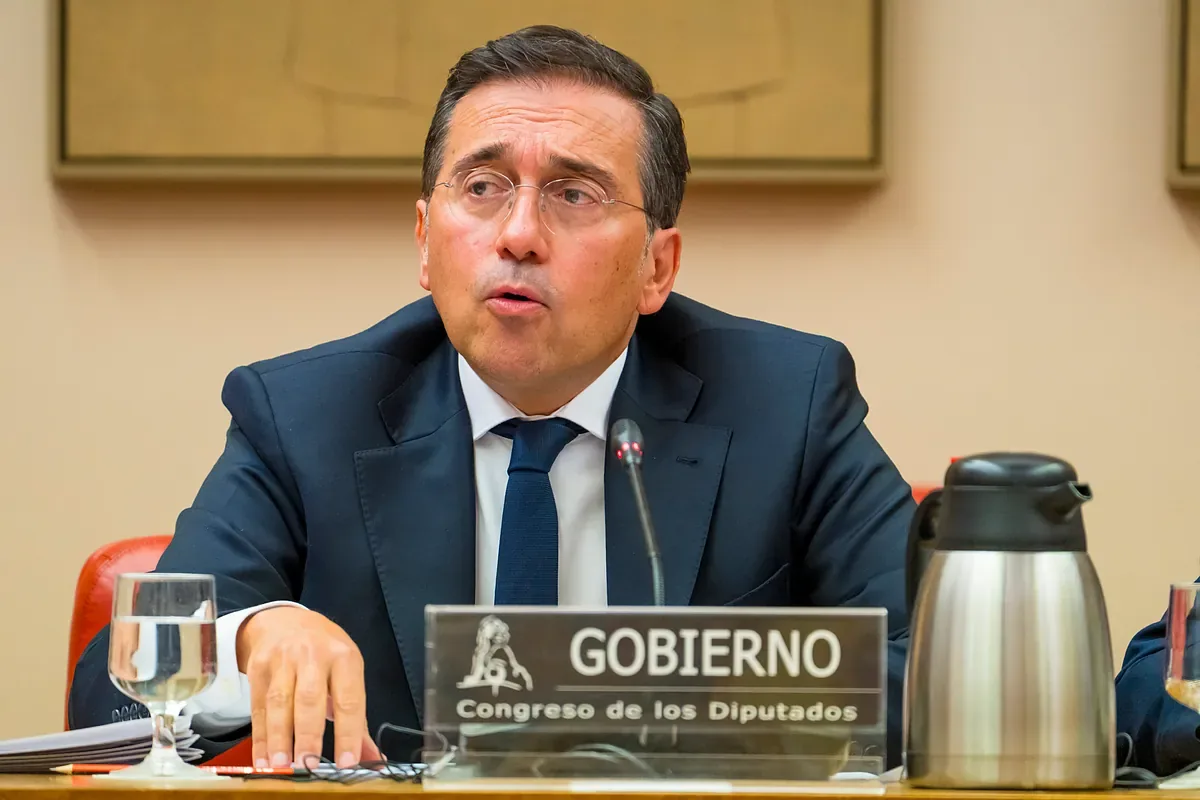
Foreign Minister José Manuel Albares absolves Morocco of any responsibility for the massive entry of about 80,000 immigrants into Ceuta and places all the blame for the crisis on the “unprecedented viral spread of lies and hoaxes” on social media, which would be the sole cause of the episode that occurred on July 30 in the autonomous city.
The Government insists, therefore, on the exculpatory narrative of Morocco before Congress despite the fact that even part of Sumar and its parliamentary partners are reproaching it for maintaining a position of “weakness” by not “calling things by their name”.
Far from going down that path, Albares’ extraordinary appearance before the Foreign Affairs Committee of Congress has praised Morocco’s cooperation and its “essential” role in “stopping the crisis” and “preventing a similar situation in the future”.
Thus, he emphasized that as a result of dialogue between countries it was possible to “facilitate” the return of 90% of the immigrants who entered on July 30 in less than 48 hours and now to “manage” the return of those who still remain in the city. It also prevented another massive entry on August 15 in Ceuta despite calls on social media to repeat it.
For all these reasons, Albares stressed that “diplomatic dialogue” with Morocco “is indispensable, since it is our neighbor on the other side of the Ceuta and Melilla border, in situations like this, where the response necessarily involves diplomacy.” This statement comes at a time when political groups are calling for a review of diplomatic relations with Morocco, something the minister does not consider at all.
So was there a hybrid attack by Morocco? Albares has not even uttered those words nor hinted that Rabat could be behind it. On the contrary, not the slightest reproach, only praise for its help.
In this way, the Foreign Minister has placed all the blame on the viral spread of “lies and hoaxes” through social media about the consequences of a Supreme Court ruling regarding entries by sea. “The misinformation on social media was the immediate trigger of this crisis by distorting a Supreme Court ruling and was also the vehicle that led thousands of people to rush into Ceuta with false news,” he explained. “As in other critical moments in other parts of the world, platforms have been the inflammable channel through which lies have spread on a global scale and at an unprecedented speed.”
In a chronological review, Albares provided data on that viral spread. How the video of two young women swimming across gained significant viral attention on July 28. This led Moroccan press and influencers to echo and multiply the dissemination until it unleashed an impact of 30 million people, especially in Morocco. This caused the hoax that the borders were open and that those entering by sea would not be expelled to spread “explosively” between July 28 and 30. In this entire account of events, Albares did not mention that Morocco could have intervened in any way to spread those “false news”.
Although Albares has presented relations with Morocco as good and cooperative, the minister wanted to send a message to Rabat regarding its imperialist impulses by making “very clear” that Spain’s territorial integrity and Spanish sovereignty over Ceuta and Melilla are not up for discussion. “There has been, is, and will never be any kind of conversation about this,” he concluded.
Ceuta and Melilla, he emphasized, “are Spain and the European Union” and are “part of our territorial integrity and our sovereignty.” “But above all,” he continued, “all Ceutans and all Melillans, regardless of their origin, the faith they profess, and their background, are Spanish and European not only by law but by heart and soul, and it will always be so.”


