



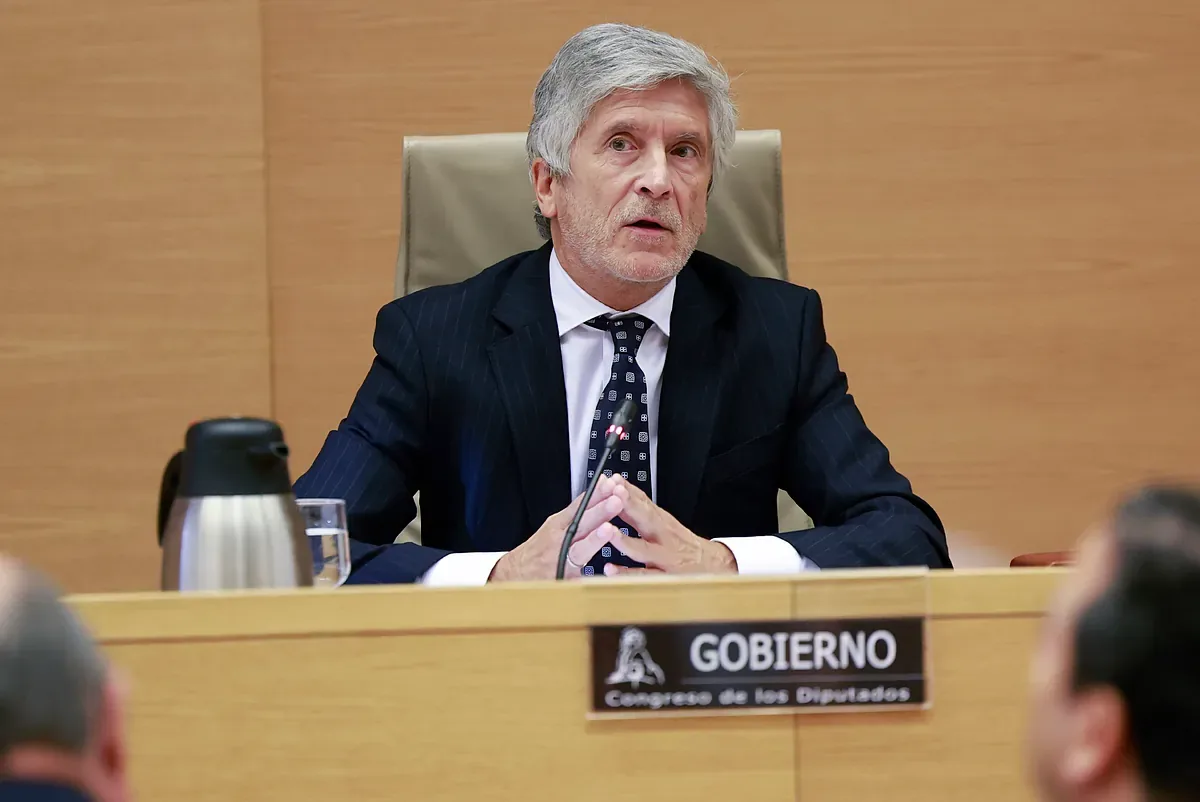
Fernando Grande-Marlaska lowered this Friday to 72,000 the “most reasonable estimate” of the number of people who crossed the Ceuta border between July 30 and 31, a figure that on August 10 the Government had estimated at 80,000, of which the majority “returned voluntarily to Morocco in just 24 hours.” According to the Interior Minister, there are 5,000 irregular immigrants remaining in the autonomous city and 1,500 minors, another figure that has been lowered from the previous estimate of 2,900 unaccompanied children and adolescents.
Additionally, the Interior Minister has implicitly accused the PP and Vox of “seeking political gain or, worse, inciting hatred and confrontation among people in the streets” following the incidents of recent days. “I call for calm and an end to any kind of violence because you are as aware as I am that violence is by no means the way to solve any problem,” he emphasized during his appearance in Congress.
Marlaska has also maintained the line of avoiding any hint of reproach to Morocco in this unprecedented crisis, highlighting that he is “in contact” with his counterpart and that the police authorities of both countries “work jointly in the fight against irregular migration and human trafficking.” In this regard, he highlighted that the Alawite kingdom “has intercepted thousands of irregular maritime departures towards the Spanish coasts” and that in the last year arrivals by small boats have decreased by 30%.
Border reinforcement
The Government assumes that it must “draw lessons” from this crisis and one of the main consequences is that a better reinforcement of the borders of Ceuta and Melilla will be undertaken to “prevent and face possible similar episodes in the future.” An investment of 35.5 million euros will be made, which will be financed 90% with money from the European Union.
Marlaska has announced that the Ministry of the Interior “is already working” on the implementation of “structural measures”, which will involve “strengthening human and material capacities, improving and expanding strategic infrastructures, and deploying surveillance and containment systems.”
In the specific case of Ceuta, the Tarajal and Benzú breakwaters will be extended and a permanent maritime containment system will be installed using anchored buoys. Concrete measures aimed at addressing the phenomenon of swimmers and those seeking entry through the sea. A new temporary foreigner reception center with a “permanent character” will also be built in the autonomous city to accommodate up to 800 people. For Marlaska, this “will improve response capacity and ensure adequate, orderly, and effective care.”
In Ceuta and Melilla, technological capabilities will be improved to reinforce border surveillance and protection, including light intervention boats, remote underwater action devices, and an aerial surveillance system with unmanned aircraft (drones).
The Interior Ministry has already initiated procedures with the European Union to cover 32 of the 35.5 million euros that will need to be invested. Marlaska specified that it will come from the European Union Emergency Action within the framework of the instruments it has to support border management.
Additionally, the minister argued that after the notification of the Supreme Court ruling confirming the impossibility of carrying out hot returns to those entering Spanish territory by swimming without crossing any barrier, the presence of the Civil Guard was reinforced with 70 personnel in anticipation of a “hypothetical increase” in irregular arrivals by this route. After the events of July 30, another 250 members of the Armed Institute and 300 national police officers were deployed, reaching a total staff of 1,600 personnel.
Read more Raphinha and Fermín dress as ‘9’ to beat an Athletic that clung to Unai Simón