



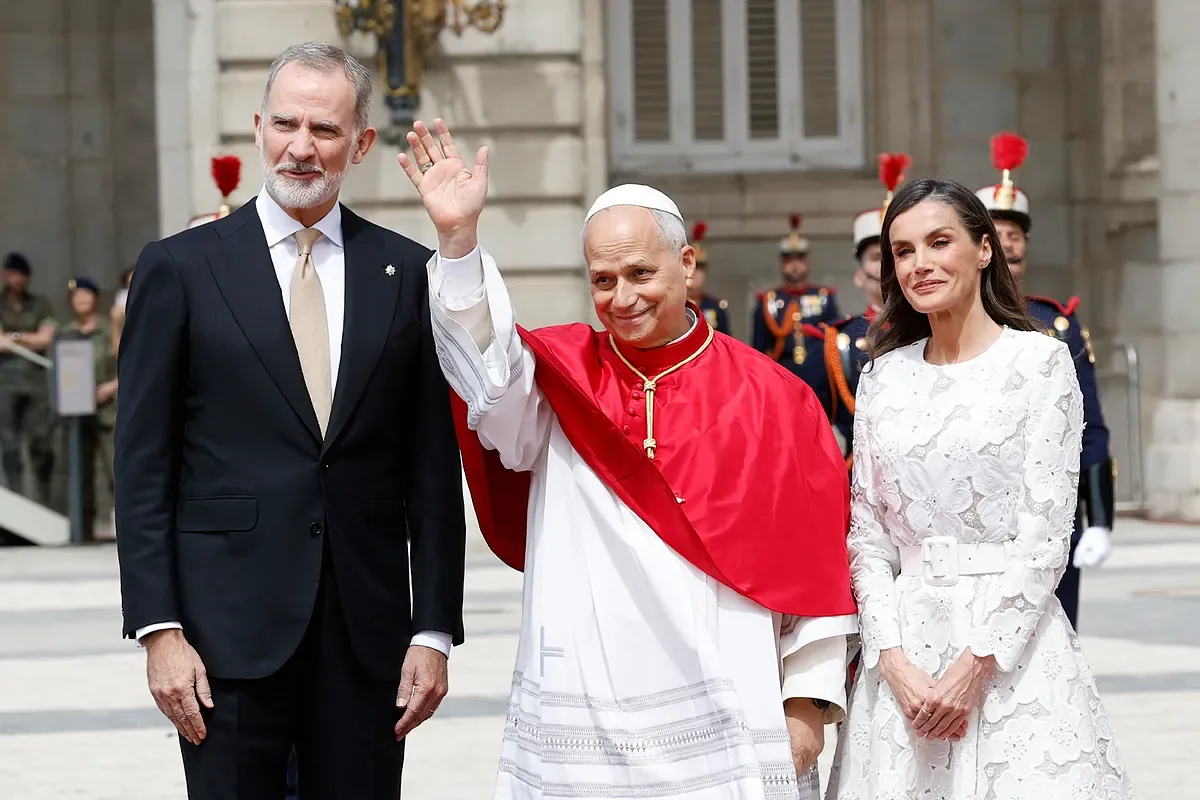
“It is not the culture of confrontation, but that of encounter, that generates stability.” Pope Leo XIV was barely a paragraph into his first speech in Spain when he uttered one of the most forceful phrases, intending to make the powers of the State, gathered in the Hall of Columns of the Royal Palace, reflect – to welcome His Holiness on his visit to the country.
The Holy Father began his official visit to Spain, which will last eight days, in the emblematic building. The Pope delivered a forceful address, with a strong political charge and without omitting any of the issues occupying national current affairs. In moments of maximum tension and before 250 guests, including the Powers of the State and the diplomatic corps accredited in the country, Leo XIV recalled that he brings a “message of peace that finds welcome in those who do not enclose themselves in prefabricated ideologies” and later returned to this idea by insisting that “the temptation to gain popularity by fanning the flames of polarization seems to grow: human dignity continues to be violated.” Thus, he called for “protecting religious freedom and freedom of conscience.” And recalling Saint John of the Cross and his night of darkness, he affirmed: “Men and women are needed who intuit light in the darkness,” because, he recalled: “Our era cries out for peace in its deepest core.”
But the Pope also wanted to leave a note of hope and optimism amidst this moment of political and geostrategic uncertainty that Europe is experiencing, stating that the old continent can offer a gift to the world to “stay young”: “Abandon polarizing narratives“. Furthermore, he expressed his gratitude to the country: “For your fidelity to the international order and multilateralism, which translates into an active commitment to peace.” Because Leo XIV knows Spain, a country where he has spent seasons. That is why he also wanted to make nods to popular culture – “A people full of passion who love life and show it” – and recalling four Spanish saints: Santiago, Saint John of the Cross, Saint Ignatius of Loyola, and Saint Teresa of Ávila.
With a “May God bless Spain!” the Pope closed his speech at the Royal Palace and thus the ceremony ended. For the first time, the King spoke before his guest. The Monarch delivered an address in line with that of the Holy Father. This is not surprising, as the King has on numerous occasions advocated for the need to ensure the “common good” or to place the citizen at the center. “The Catholic faith is rooted in our country and without it, our history and our culture would not be understood,” recalled the Monarch, who holds the historical title of Catholic King.
Although the King wanted to “highlight the enormous social work of the Catholic Church” and confessed a “special admiration for the thousands of missionaries,” he also did not overlook the shadow of sexual abuse within the Curia, an issue that the Pope addressed during the flight. “There can be no greater contrast with everything [the Church does] than the pain caused by cases of abuse, which are not and cannot be representative of the immense ecclesial community,” emphasized Don Felipe. In this regard, the Head of State wanted to acknowledge the “clarity and firmness” of the Holy Father on this issue, values “essential in the healing process and reparation of the inflicted harm.”
The King defined the Holy Father as “a man of spirit and science, with a great social conscience and a deep attention to change.” A way of being that, he affirmed, “takes on special value in the time we live in, a time that can no longer be explained in the terms we were accustomed to and which we continue to try to interpret.”
Therefore, Don Felipe, who on multiple occasions warns of the crisis of the international order, wanted to warn of the risk we run of “forgetting what truly matters, of sliding towards the mistaken belief that anything goes, everything is admissible, negotiable, justifiable. And it is not so,” he asserted, to remind us that “the dignity of the person, human rights, democratic values, and international legality must continue to be our prime numbers.” Making a nod to the Holy Father’s mathematical vocation, he affirmed that therein lies “the arithmetic of freedom, equality, and justice: the one that adds and multiplies, not the one that subtracts and divides.”
The King has embraced the Holy Father’s encyclical, Magnífica Humanitas, and recalled that “the person must be kept at the center of any discourse, never replaced, subjugated, or coerced by any algorithm.” Thus, he insisted that “when attention is on the other, on the one in front of us, we can identify with their pain.”