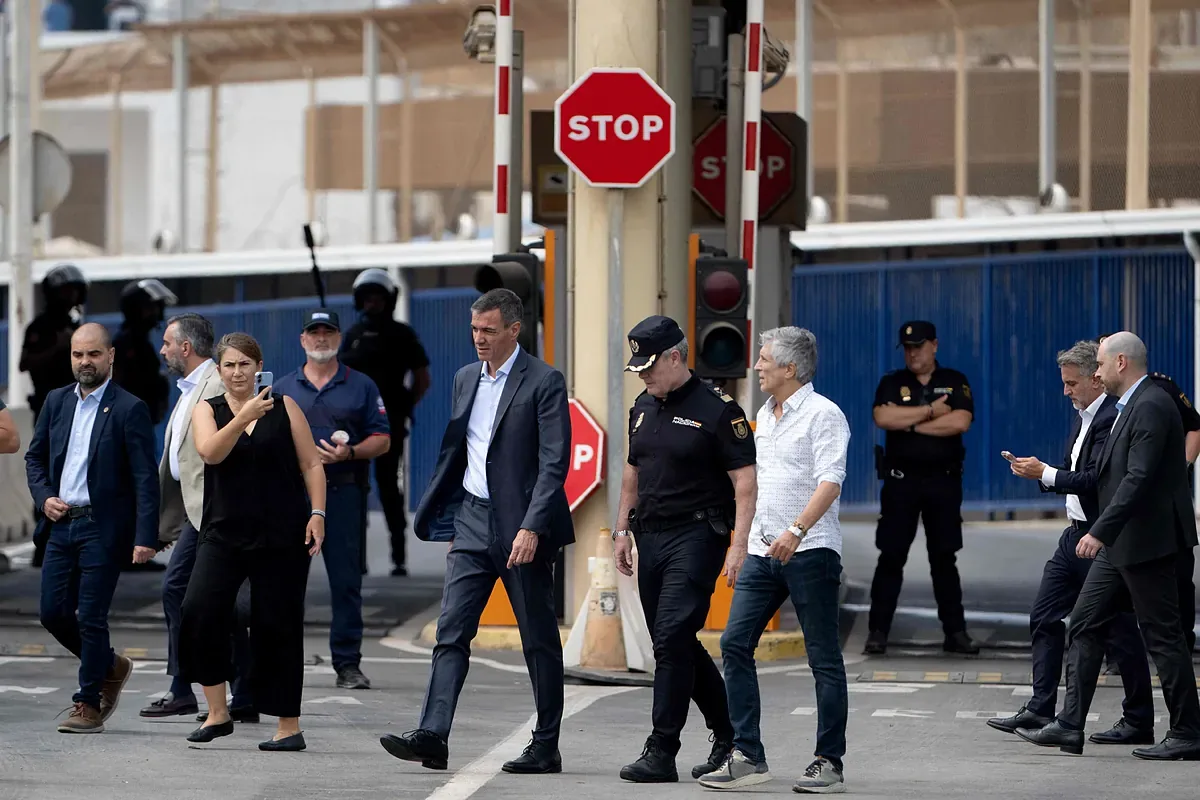





The Minister of the Interior has insisted that he did not receive any “report, warning, or communication” about the massive arrival of foreigners to Ceuta, whose number the Government has officially raised to 72,000. In a press conference, Fernando Grande-Marlaska argued that “if there had been any possibility that something like this could happen,” not even of the magnitude it finally had, but “nothing like” what happened in 2021 – when 10,000 people entered the autonomous city in a matter of hours – it would have been known at “the highest levels”: “I think that says it all.”
According to the top security official in Spain, who nevertheless has expressed his “confidence” and “recognition” for the work of the intelligence services, he has ruled out possible dismissals arguing that “many things happen and there does not necessarily have to be any responsibility.” Likewise, he has again attributed the causes of the avalanche to an operation “orchestrated by the set of mafias” that traffic people “using networks and with the excuse of an interested reading” of the Supreme Court ruling that prevents hot returns of those who arrive swimming without overcoming physical barriers.
Unlike the Minister of Defense, Margarita Robles, Marlaska still does not believe it necessary to demand explanations from Morocco about the alleged laxity of its authorities in the mass crossing of thousands of citizens to Ceuta and has limited himself to highlighting their cooperation in the returns, which he has estimated at 70,000. And regarding involuntary expulsions that military forces are enforcing in the autonomous city, including minors – as the reporters from EL MUNDO have been able to verify in the area – he has limited himself to saying that “in Spain the fundamental rights of minors and adults are respected” and that this “is beyond discussion.”
In his appearance after the meeting with his European counterparts convened urgently due to this crisis, the Interior Minister assured that it was in a “constructive tone” despite the criticism of 22 of them of Spain’s migration policy, led by Italy and Denmark. He also pointed out that in that telematic meeting, which lasted about three hours, “the extraordinary work and the effective and immediate response of the Spanish authorities” was recognized and that the cooperation of the Alawite kingdom was also valued to “avoid any human tragedy” in the return of foreigners who crossed the border irregularly.
Regarding the bilateral relationship with Morocco, he highlighted that he sees Spain as a “reliable partner,” who if not “would not have accepted the return on the terms” in which it has taken place and that “it is not a question of who is stronger or weaker,” that they do not move “in terms of testosterone.” About the Government of Ceuta’s concern that a similar situation could be repeated, he pointed out that they provide “at all times the necessary and precise means based on the needs” and that for now a reinforcement is not planned in this regard.
What Marlaska did not avoid referring to was the dismissal of the National Security official who reported the number of arrivals in Ceuta before the Government had made it public, arguing that it is not a department under his responsibility.