









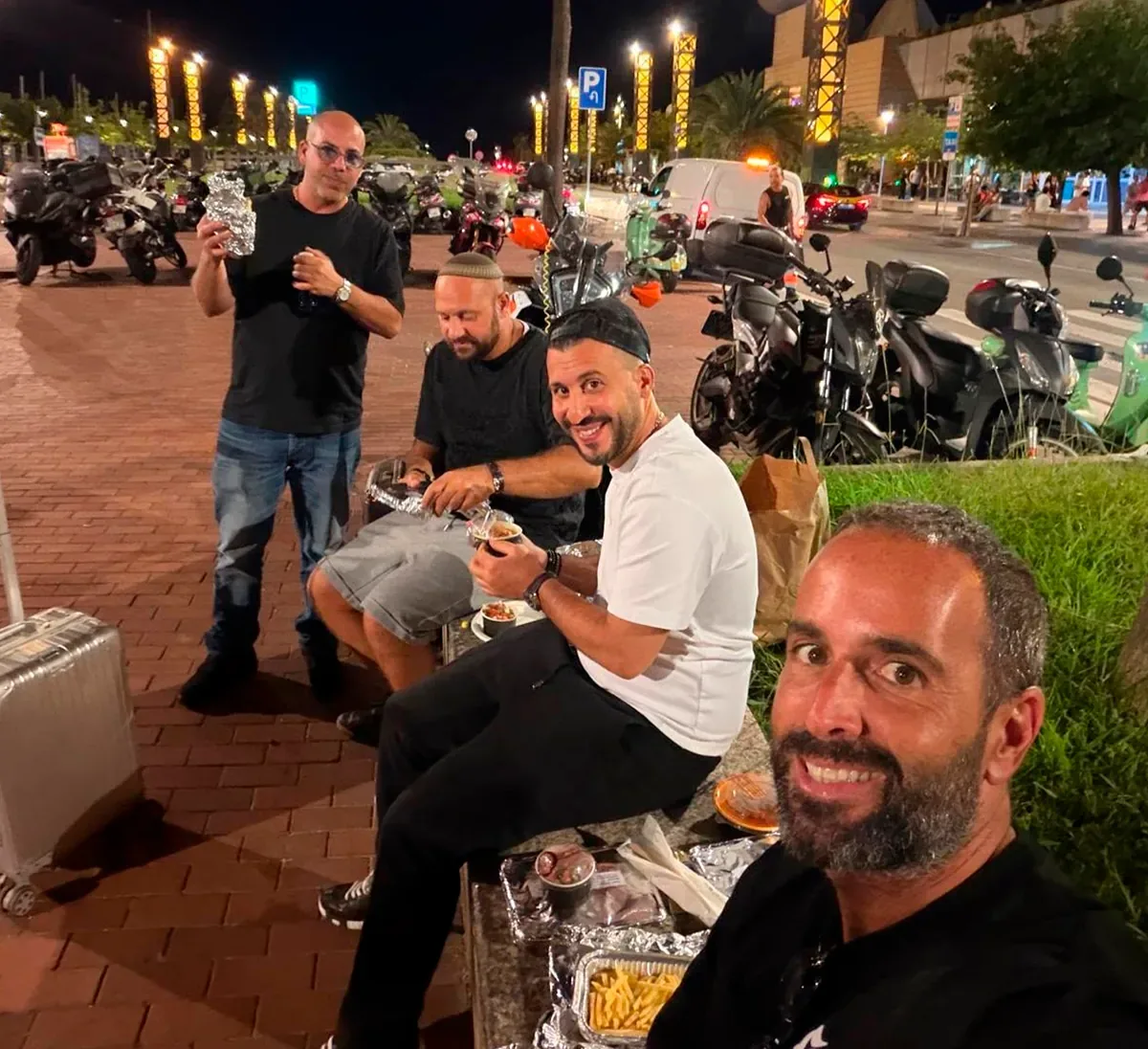
A kipá—the small cap with which many Jews cover their heads as a sign of respect to God—can today abolish an entire biography in Spain.
Jimmy Zaghroun is, in fact, a 41-year-old Parisian, son and grandson of Tunisian Sephardim, a tourist souvenir merchant and follower of Breslev, a Hasidic movement that has made joy a spiritual discipline. But “the mob of antisemitic thugs” who, according to his account, confronted him on July 3 while walking through Barcelona with six other Jewish friends decided they were Israelis based on their appearance.
“If you really are not, say ‘Fuck Israel’,” they shouted after surrounding them, several men whom Zaghroun identified as Maghrebis. “I have never harmed anyone in my life. I am a Breslev Hasid. That is my path: always happy, always calm, always smiling. Life is a gift from God. But I would not curse Israel even if they threatened to kill me. First, because I love that country; and second, because Israel is not Netanyahu,” he states.
The so-called `Breslev Hasidim` take their name from the Ukrainian city of the same name—today Bratslav—where Rabbi Nachman founded this movement at the beginning of the 19th century. Its spirituality places central importance on direct and personal conversation with God and the rejection of despair.
Its followers are, so to speak, rigorously observant faithful who have turned singing and music into spiritual weapons against bad vibes. Being joyful is, for them, “a great mitzvah” or spiritual duty. However, the guitar must be silent when Shabbat begins, which is the Hebrew term for the sacred day of rest.
The seven Jewish friends arrived in Barcelona on Thursday, July 2, to celebrate a birthday. Their first day in Catalonia they went out around the casino area; on Friday morning they went to the beach and, at dusk, headed to Beth Habad of Barcelona, the synagogue located on Montnegre Street, in the Les Corts neighborhood. There they were going to pray, receive the day of rest, and have dinner with the community.
For Judaism, Shabbat does not begin on Saturday morning but at sunset on Friday. And that weekend’s was the parashah Pinchas, which is the name of the weekly Torah portion to be read that tells the peace pact granted to a priest.
The religious program included Mincha, the afternoon prayer, and then Kabbalat Shabbat and Maariv, the prayers welcoming the sacred day. At 9:10 p.m., the candles were lit and the Sabbath celebration formally began.
From that moment, Shabbat had changed the rules of Barcelona: they could no longer hail a taxi or use a car or phone, consult Google Maps, call the police, or record anyone with a mobile phone. What happened afterward has been reconstructed by several French and Israeli media as a “genuine hunt for Jews.”
Around half past ten at night, they began the two-hour walk back to the Hotel Arts. Only two of the seven walked with a kipá. Jimmy kept hidden under his clothes the talit katan and tzitzit, the small ritual garment and the fringes that hang from it. Without the cap, nothing in his appearance would have betrayed him as a son of Abraham.
Besides the kipá, his friend Haim Touaty wore the classic black and white attire with which Chabad-Lubavitch Hasidim usually welcome Shabbat, which is the branch of Judaism to which the Barcelona synagogue belongs.
Unlike Breslev followers, these place special emphasis on the study and intellectual understanding of mysticism. The black and white of Haim, it should be noted, is not an exclusive uniform of this movement but common attire among ultra-Orthodox.
That Zaghroun’s Hasidic friend was the most recognizable is the main reason why he was also the first group member the unknown woman confronted.
Jimmy describes her in the police report as an athletic-looking woman, wearing fuchsia pink sneakers, black shorts, Eurasian face, “perhaps Hispanic,” and a sports bra. Her body was covered in tattoos, a Palestinian flag tied around her head like a bandana and a kufiya—the classic Arab scarf—attached to the end of her ponytail.
During the first hour and a half, they had walked without incident “joking and playing games.” The woman appeared shortly before midnight near a billboard close to Moll del Dipòsit and started shouting “Free Palestine.” “We didn’t pay much attention because we have heard that many times,” says the Parisian merchant. “I remember Haim quickened his pace while we all walked silently and I told him: ‘You can speed up a bit, but don’t run.’ I work in security at Jewish schools in Paris and I know running is the worst when someone starts chasing you.”
However, the woman let them advance about fifty meters, then ran after them and, when she caught up again, put her hands to her mouth like a fan demanding a response from the crowd. She found it on the terraces, among those watching the World Cup and among North Africans smoking hookah in the cafes.
“From that moment, a crowd joined her and began surrounding us. Among them were Spaniards but most were Maghrebis. My wife is a Moroccan Jew and my family are Tunisian Sephardim so I can recognize them. They followed us on bicycles and scooters. What happened next was horrifying. They started shouting: ‘We’re going to kill Jews,’ ‘Child murderers,’ ‘Disgusting Zionists.’ Did we fear for our lives? Of course. We lived terrifying moments. I was especially alert to what they did with their hands in case someone pulled a knife.”
Jimmy and his friends had good reasons to expect the worst. In March last year, the rabbi of Orleans (France), Arié Engelberg, was attacked in the street while returning from the synagogue accompanied by his nine-year-old son. The attacker asked if he was Jewish, spat on him, insulted him, hit him on the head, and bit his shoulder.
Just three months later, Rabbi Elie Lemmel was attacked twice in one week: first in Deauville and then in Neuilly-sur-Seine, where a man threw a chair at his face and opened a wound on his forehead.
In March of the same year, a man tried to set fire to the Rimmon Kosher pizzeria in Madrid while customers were still inside. Employees managed to prevent the fire and the suspect was arrested a month later and sent to provisional prison as the alleged perpetrator of hate crimes, attempted homicide, and arson.
Since October 7, 2023, more than 400 antisemitic incidents have been documented in Spain. The figure includes assaults, threats, graffiti, desecrations, discrimination, and targeting campaigns.
Practically not a week goes by without some attack being recorded. Just two days after the pursuit of Zaghroun and his friends, dozens of pro-Palestinian activists surrounded the stage at the Santander Book Fair and prevented Jewish poet Marcos-Ricardo Barnatán from presenting his latest book alongside his son, actor Jimmy Barnatán. The organizers ended up canceling the event.
This same week, two homes linked to relatives of some anti-tourism activists were found marked in Santa Maria del Camí (Mallorca) with Stars of David, the words “Jews” and “Juden,” and a clumsy sketch of a swastika.
In Barcelona, the antisemitic targeting campaign took on a more sophisticated and sinister form when, at the end of 2025, an anonymous group of pro-Palestinian activists published a collaborative map geolocating 152 targets in the city. Among them were marked Jewish businesses, kosher restaurants, community entities, and even the Jewish school of Barcelona.
The terrifying stretch of the long walk of the Parisians started precisely from one of the targets marked on that antisemitic map and then went from the red footbridge, along Doctor Aiguader Street, and finally along Joan de Borbó promenade, heading toward the large hotels on the coast. In total, half an hour. Some harassers followed them for a few minutes, shouting violently at them and then returning to their tables or in front of the TV screens where La Roja was about to defeat Portugal. Others took their place. The crowd renewed itself alternating stretches of lit roadway with darker street segments. “I spoke to them in French, Arabic, and English. I said: ‘I am French. I am French.’ I told them in Arabic ‘metashem’ (what a shame). But it was useless. If one of my friends had stayed behind, I wouldn’t be here talking to you.” It didn’t matter what they said because the shouts and intimidations did not stop: “Jews are not welcome”; “Get out of Barcelona.” They overtook them on bicycles or scooters, disappeared for two minutes, and reappeared further ahead; others flanked them spitting on the ground. Even a car tried to stop to join the mob. Only traffic prevented it from completing the maneuver.

“We didn’t see a single police officer along the entire route. It was incredible,” says Jimmy. “The crowd didn’t leave us until we reached the Hotel Arts. The woman was forced by staff to leave the reception area. If it had been only her, it wouldn’t have been so terrifying, but there were moments when we were flanked by fifty angry men.“
Saving the distances, the scene in Barcelona recalls one of the first major street pogroms organized by the Nazis two years before they came to power. On September 12, 1931, during the Jewish New Year, more than a thousand SA members mingled with the strollers on Berlin’s Kurfürstendamm and waited for the faithful to leave the Fasanenstraße synagogue.
Then, they attacked those they recognized—or simply believed to recognize—as Jews, chased them through the streets, beat several, and chanted slogans like “Death to the Jews,” which is precisely one of the chants the Barcelona mob and the woman with the Palestinian kufiya dedicated to the Parisians.
The instigator of the events disappeared from there with a considerable advantage: the victims of the harassment operation had not been able to photograph, record, or call the police on her. The pursued assumed, however, that her face had been recorded by the video surveillance systems along the route.
“It’s impossible that she doesn’t appear,” says Jimmy. “There were cameras on the street, at the Sofitel, and at the Hotel Arts. I wrote to the director to request the footage and he replied that the police had to request it.”
According to the president of the Federation of Jewish Communities of Spain (FCJE), David Obadía, “it is necessary for the authorities to act to identify the perpetrators of the harassment because no one should suffer intimidation or aggression because of their identity, nationality, beliefs, or religion. We do not want this type of attack for Jews or any other group, neither in Barcelona nor in any Spanish city.”
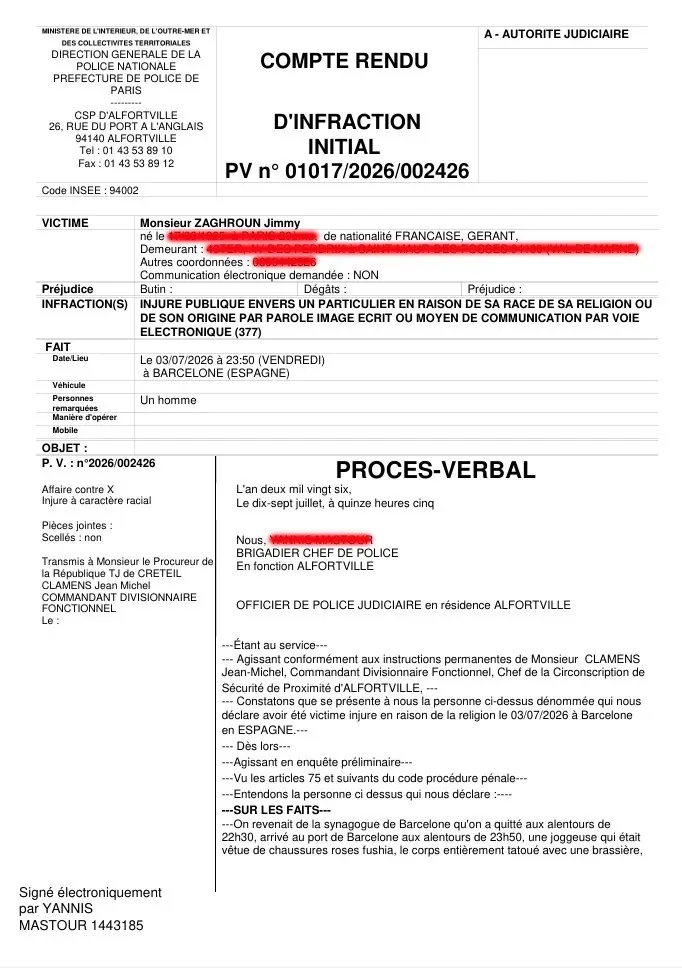
Back in France, Jimmy filed a complaint against the unknown woman at the Alfortville police station. The French police provisionally classified the events as public insults against an individual because of their religion, race, or origin and forwarded the proceedings to the Créteil Prosecutor’s Office. The document itself notes that the French Consulate in Barcelona had been informed and that he was advised to report it in France so the investigation could continue in Spain.
On July 14, a representative of the EMET Foundation also appeared before the Mossos d’Esquadra and recorded what happened on behalf of Zaghroun. Jimmy urges Spaniards who have any information to cooperate with the police.
Read more Once upon a time the ‘Spanish model’…
@ferranbarber