









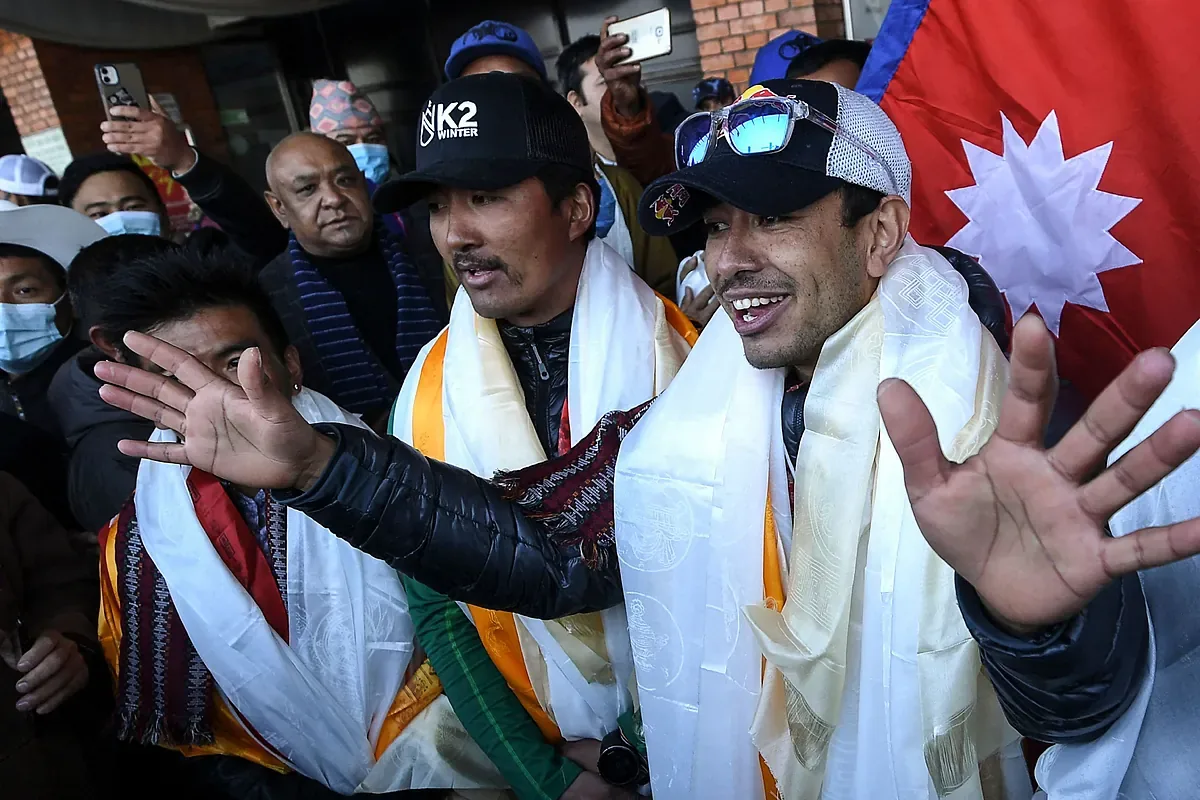
The renowned mountaineer Nirmal Purja, a former British Army soldier born in Nepal and widely known as Nims Dai, is one of the mountaineers who died in an avalanche on Broad Peak in Pakistan, according to the company that organized the expedition confirmed this Saturday. Yesterday, four bodies were located and three of them recovered, and they continued working to find the others despite the bad weather that hindered helicopter flights, authorities reported.
Purja, 43 years old, who served in the British Army’s Gurkha Brigade before joining the Royal Marines Special Boat Service, has broken multiple climbing records since becoming a full-time mountaineer and mountain guide. He climbed the 14 “eight-thousanders” – the famous peaks over 8,000 meters – in six months and six days between April and October 2019, which was a record at the time. The Netflix documentary “14 Peaks: Nothing Is Impossible” about that feat also earned him international notoriety.
In 2021, along with a team of nine other Nepalese climbers, Purja completed the first winter ascent of K2.
A statement from the Gilgit-Baltistan regional government identified the three recovered bodies as those of Nepalese climber Pur Bahadur Gurung, Omani climber Nathira Ahmed, and American climber Mallory Geis. It indicated that the bodies had been taken to a hospital.
His climbing company Elite Expeditions confirmed that Nirmal Purja through their social media: “With deep sadness and immense pain, we confirm that Nirmal Purja tragically lost his life following the avalanche on Broad Peak. We have also received confirmation that other members of the expedition unfortunately did not survive.”
The athletes lost contact with their base camp after an avalanche on Broad Peak while trying to reach the summit, explained Karrar Haidri, vice president of the Alpine Club of Pakistan. “The team has been out of contact since Thursday,” he said, adding that army helicopters were participating in the operation.
Authorities noted that the search for the missing mountaineers continued until Friday afternoon and would resume on Saturday.
According to the Alpine Club, the expedition consisted of five Nepalese climbers in addition to the Omani and American climbers, as well as Pakistani Sohail Sakhi, a Chinese climber identified only as Wang, and another foreigner.
On Friday, the Chinese government indicated it was trying to verify if any of its nationals were among the 10 missing mountaineers.
“We will provide assistance to Chinese citizens who need it and are also willing to offer help according to the needs of the Pakistani side,” said Chinese Foreign Ministry spokesperson Mao Ning on Friday in Beijing.
Moving Mountains, a travel company based in Pakistan, announced at the end of last month that the expedition was heading to the small village of Askole and wished them a safe journey to climb Broad Peak. The company indicated that this was Geis’s first attempt on an 8,000-meter peak in Pakistan, while Sakhi’s was expected to be his last.
Sakhi is a guide for the company, as well as a geographer and high-altitude photographer, and has summited some of the world’s major mountains, according to Moving Mountains’ website.
Geis, 39, lives in San Antonio. Earlier this year she announced on social media that she was closing her Pilates studio to take “a big leap of faith into the unknown to see where life goes. I suspect there will be many helmets, harnesses, and crampons involved.”
Broad Peak, at 8,047 meters (26,401 feet), is the twelfth highest mountain in the world. It is located in the Karakoram range in Pakistan, where five of the 14 peaks over 8,000 meters are found, attracting climbers from all over the planet.
Accidents are common during climbing expeditions in northern Pakistan due to avalanches and rapidly changing weather conditions.