




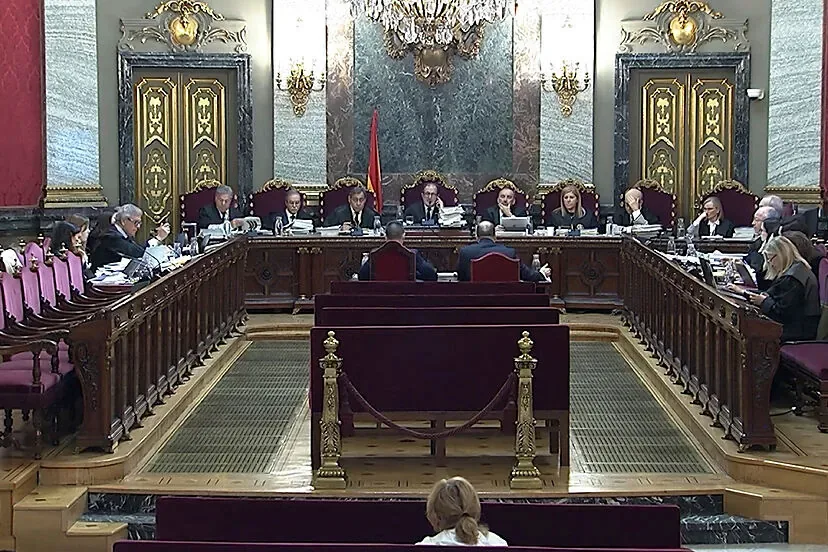
When he sat in front of magistrate Leopoldo Puente in his office at the Supreme Court on May 19, 2025, the head of Arms of the Civil Guard, Antonio Cortés, was, whether he knew it or not, whether he shared it or not, the last link in a long chain.
That started from Leire Díez, the PSOE plumber, who according to judge Santiago Pedraz had been trying for months to “destabilize” judicial cases against the PSOE (specifically, the cases against Begoña Gómez, the president’s brother, former minister Ábalos and former socialist leader Santos Cerdán, among others).
A chain that at that moment, thanks to Cortés, ended for the time being there: in the very Supreme Court. Before the judge investigating the (later convicted) Ábalos, the man who, for years, had been everything in the Socialist Party and for the president, Pedro Sánchez.
The Civil Guard commander represented there, right under Puente’s nose, another very symbolic role. The Executive power of the State went to the Judicial to, supposedly, settle scores with itself. Two powers, in their most patrician manifestation, face to face.
Antonio Cortés was there as the instructor of a “reserved information” about the Central Operative Unit of the Benemérita, the already famous – to his regret – UCO.
Not to inform the magistrate of the threats looming over the unit, which had already detected “maneuvers” from Díez’s environment and the former PSOE number 2 Santos Cerdán to undermine its credibility. Maneuvers that had been communicated by the Civil Guard Intelligence (on April 29) and by the UCO itself (on May 5) to the Deputy Operational Director (DAO), Manuel Llamas.
Neither Llamas nor the one who appointed him, the general director, Mercedes González, had done anything with both notes in those days, apart from acknowledging them. But they had done other things. Exactly in the opposite direction.
On May 9, a few days after those notes in which the UCO detected that they were trying to cut the grass from under its feet, Koldo García‘s lawyer, Leticia de la Hoz, complained to Leire Díez about leaks in the procedure, and wrote to her on WhatsApp: “The strong thing is that it is the UCO who leaks, and is both judge and party, all at once.” Leire replied: “I just bet a lunch with Mercedes [González] that the leaks come from the UCO.”
The next day, EL MUNDO published several compromising WhatsApps between Pedro Sánchez and Ábalos, with the former minister increasingly pressured by investigations around him. It did not take Einstein to imagine where the messages could come from, and the UCO had not even yet intervened Ábalos’s phones – it would not do so until exactly a month later – but Leire again spread the rumor she had been disseminating here and there for months: the Civil Guard was leaking information against the Government. The Benemérita was doing politics, it wanted a change in Moncloa.
The operation that Leire and Santos Cerdán, Ábalos’s successor alongside the president, had been plotting for years was set in motion. One day later, at 9:16 a.m., Mercedes González activated the automatic deletion every 24 hours of her WhatsApps with Leire, and with them she believed she buried her link with the plumber. At 11:30 a.m., Llamas met with Antonio Cortés in the general directorate’s cafeteria, in Guzmán el Bueno (Madrid). He asked if he would take charge of the file to the UCO itself. Cortés agreed. A Civil Guard investigating, spuriously as the judge later intensely sniffed, the elite of the Civil Guard. González would later defend that it was something “normal” within the institution. In reality, from 2023 until today Llamas has only opened six files of this type. Three of them, to the UCO.
So on May 19, two weeks after the UCO itself detected that an operation born from the very heart of the PSOE was trying to undermine it, Antonio Cortés appeared – knock, knock – before judge Leopoldo Puente.
Reserved information are internal administrative processes of the Civil Guard, but when they cross into a procedure opened by judicial authority it is better to discuss it, the instructor must have thought before communicating to the magistrate his intention: to set course against those who at that moment had been investigating for years both the president’s environment – former ministers, his wife, his brother – and the PP itself and, law obliges, everything any judicial authority entrusts him with.
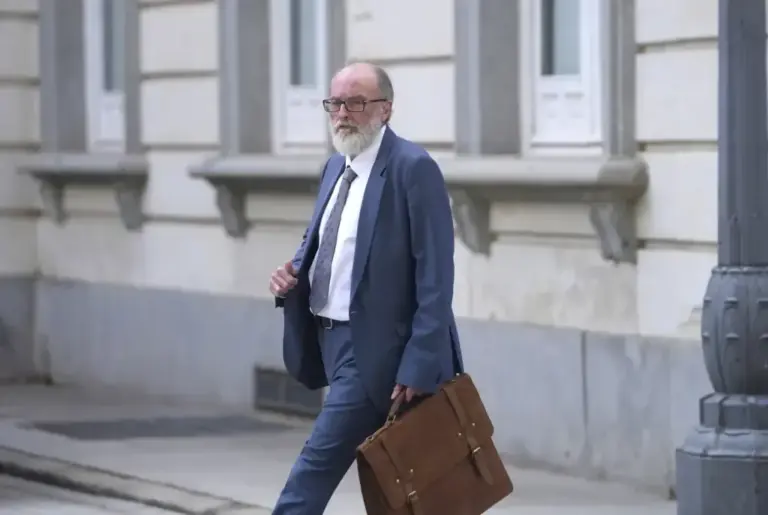
Puente’s response, from his glasses usually on the tip of his nose and his gray beard, was so categorical that it has almost resonated since then in every corner of the Benemérita barracks, a body finally military, and in whose soul the exemplary role of the commanders is engraved in fire: “I do not authorize any formal opening of something like this. And I warn you that, if you go ahead, I will open proceedings against you and against whoever has commissioned it.”
The State, in short, stayed in its place and said no to the other State.
Cortés went back the way he came and proceeded to close the reserved information just a week later, on May 26.
Magistrate Puente had been in his place, as have been for the last few years dozens of public servants who have had to deal with the tentacles, if not the very epicenters, of corrupt plots of all kinds, affecting whichever party they affected.
The reader will have heard and intoned the litany several times in recent months: the groundwater level of corruption seems to have skyrocketed in the Spanish Administration and politics, sometimes to informatively unbearable levels.
However, and although it may not seem so much, because we media are not Mr. Wonderful, for every rotten apple that fills newscasts there is an army of officials who will never appear on the front pages, but who have been in their place and have resisted the, let’s say, bad guys. This text intends to remember some of them.
There are already famous ones, like the UCO lieutenant colonel Antonio Balas, who was intended to be portrayed as a great inquisitor against the Government, but who has spent several decades monastically dedicated to chasing thieves, no matter which side of the street they are from. An example: in the Civil Guard they still remember the year Balas spent, more than a decade ago, trying to prove that Rodrigo Rato would have benefited from the privatizations he himself had promoted from the Government, only for Justice to throw it out due to statutes of limitations that required, using a football analogy, VAR.
There are anonymous ones, and eager to maintain that anonymity, like the Civil Guard general Alfonso López Malo, who opposed with the greatest calm the maneuvers of the DAO and the general director, and who, for being known to be on the incorruptible side, the Government even set a clever trap proposing him for an international post in Portugal, with the obvious aim of getting him out of the way… And he worked hard to deny such a maneuver, in a display of responsibility, institutional normality and, finally, sagacity.
The case of the chief anti-corruption prosecutor, Alejandro Luzón, is evident: a Numantine defender of his independence to leave open the path of benefits for Víctor de Aldama after his collaboration with Justice, Luzón has spent decades – he accused for example in the Roldán case – leading the State forces against corrupt people. He was, for example, prosecutor, already in 2000, of the Reserved Funds case that affected the PSOE, founded Anti-Corruption in 1995 and went on to lead it in 2017, and has been responsible since the leadership of all the hard cases against the PP: Gürtel, Púnica, etc.

But there are very silent ones. The already condemned maneuvers of Álvaro García Ortiz at the head of the State Attorney General’s Office to operate against Isabel Díaz Ayuso in the figure of her partner exposed to everyone the case of the senior prosecutor Adriana Lastra, who reproached her boss for leaking information and has paid with her replacement… But also that of the head of Communication of the Madrid Prosecutor’s Office, Íñigo Corral, who stayed in his place against all odds, and who has only been saved from dismissal that the Community of Madrid has fought to keep him.
Of course, in times of alleged lawfare – the buzzword put on the map by Catalan secessionists and from which, sadly, Moncloa and its followers have ended up hanging – there cannot be missing here two other magistrates, José Calama and Santiago Pedraz, who after very long careers (68 and 67 years, respectively) dealing with bad guys of all kinds and conditions, and without any ideological color after a thousand encounters, at this point in the story have had to tighten their belts to gently put powerful people like former president José Luis Rodríguez Zapatero (Calama) and the former everything of the PSOE Santos Cerdán (Pedraz in the Leire case), with a legal delicacy that restores faith in the law. But equally in their place, not a millimeter to one side or the other, have been, for example, the Environmental Evaluation officials of the Ministry of Ecological Transition, who first suffered how Eugenio Domínguez, later arrested, forced to favor Forestalia from the Ministry, and then told everything to the Civil Guard so the house could be cleaned.
That is to say: yes, there are rotten apples, one could even say many. But there is also a State that works. Wounded and attacked, captive and disarmed, but it works. Against all odds.
AND IN NAVARRA…
LORENZO SERENA. The case of the Navarrese official Lorenzo Serena is one of the most paradigmatic seen in recent years of fighting at a disadvantage from within the Administration. After almost 30 years participating in contracting committees, Serena, a quiet and hardworking guy – it could be said, according to those who know him, that he is a prototype of an ‘administrative geek’ official – was stunned in 2024 when, as secretary of the awarding committee of the largest work in the region in 15 years, the doubling of the Belate tunnel for 74 million euros, he saw the president of the committee commit a series of irregularities before the contract ended up in the hands of a company without experience of which, moreover, he had heard before that everything was rigged in its favor. Serena first complained in writing to the Basque Parliament, which mocked him and the committee’s auditor in one of its sessions. Then he wrote to the Navarre Anti-Fraud Office, determined not to tolerate abuses. He was expelled to a warehouse on the outskirts of Pamplona, treated like an outcast… And a year and a half later, the UCO discovered that the firm, Servinabar, had a shadow owner (45%), none other than Santos Cerdán. Without heroics, Serena thinks, who remains in his post, as he has for the last 30 years.