





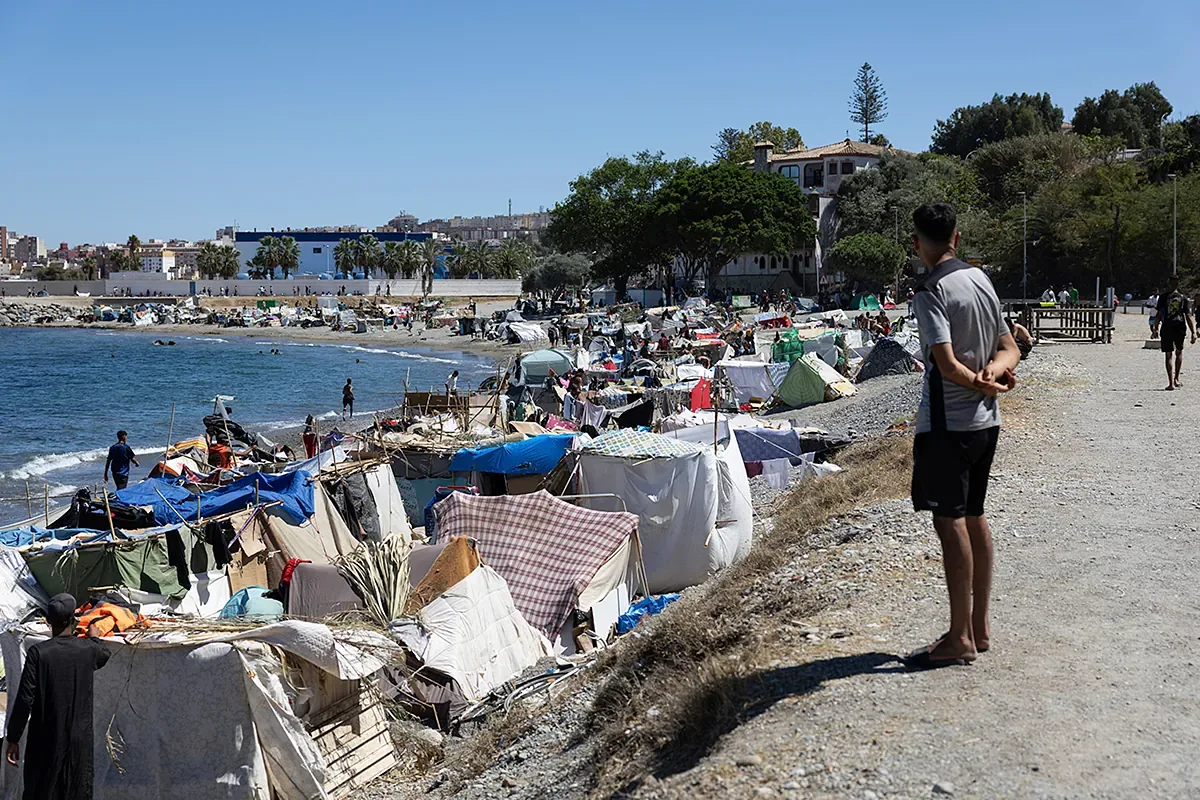
“Mom, is this a nightmare?”. The nine-year-old boy couldn’t help but ask his mother Yolanda this question a few days ago in Ceuta. The sight of hundreds of people arriving from Morocco wandering the streets, the sound of sirens, and the militarized city made a scene too similar to the images that have appeared in the boy’s dreams for a month. “The truth is that he is having a hard time. He experienced everything, and from the day the immigrants arrived, my son stopped eating and sleeping well,” his mother laments. Despite her own fear, she tries to convey calm and provide some distraction, like going to a café as a family some afternoons. “We don’t want him to live in fear, in anguish.” Like so many ‘caballa’ parents, Yolanda feels that the migration crisis has “stolen” the summer and freedom from Ceuta’s children.
Read more The unstoppable ‘rebellion’ of PSOE mayors against Sánchez over Ceuta spreads and exposes Ferraz
“As a precaution” and citing “security reasons,” hundreds of families have had to sacrifice their vacation plans in the autonomous city. Thus, minors have been forced to give up the “big week” of the fair, the endless days at the beach, visits to the cinema, playing in the park, football matches, and walks to stay at home between video games, video calls with friends, longer-than-usual naps, and lots and lots of boredom. “They have taken away our right to go outside”, complain mothers and fathers worried about their children’s well-being not only because of wasted vacations and broken summer traditions but also because they see no short-term solutions to the crisis unleashed on July 30 and 31, when 72,000 people entered Spain illegally.
“The older one stays home playing on the ‘play’ all day, and I sometimes take the younger one with me to do the shopping, nothing else,” shares Ikram, mother of two children aged 5 and 10. “We are having a hard time psychologically,” she adds. Psychologist Luis Antón explains that replacing an outdoor summer with four walls affects childhood. It deprives children of movement and exercise, something that “has effects on depressive and anxious symptoms in minors”; of sunlight, which can cause “phase delay, later sleep, and more awakenings”; and of the possibility to socialize with peers, with the consequent “risk of depression” associated with isolation and loneliness.
Summer without beach or park
Ikram describes what summers are usually like in Ceuta. Everything revolves around the beach. “We stay until twelve or one in the morning at Chorrillo, among friends, with the children.” This coastal city takes advantage of its geographical location to spend as much time as possible between the sea and the sand throughout August. Except the last one. “[The immigrants] are on the beach, and I can’t take my daughter to swim there. It’s full of filth, excuse me, because they relieve themselves there: there is urine and feces.”
“We are users of the most famous beach right now, Trampolín, and we can’t go,” says José, father of a 14-year-old girl and a four-month-old baby. In that same place, in fact, several clashes have occurred between immigrants, as well as between them and the Ceutans. “The beaches are exclusive to them, they are not ours,” criticizes Sofía, mother of a nine-year-old girl who is “more irritable and rebellious because all her expectations of enjoying herself have collapsed and she is bored because she can’t play, jump, swim.”
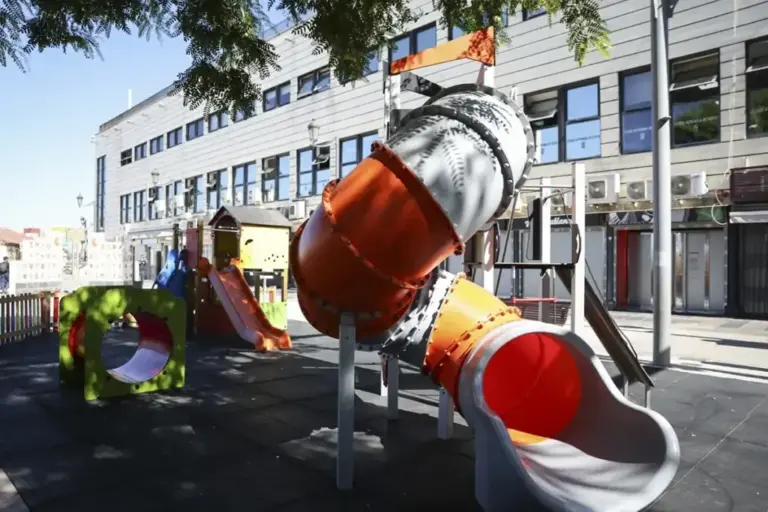
That description of uncleanliness on the beaches extends to playgrounds. “The park we used to frequent every afternoon has been invaded”, says a father who asks to remain anonymous because he is part of the Army. “The immigrants were sleeping for a week in the gardens with cardboard,” he recounts. “If they needed to relieve themselves, they did it in the corners, among the hiding spots of the swings, in the towers where children climb to slide down the slides. It was disgusting.”
Where the rights of Moroccan children begin, the rights of Spanish children end
Father of an eight-year-old boy.
The father of an eight-year-old boy explains how some neighbors have managed to offer their little ones moments of outdoor recreation amid the self-imposed confinement. “The cleaning services are overwhelmed, so we got strong and spent an afternoon cleaning the park with bleach, disinfectant, and a hose. We cordoned off the area and stayed guarding so the children could play for a couple of hours,” he assures. “The next day, they were there again, washing their parts on the benches with water bottles.” This father, exasperated, believes that “the rights of Ceutans, both minors and adults, have been exhausted.” He interprets that “where the rights of Moroccan children begin, the rights of Spanish children end.”
The fear of contracting infections is also part of some families’ concerns. In fact, the Minister of Health, Mónica García, confirmed this week the first cases of tuberculosis, several of scabies, and at least 60 of gastroenteritis. “We have to take care of ourselves like during COVID,” asserts Yolanda. However, health authorities deny that there is an epidemic and much less have imposed a lockdown.
Filth and crowds are not the only reasons some families have decided to stay locked in their homes. The main reason is the feeling of insecurity they say they experience every time they step outside. Some have witnessed confrontations and fights, mainly between migrant groups, as well as finding people sleeping or occupying public spaces, despite the government’s attempt to concentrate foreigners in other areas. They fear being victims of theft or violence. “I don’t let my wife go out alone with the baby because even when she is with me, they have tried to rob her,” laments José.
Similarly, parents feel fear due to uncertainty about the scenes that may take place in the presence of their children in public places. “I see them swearing and fighting among themselves, and it scares me because a stone could hit my children,” says Ikram. “No child goes out alone on the street; it would be reckless. That is terrifying,” continues the father who belongs to the Army. “I used to send my son to buy bread in front of my house, gave him a euro to buy the bread, and let him keep the 10 cents to save. That is now impossible, even if it is just a few meters.”
I see them swearing and fighting among themselves, and it scares me because a stone could hit my children
Ikram, mother of two children aged 5 and 10.
For parents of teenage girls, there is an added concern. Two of Úrsula’s daughters are 15 and 18 years old. They are also confined to their homes. “They can’t go out on the street because they are young, they are girls, and these boys start bothering them.” So they spend the days glued to their phones or even going up and down the building stairs “to get some exercise.” “My 15-year-old daughter’s biggest fear is that something might happen to her. She tells me: ‘Mom, if someone touches me or rapes me, I will kill myself.’ You don’t know the pain it gives me that my daughter says that; it’s not normal. They have ruined our city.”
José shares the same fear as Úrsula. “My daughter has friends who have had bad experiences with them on the street. Now she doesn’t want to leave the house, doesn’t talk to anyone, hides behind video games,” he confesses. “Besides, we as parents, for safety, also don’t let her go out. I see how things are, and I’m not willing to risk ruin because something happened to the girl.” Therefore, his daughter is banned from going to the beach or downtown with her friends. “She only asks when we are going to leave.”
Psychological consequences
Specialist Luis Antón, from IPSIA Psychology, lists the consequences of this confinement on minors. First, “a decline in mood: if restoring activity heals, removing activity makes one sick”; second, “impoverishment of the repertoire: with few alternatives available, behavior concentrates on the little that works.” Here the screen comes into play, which “doesn’t win because it is addictive by itself; it wins because it competes in a market without competitors… Data confirms it: during the pandemic, screen time in minors increased by 84 minutes per day on average, from 2.7 to 4.1 hours.”
Third, Antón mentions a “escalation of family conflict: if the adult becomes the only source of available social attention, attention-seeking behaviors increase. And since the adult is overwhelmed, those demands are met intermittently and only when they intensify”; and finally, there can be a “narrowing of the learning context”: the psychologist explains that “the street is where you learn to negotiate, to lose, to calculate risks, to resolve a conflict without an adult referee. That repertoire is not learned in the living room, nor with an adult present, nor on a screen.”
The street is where you learn to negotiate, to lose, to calculate risks, to resolve a conflict without an adult referee. That repertoire is not learned in the living room, nor with an adult present, nor on a screen
Luis Antón, psychologist.
Now parents face a new challenge with the return to school. Sofía, in fact, has created the group ‘Safety for Ceuta’s students’ to unify that concern. They are especially worried about how children and teenagers will get to their schools, especially those who tended to go and come on their own. “No mother in her right mind is going to let her child move around the street alone,” warns Sofía. She also expresses her fear that the lack of hygiene and contact between minors and the outside will foster infections.
Lutgarda is a teacher and mother of a 12-year-old boy with autism. She says she has been “lucky” to spend the summer in Málaga and that her son’s childhood has not been “stolen” like other children’s. But she fears returning to Ceuta, especially because she will not be able to guarantee her son the stability, routine, and normality he needs. She confesses that she spends sleepless nights thinking about how to face the return to classes. “It’s like organizing your life in an apocalyptic COVID.” For example, when the little one was beginning to have independence to go on his own to extracurricular activities, like English classes, his mother is already reconsidering having to accompany him everywhere.
She is also warning him that he will not be able to go to the park every afternoon as he likes. Being a child with second-degree autism, who “has difficulty relating,” Lutgarda celebrated that in those environments “he sought contact with other children, even if it was hard, and now having to deny him that is frustrating.” “I also won’t be able to take him to have a snack or eat the churros he loves so much. He won’t be able to go anywhere in the afternoon. He hates being touched. If someone brushes against him on the street, he will go into crisis,” she foresees.
As a mother and as a ‘caballa’ citizen, I am afraid, I am outraged, and above all, I feel a deep sense of abandonment
Lutgarda, mother of a 12-year-old boy.
Although she has already explained the situation to him so he understands his “new reality,” she knows her son will “explode” at some point. “This is called ‘autistic burnout,’ they are escapist children. It has already happened to me that he gets angry and runs into the street, and I have to go after him.” Her son has also had to give up the special therapies for autistic children he had at the equestrian center, now turned into a temporary settlement for migrants. “His routine is completely broken and shattered,” laments Lutgarda. “As a mother and as a ‘caballa’ citizen, I am afraid, I am outraged, and above all, I feel a deep sense of abandonment.”
Parents want to recover the normality of July or September last year. But they see no solutions. “In the end, citizens will have to face them because if the government does nothing, we will have to do it,” José anticipates. Similarly, the other father of an eight-year-old boy says, “It’s a nightmare day after day. The town is going to explode. The bomb is getting bigger because people are increasingly tired, fed up, outraged. Every measure the Central Government takes is to tighten the noose around our necks a little more.”
Mothers and fathers can’t wait to enjoy activities outside the home again. They know it is one of the ways to give back the freedom they have lost this summer. As psychologist Antón states, “a locked-up child doesn’t break inside; their repertoire shrinks. And fortunately, that is not treated with diagnoses: it is treated by giving back things to do, people to do them with, and decisions to make.”