
Ukraine’s biggest internal political crisis since the start of the Russian invasion entered a new phase this Friday. After a brief pause to give President Volodymyr Zelenskyy some leeway, protesters have once again gathered in Kyiv and other cities with a warning: they will maintain protests indefinitely until the government responds to their main demands.
A year has passed since Ukrainians first protested after the start of Russia’s full-scale invasion of the country. At that time, widespread outrage was due to an attempt to weaken the independence of anti-corruption bodies. Zelenskyy was forced to back down.
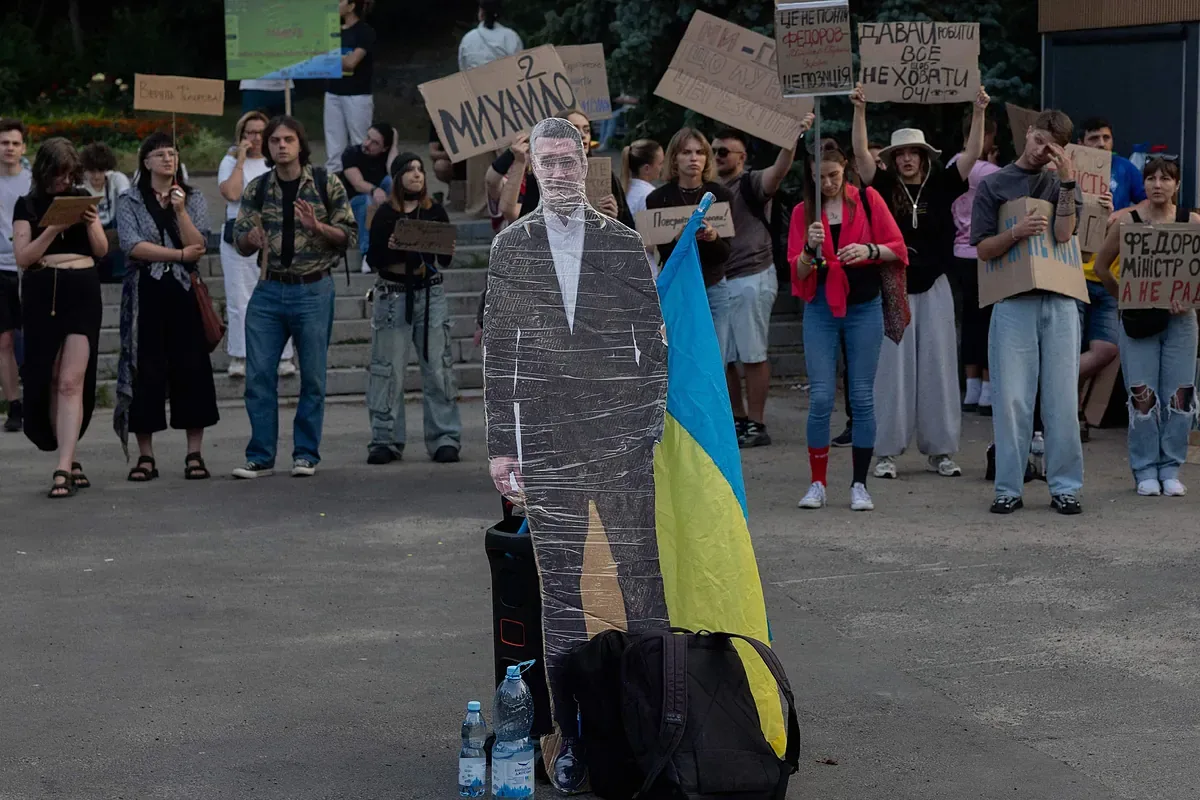
Now, once again, a rectification is being loudly demanded from the president in several cities. This time, the mobilization was born as a reaction against the dismissal of Defense Minister Mykhailo Fedorov, considered by many military personnel and a growing part of society as the symbol of the Army’s technological modernization. Protesters also demanded the removal of the commander-in-chief, Oleksandr Syrskyi, whom they held responsible for an excessively centralized war model, inherited from the Soviet tradition and too demanding of human lives. One of those two demands has already been met: Zelenskyy dismissed Syrskyi on Tuesday and replaced him with General Mykhailo Drapatyi, a change interpreted as an attempt to de-escalate tension without reversing Fedorov’s dismissal. But for the organizers of the protests, it is not enough.
More than 500 people gathered in Kyiv yesterday just hours after a Russian ballistic missile killed 10 people. Protests also took place in Ivano-Frankivsk, in western Ukraine, where dozens of demonstrators braved a summer storm; in Lviv, the main city in the west of the country, and in Cherkasy, located in central Ukraine, on the banks of the Dnieper River. Mobilizations calling for Fedorov’s return have lasted nine days. In the capital, people gathered in the city center with cardboard signs bearing the inscriptions “Exchange prisoners, not Fedorov,” “The source of power is the people,” and “Restore an effective Ministry of Defense.” They also shouted, “Let drones fight, not infantry.”
Veteran Dmytro Koziatynskyi, one of the visible faces of the protest, has called for maintaining the gatherings “every day, for as long as it takes” until the former minister’s return is achieved. “We must do everything possible for the authorities to listen and meet society’s demands,” he wrote when calling for the new day of mobilizations.
The movement brings together veterans, military personnel, volunteers, activists, and urban youth who have largely supported Zelenskyy during the war, but who now question one of his most delicate decisions. In recent hours, new demands related to the Ministry of Veterans have even appeared, a sign that the discontent is beginning to spread beyond the initial conflict. Behind the protest there is no organized political opposition, but rather a network of prestigious military personnel, volunteers, and civil society representatives who believe that the dismissal threatens the reforms undertaken in Defense. They fear that Fedorov’s departure will restore prominence to bureaucratic and military structures that he had tried to limit through audits, digitalization of contracts, greater transparency, and a determined commitment to technological innovation.
Fedorov himself has hardened his position, rejecting Zelenskyy’s offer to take another post: “Today, in the country, there are only three positions, besides the military on the battlefield, that truly determine the course of the war: the President of Ukraine, the Minister of Defense, and the Commander-in-Chief of the Armed Forces of Ukraine. Therefore, I do not accept any position other than that of Minister of Defense.” He asserts that only from that portfolio can he complete the initiated reforms and continue to promote key programs such as drone development, air defense, or long-range operations. Precisely, on Friday afternoon it was learned that Ukraine plans to acquire drones with a range of up to 10,000 kilometers by 2027.
CHANGE OR DIE
The outcome of this challenge to the president will also affect the balance between the Ministry of Defense, the General Staff, the SBU, and the Presidency itself. Military innovation will likely survive even if Fedorov does not return. Drones, long-range attacks, and special operations are already a structural part of Ukraine’s strategy and enjoy broad political and military support.
Much more uncertain is the future of institutional reform. Audits, controls over public procurement, redistribution of powers, and oversight mechanisms clash with administrative and military interests consolidated over decades. Zelenskyy can preserve technological capabilities and transfer them to structures directly dependent on the Presidency, but that would mean keeping virtually intact the system that Fedorov tried to transform from within. Such a scenario, with innovation renewing weaponry from outside the ministry, would further strengthen the SBU security service and agencies closely linked to the presidential environment. Security services have accumulated enormous prestige thanks to their operations in occupied territory and within Russia.
The president continues to try to buy time. The pause that protesters accepted for a few days allowed him to negotiate discreetly, gauge the Army’s reaction, and explore formulas to avoid opening a fracture in the midst of war. But that leeway is starting to run out. The return of protests increases pressure and reduces the space for intermediate solutions. Russian propaganda celebrates these Ukrainian controversies, but applauded Fedorov’s demise even more, whose initiatives have done much damage to the Russian army.
The crisis changes nature with each passing day. Fedorov’s return could calm the streets, but it would represent a far-reaching political rectification for Zelenskyy. Syrskyi’s dismissal has already renewed military command, although it now opens a period of adaptation at the front. Keeping Fedorov out of the government would prolong the conflict with a part of the Army and civil society. And any compromise solution risks no longer satisfying any of the involved actors.
Zelenskyy thus faces one of the most delicate decisions of the entire war. Fedorov’s dismissal was intended to resolve a conflict in the military leadership and has ended up transferring it to the streets, the Army, and the presidential environment itself. While consultations continue and names for definitively occupying the Ministry of Defense are still circulating, Kyiv awaits a move that could come at any moment.
Read more Alpe d’Huez succumbs to a display for the ages from the god Pogacar