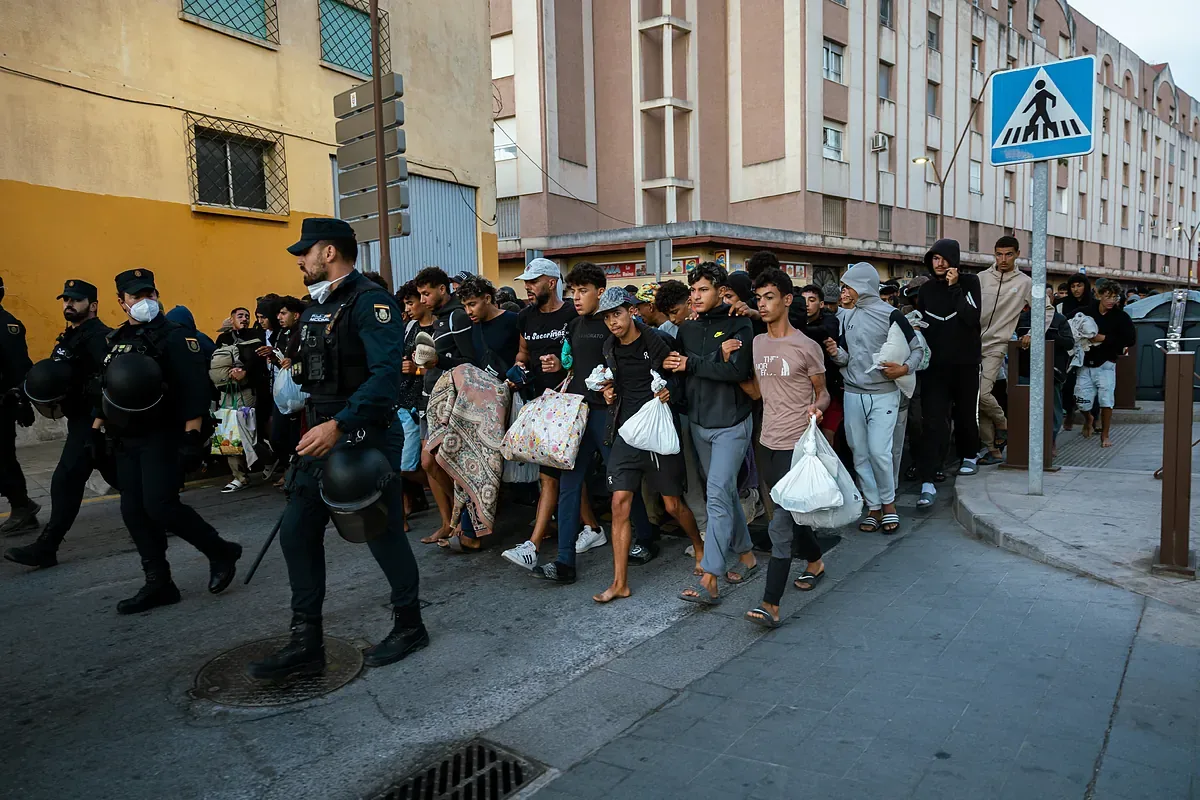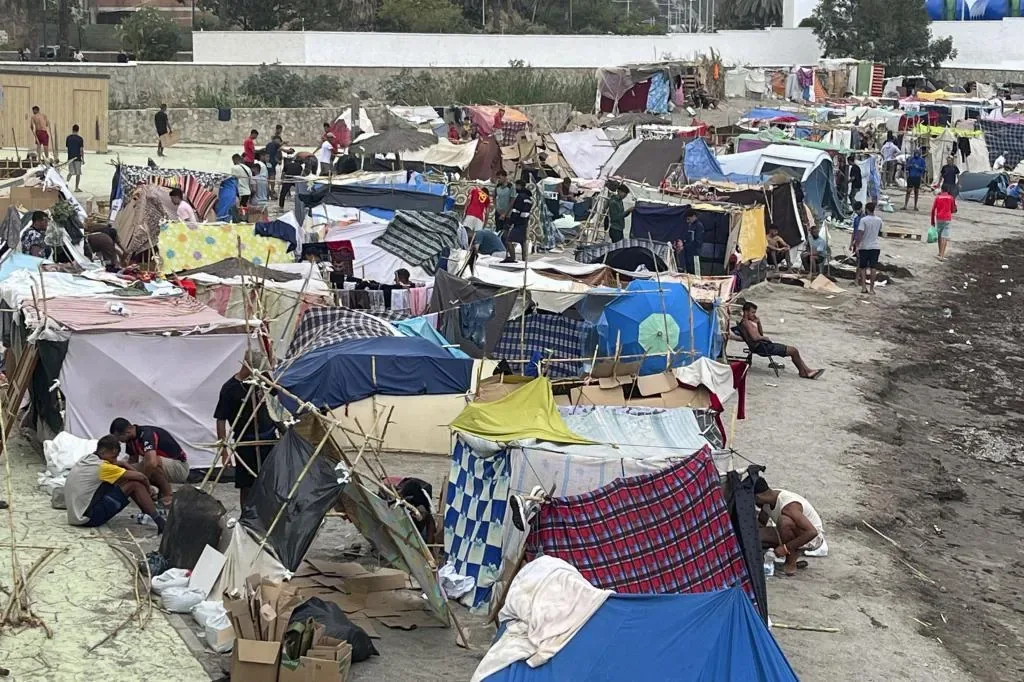








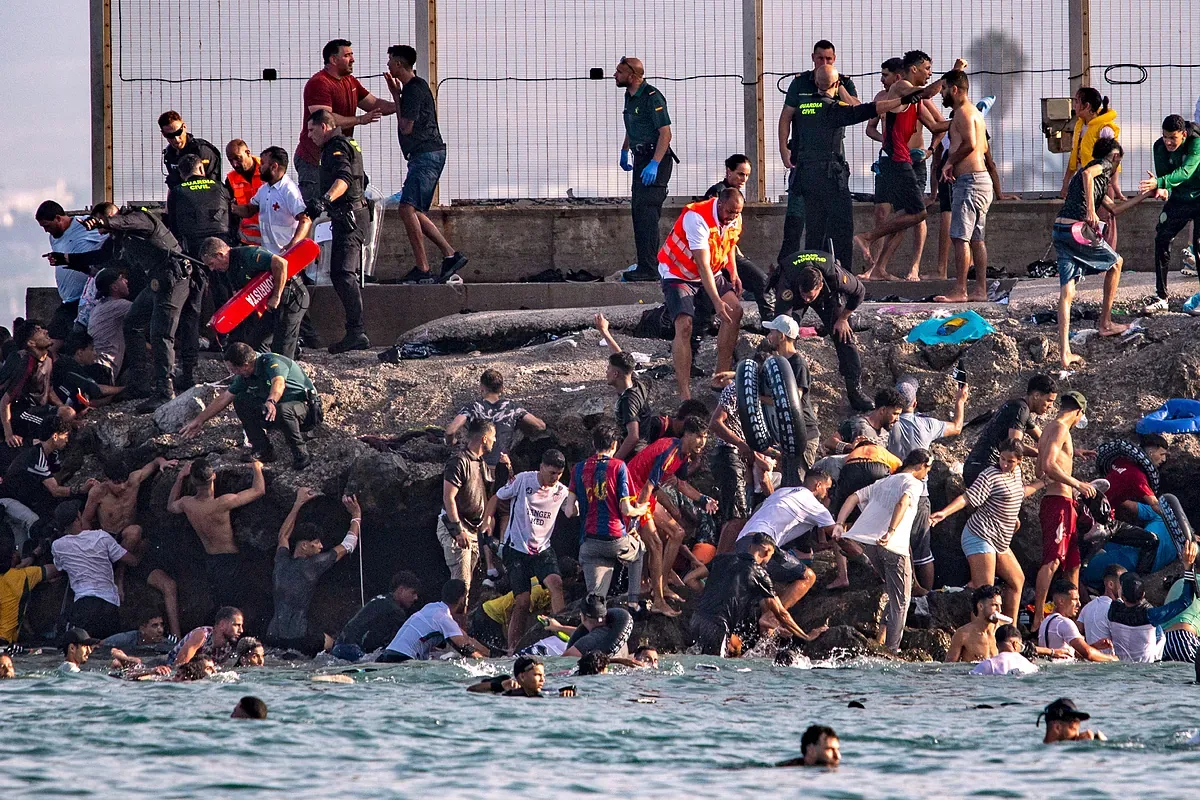
“A Government that works.” This is the definition that Pedro Sánchez gave of his own just five days ago, praising the number of laws passed and assuring that his terms have “advanced our country to place it in a much better, infinitely better position than where we were in 2018.” Barely 48 hours after those statements, more than 50,000 people irregularly entered Spain through its southern border, in Ceuta, without the security forces deployed there being able to stop it. Diplomacy also failed to prevent it—yes, to reverse it, but several hours later.
On the issue Sánchez boasts most about, management, Spain saw a fault line open again, with the country’s “territorial integrity” questioned, in the president’s words. A fault line that, once again, revealed how the lack of anticipation overwhelmed the Executive. It happened during the pandemic, the blackout, and other record crises that mark Sánchez’s terms.
Exactly one week ago, the Ceuta Government called for modifying the Immigration Law because a recent Supreme Court ruling resolved that this law does not authorize the express rejection of those who enter irregularly by swimming. The next day, Monday, the Ceuta executive was already talking about a “migratory emergency situation” in the city, as more than 1,000 people had crossed the border in the past week. The warnings continued in the following days, but Spain’s largest fire in history—Burgohondo (Ávila), more than 50,000 hectares burned—and the 79,000 people evacuated from their homes due to the fires kept the focus elsewhere. Also the Government’s: on Wednesday afternoon, hours before the wave of arrivals began in Ceuta, the Interior Minister, Fernando Grande-Marlaska, remained in Navalcarnero (Madrid) at the command post set up for the fires.
However, the Government was not unaware that irregular entries into Ceuta had been increasing in recent weeks. This was reflected in the bimonthly immigration reports by the Interior Ministry—up to July 15, 2,826 people had entered by swimming and on foot, almost 150% more than at the same time the previous year.
The Executive was also not unfamiliar with facing a migratory crisis. It was an emergency of this kind that Sánchez first managed when he came to power: with barely 10 days as president, he ordered the reception of more than 600 people aboard the Aquarius ship, which Italy—the same country that has now suspended Schengen with Spain due to the Ceuta crisis—refused to accept.
After the Aquarius, other migratory crises involving small boats in the Canary Islands, an attempted crossing of the Melilla fence in 2022 that ended in tragedy, and a massive crossing of the Ceuta border in 2021—14,000 people, less than a third of the 50,000 who crossed this time—are part of this Government’s management record.
The last of these episodes, which was Morocco’s response to the reception in a Spanish hospital of the Polisario Front leader, Brahim Ghali, demonstrated the neighboring country’s power in controlling migratory flows. And especially since then, Sánchez has worked hard to maintain the relationship with the Alawite kingdom. The prime example was the change in stance on the Sahara, which served the Government to redirect relations with Morocco after the clash over Ghali’s reception. However, this time, the neighboring country did not prevent more than 50,000 people from crossing into Ceuta on Thursday. Sánchez’s big bet, in an unexplained international policy shift to pamper Mohamed VI, has proven to be a failure. It only helped, however, that most returned to Morocco within 48 hours.
Read more Cover of EL MUNDO on Sunday, August 2, 2026
In any case, despite that record, the trickle of entries in the previous days, and the legal gap left by the Supreme Court ruling, the flood of arrivals in Ceuta was not anticipated. Nor was the magnitude of the Covid pandemic that hit Spain in 2020, placing it at the top in number of deaths, or the energy collapse that left the country without power in April 2025. Then, as now, there were signs that were not enough to react in time and contain the crisis. The Executive’s management capacity was questioned, as a breach opened in the system’s seams. These days, the number two of the main opposition party, Miguel Tellado, has again spoken of a “failed government.” “A government that governs nothing; that only has the name of government,” he said on Friday.

The major management failures that have occurred during Sánchez’s eight years in power have been one of the issues the president has been most criticized for in polls, along with corruption cases. For example, the PSOE hit rock bottom in the Sigma Dos poll for EL MUNDO in February, the first conducted after the train accident in Adamuz (Córdoba) which, with 46 fatalities, exposed serious cracks in the national transport system. Sánchez also dropped after the heavy rainstorm, despite most of the tragedy’s management being in the hands of the Generalitat—the Government never took command.
On Friday, Tellado also wrote that the Executive “arrives late and badly to all crises.” He supported this in view of the fact that the Government did not order the deployment of the Army in Ceuta until Thursday afternoon, despite the opposition requesting it since the morning, and did not accept the European offer to have Frontex at the border. The Executive reinforced the active forces of Police and Civil Guard in the city, but mainly starting Thursday, even though the president of Ceuta had been warning of a continuous trickle of arrivals for days. Also, it was not until early yesterday that the Government installed containment barriers on the Tarajal (Ceuta) breakwater: it placed an inflatable that serves to circumvent the jurisprudence dictated by the Supreme Court and validate hot returns. But the solution comes two years after the first warning on the matter—a Ceuta court had already ruled then what the Supreme Court endorsed this July.
Moncloa has clung to that ruling to find a reason for the flood of entries into Ceuta, avoiding at all times blaming Morocco. The PP and Sumar, on the other hand, have questioned the neighboring country’s role in containment. The Executive has also not engaged in self-criticism and instead has insisted on censuring the stance adopted by several European countries. The refusal to assume responsibility and reluctance to consider certain hypotheses also marked other crises: the blackout, where the Government avoided attributing the origin to renewables; Adamuz, where pointing to infrastructure failure was delayed; in Covid, the focus was shifted to the autonomous communities; and in the heavy rainstorm, Carlos Mazón facilitated that same strategy.
“Another crisis resolved by Pedro Sánchez,” wrote Minister Óscar Puente on social media yesterday. “This should not have happened,” said Alberto Núñez Feijóo from Ceuta shortly after.
Read more At least 13 dead as a small plane carrying tourists crashes in southern Peru