


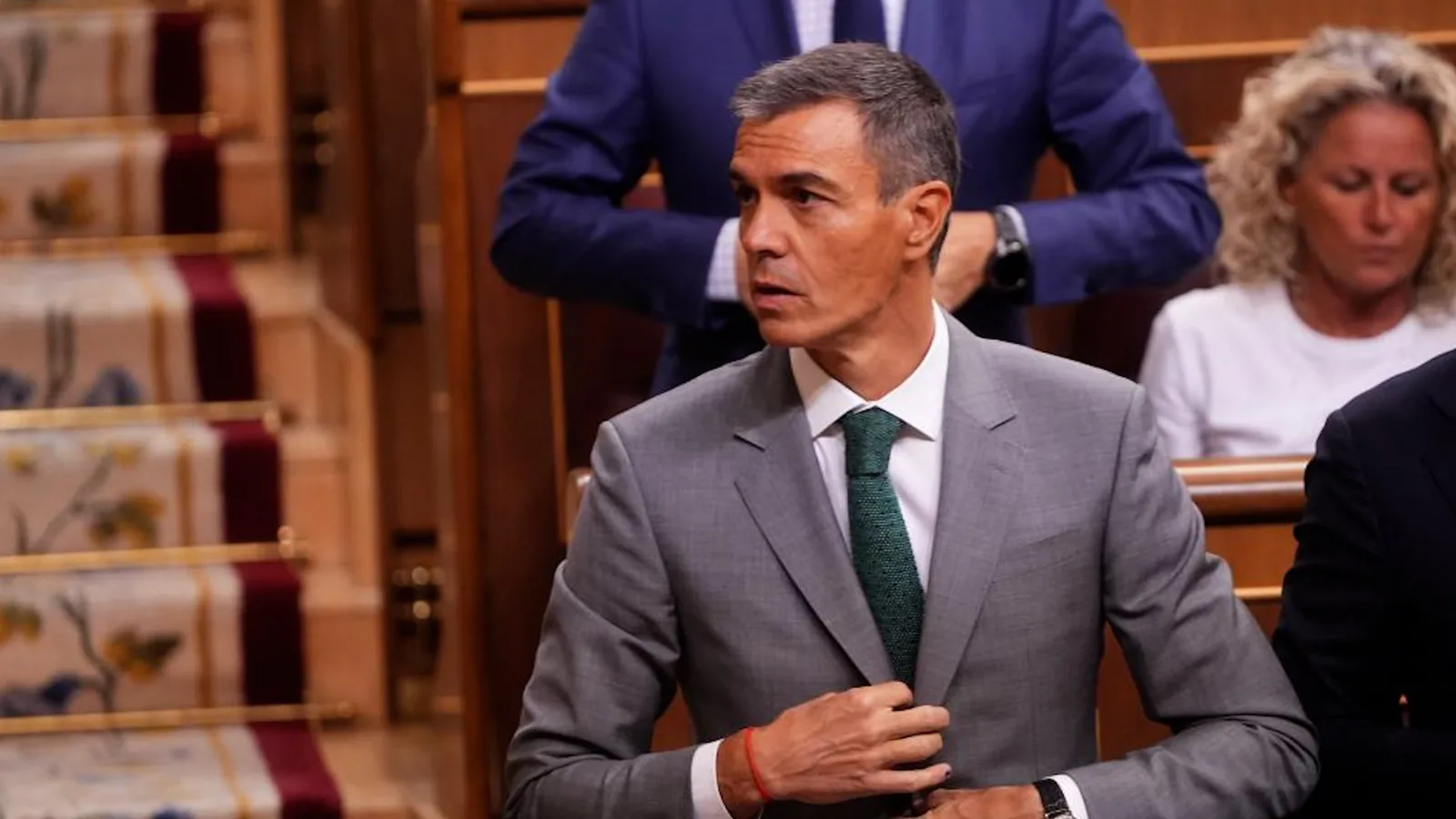
At midday, a food cart appears in the hallway of the Congress. It carries a couple of plates of ham. The stomach calls out. Salivation. It passes by. Everything against it, because, moreover, lunchtime is delayed, although they did not go five without eating. A long day in the Chamber to open the political course. The crisis in Ceuta due to the massive entry of more than 70,000 immigrants led Pedro Sánchez to appear this Thursday to offer his explanations, after more than a month has passed since the massive entry and the critical situation in the autonomous city has not yet ended. The head of the Executive made a turn in his position by hardening the discourse regarding Morocco: from exempting this country from responsibility, to not closing the door to it possibly having some, and warning that measures will be taken if “solid evidence” appears.
Read more The key report of the “mass entry” arrived three days late and with the invasion unleashed
The exemption from blame that almost all members of the Government have made for a month – “There is no evidence, no report, no indication that Morocco participated” – was not shared by everyone in the PSOE, by the Government’s partners, and by part of society. The idea that Sánchez is lukewarm or soft with Morocco for whatever reasons each considered is a narrative that Government members are aware is installed in part of the collective imagination and is very difficult to combat. “Everyone is the owner of their words and silences,” socialist sources point out regarding La Moncloa’s position in this crisis. Within the Executive, there are members who consider it vital to do “pedagogy,” “we have to explain the situation well and what we have done and can and cannot do.” A subject in which government sources object that it has been a subject to improve. There are voices that are clear: “We cannot treat people like fools,” referring to the fact that it was unreasonable to completely exculpate Morocco from responsibility when not all information was available or what happened invited, at least, doubts about it.
Although La Moncloa defends that there is no change of position, the president of the Government does not now close the door to ongoing investigations – both by the Security Forces and Corps and by the Justice system – possibly determining the involvement of the Moroccan government in the massive entry. The neighboring country is not pointed at “as of today,” “for now,” pending whether there are developments or “solid evidence” appears. And in a step forward, Sánchez warns that if these appear “we would act with total force,” verbalized for the first time. “This government is not afraid to confront other foreign powers.”
More forcefulness, in a key appointment and scenario, with the aim of combating an idea: “There is a false collective imagination promoted by the PP that we are sold out to Morocco. Thinking that is madness. We have done what we have considered because in the last week we have been accused of being trapped with Morocco,” they explain in Sánchez’s inner circle. In the intention to shake off that image, the head of the Executive closed the six-hour appearance showing his commitment that “what happened these days has consequences and is paid for.” And in his intervention, also a new warning in this crisis directed at Morocco: after what happened, “cooperation has to be different.” That said, without giving more details on how it has to change, although government sources allude to border controls, information exchange…
An example of that turn is that Sánchez decided to make public that on August 21 the Moroccan ambassador was summoned, something that had been kept secret, to reject the statements of a Moroccan minister about Ceuta and Melilla. “It was not told out of prudence and responsibility,” government sources point out. Finally, Minister José Manuel Albares spoke with the ambassador by phone and met with the chargé d’affaires of the embassy, as she was outside Spain.
Read more Lights and shadows of the ‘Ozempic era’: the business that threatens progress against obesity
The Government is aware that it has to “measure decisions and their consequences very well,” hence it works to avoid a “diplomatic conflict” with Morocco, but, at the same time, is obliged to convey a message internally to shake off the pressure from its partners who unanimously demand more firmness with the Alawite kingdom. “We do not have a policy of appeasement with Morocco, but of a neighborhood with red lines.”
Because Sánchez’s presence in Congress outlined the picture of a leader in solitude on this matter. Political parties pressed and demanded more from the president of the Government. “It is the loneliness of the captain of the ship. We have to be serious and responsible,” they say in La Moncloa.
The head of the Executive promises to make public all situation and alert reports prepared by the competent bodies – CNI, National Police, Military Intelligence… – between July 1 and August 1. He is determined to declassify those that require it. He continues to deny that they received any warning that anticipated “the scale or the probability of what happened. None went beyond the description of data or routine warning.”
Read more ChatGPT, Claude, and Gemini restore their services after a global outage that lasted several hours