




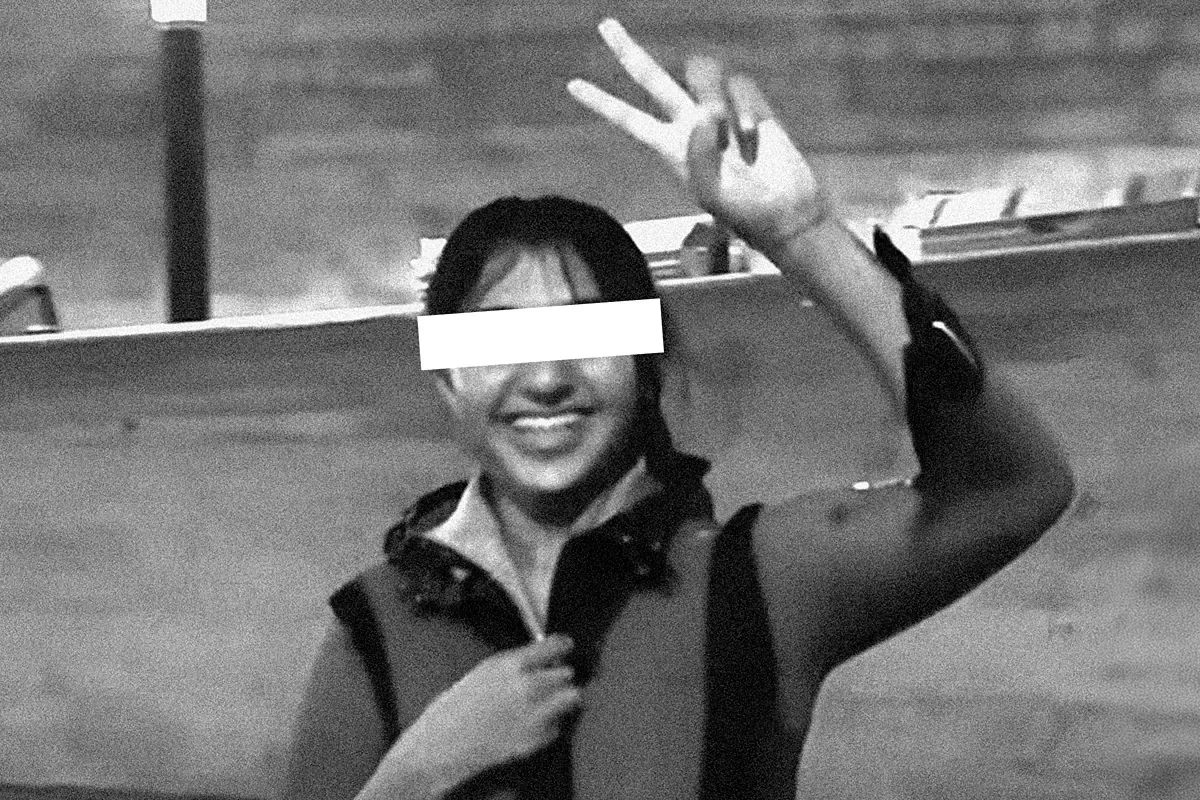
With a clean smile and showing the victory gesture with her left hand, Farah S., a young Moroccan woman who has just arrived swimming in Ceuta, lets herself be photographed by a reporter from El Faro, a local Ceuta newspaper. Upon arrival, the girl, a promising Moroccan athlete, lover of football and volleyball, walks barefoot, aimlessly, through the streets of the city. She still wears the wetsuit with which she swam about five kilometers, wet.
Read more 21 arrested after a new stone attack on soldiers in Ceuta
That same night, a Moroccan mother and her three children went into the water, although they did not manage to reach Ceuta. The gendarmerie of their country rescued them before they collapsed.
Farah, a minor, set off from a beach in Castillejos, the town on the other side of the border fence surrounding the autonomous city. She has just touched Spanish soil for the first time. She did not come alone. Her friend Bouchra, also from Larache like her, accompanied her throughout her swimming journey.
It is the early morning of July 28, 2026. Two days remain before the great human avalanche of more than 70,000 people who will break into Ceuta through the breakwater that separates it from Morocco.
In that moment of euphoria, Farah does not even suspect that her smiling face, her wet hair, her joy at reaching Schengen territory — although still in the north of the African continent — will almost immediately make her an icon of the greatest migratory crisis in recent Spanish history.
Even the Spanish Minister of Foreign Affairs, European Union and Cooperation, José Manuel Albares, will refer to her a month later, in Madrid, during his appearance before the Foreign Affairs Committee of the Congress of Deputies.
When Farah crossed, Ceuta had been receiving hundreds of people swimming from the other side of the border for about a week after a recent Supreme Court ruling prevented hot returns of those arriving by sea. At that time it was still the swimmers’ crisis.
On August 28, Albares was forced to give explanations before the other political parties in parliament. The minister pointed to Farah and her friend Bouchra.
He said that the image captured by El Faro photographer Joaquín Viera had been the seed for a call effect towards Ceuta through social networks in Morocco. Morocco, as the Government still maintains, albeit with nuances, had nothing to do with the matter.

“On July 8 the Supreme Court ruling was made public, the information crossed to social networks,” Albares said on the morning of August 28, 2026, in the Foreign Affairs Committee.
“From July 8 to 23 there were few publications in Arabic about it. July 28: the video of two young women crossing the border goes viral, views soar to 30 million in Morocco. The news ends up being decontextualized and determines that the border was open. July 30, 60% of the publications are concentrated that day, 215 with the same text.”
The spark ignited just two days after Farah’s arrival. Ceuta, with 84,000 inhabitants, saw its population almost double in just 24 hours, between the morning of July 30 and that of July 31. To date, according to government estimates, around 5,000 immigrants remain in the city — about 1,500 of them minors, like Farah —.
“Of course, she’s the girl from Larache who…”
Last Thursday, September 3, a Crónica reporter traveled to Ceuta to follow Farah’s trail. The girl has become a legend for Moroccans who crossed during those two historic days.
Everyone is happy when asked about her, although very few know for sure where she is. “Go to the Equestrian Center”, says a young man from Morocco wandering through Ceuta mid-morning when shown a picture of the young woman. “Yes, yes, I know who she is. Farah! They told me she was there, with many other women.”
Social networks, especially Instagram and TikTok, are full of profiles created around Farah’s figure — and, to a lesser extent, her friend Bouchra’s. All were created following that image of the girl making the victory gesture.
Some of the photos appearing on them have been taken from old profiles of Farah herself or people who know her. In some, she appears playing football on a beach with her teammates. Other images, however, have been created with Artificial Intelligence.
In one of these latter, generated with AI and published on TikTok, Farah appears dressed in a wetsuit, making the same gesture as when she arrived in Ceuta, but on top of a pedestal in Plaza de España, Seville. On her feet it reads: “From the hell of Morocco to the paradise of Spain.”
Last Friday, at the close of this supplement, that post had more than 195,000 views, over 300 comments, and almost 8,000 likes. “I’m happy for her. Brave woman. I hope life is easier for you outside your country, inshallah (God willing),” a woman replied to that fake photo of Farah.
Read more Jordan Bardella: “In Ceuta there was a migratory invasion and the role of Morocco must be examined”
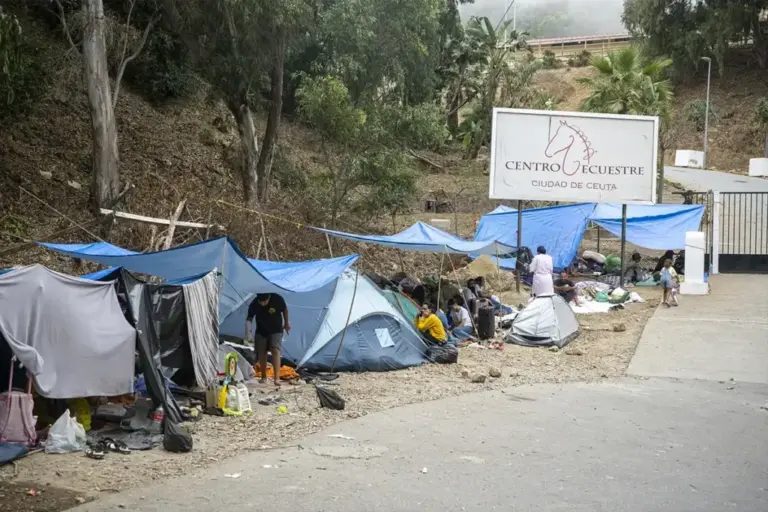
The Ceuta Equestrian Center, known as the Equestrian Club, is located on the outskirts of the city, next to a hill. It is also located, fence to fence, next to the Temporary Stay Center for Immigrants (CETI).
The Government has set up a reception point for women and children at the Equestrian Club. There, immigrants have tents to eat and sleep, as well as hygiene areas. It currently accommodates around 250 people, although outside, in tents, about 50 more are waiting to enter.
The reporter asks several adult women leaving that immigrant reception point about Farah. They all say they know her but assure that the teenager is not there. One of them says she believes she is at the CETI, right in that facility whose fence can be seen from the door of the city’s equestrian center. Difficult, since only adults are there.
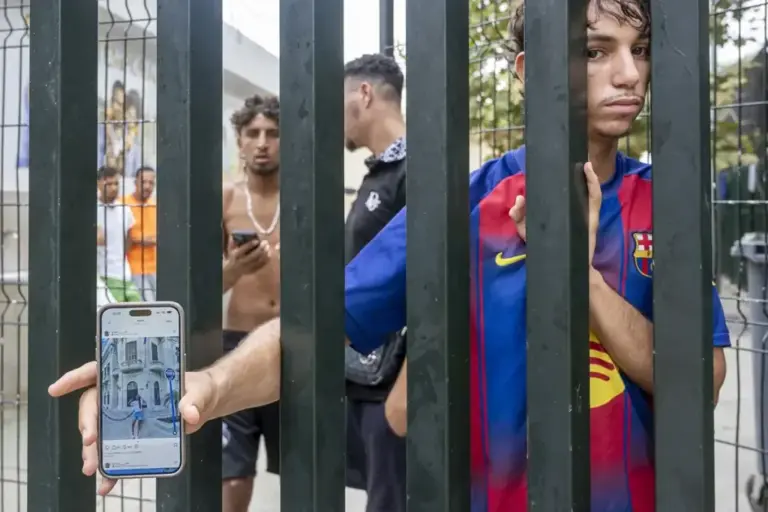
On the way to the CETI, a young man approaches the perimeter gate of the facility. The boy wears an FC Barcelona shirt. He is Moroccan. Like the rest of his friends, he also immediately recognizes Farah’s face.
“Yes, the girl from Larache who arrived swimming, in a wetsuit, before most of us,” he says. “Of course we know her. Here — inside the CETI — there is a friend of hers who is also from there. He has been able to talk to her through the Instagram account created after arriving in Ceuta. He told me Farah is in a center where there are only minors, but I don’t know which one.”
Crónica’s route through Ceuta ends in an industrial estate near the Loma Margarita road. In one of the warehouses, the Samu foundation has been hosting more than fifty underage girls since mid-August who until then were in another provisional camp in the city.
“Farah is here,” says a Samu technician who comes out of the facility to warn the reporter that all the people housed in that warehouse are minors and that he does not have authorization to allow talking to them.
“We cannot give information about any of them, sorry,” he says before closing the gate that separates him from the street again. Hours later, already in the afternoon of last Thursday, a group of about twenty girls leaves the facility.
They are accompanied by a monitor. They have gone out to play football and stretch their legs in a nearby vacant lot. Farah is not among them; she remains inside the warehouse where she is currently residing.
The turn towards the MarrOQUÍ route
Until this week, the Spanish Government had never pointed to Morocco as the architect, not even as a permissive party, of the arrival of more than 70,000 immigrants in Ceuta.
The Executive only mentioned immigration mafias, the power of social networks to spread hoaxes (as Albares did at the end of August), and even Israel and Russia as being behind it.
It was also said that there was no prior report indicating what was going to happen in the autonomous city.
However, last Thursday, the Government qualified its position after the content of a report from the National Immigration and Borders Center (Cenif) sent to the National Court became known. This document points out that Moroccan agents “guided” the entry of immigrants into Ceuta.
The Immigration report points to the “permissiveness” of Moroccan authorities and gendarmes in uniform and plainclothes. It states that the entry was planned, although it does not define a specific author.
On Thursday, in the Congress of Deputies, the president, Pedro Sánchez, hardened his discourse regarding Morocco: he went from exempting the neighboring country from any responsibility in the crisis to not closing the door to the possibility that it may have some. He also warned that he will take measures if “solid evidence” appears.
“We would act with total force,” he said for the first time. “This Government is not afraid to confront other foreign powers,” he added, although he insisted on the existence of “a conjunction” of factors and the action of “numerous actors.”
If Sánchez’s turn was evident, last Thursday it was also evident that the Executive no longer places much of the responsibility for the crisis on the call effect that social media posts by those who arrived swimming in Ceuta before July 30, such as Farah, icon of those who crossed the border irregularly, may have had.