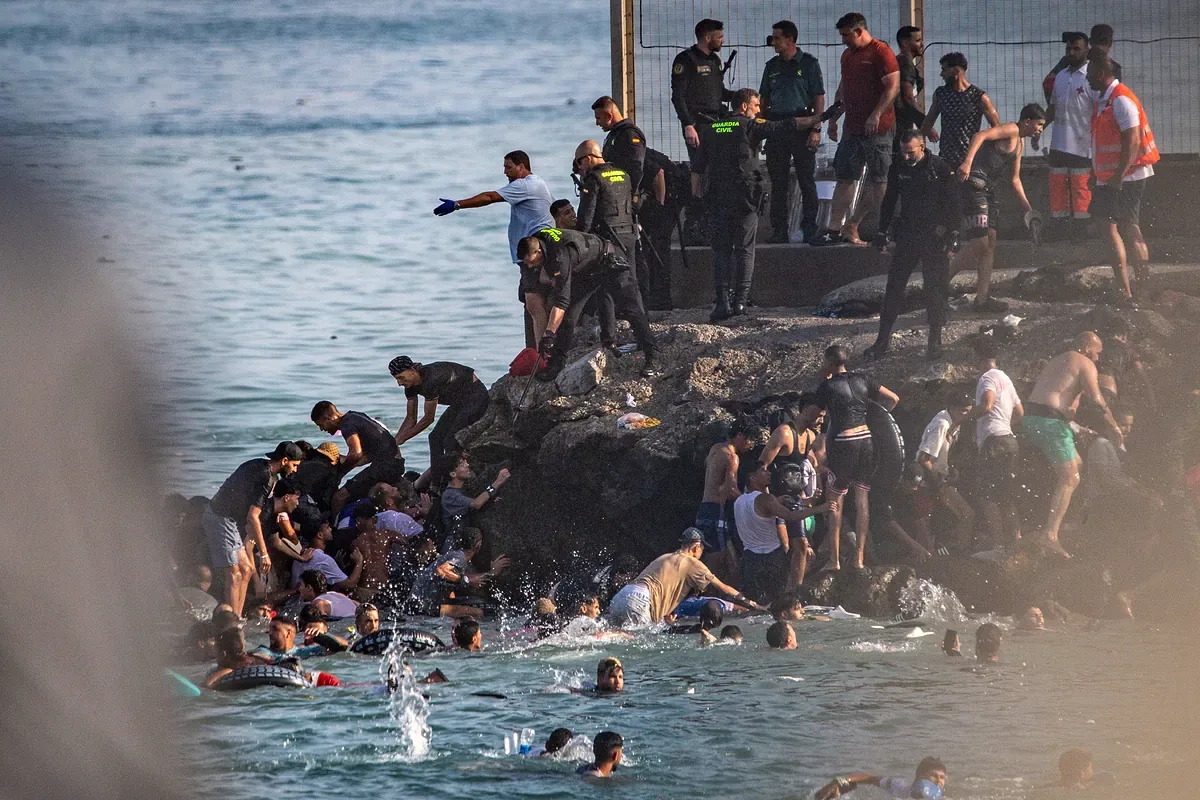


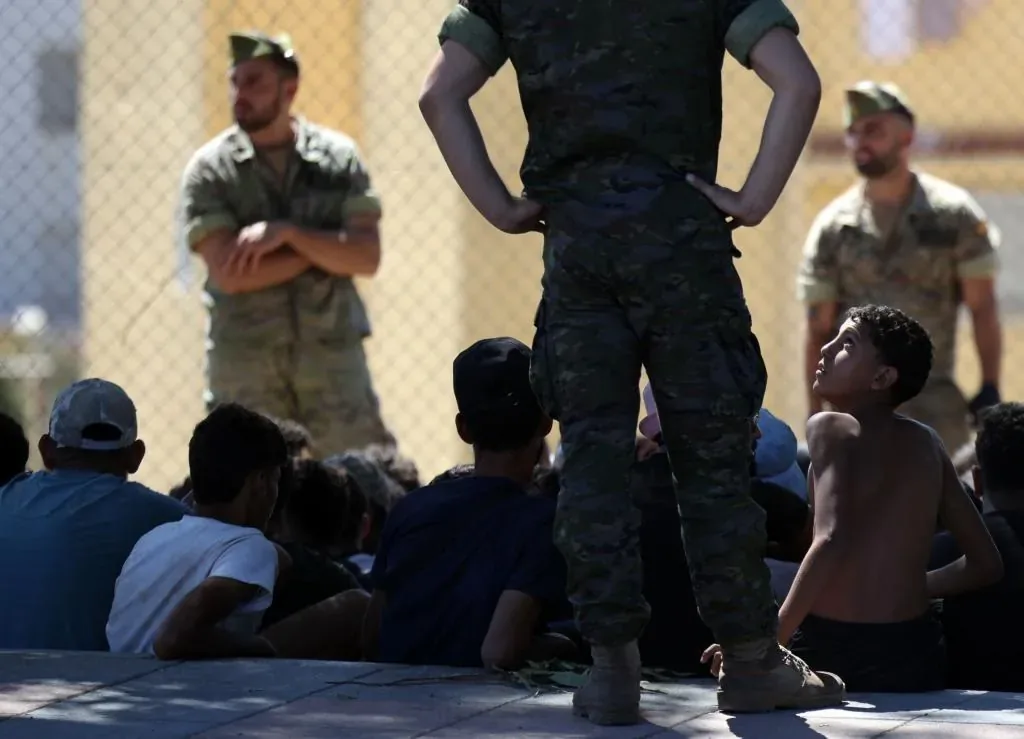
Most of the 60,000 immigrants who swam, climbed, and then broke into the tiny Spanish enclave in North Africa this week had returned on foot to Morocco by Sunday, but some stayed in the hills surrounding the city. Spanish authorities were still searching for bodies in the waters near the stretch of urban beach that tens of thousands of migrants had crossed days ago.
Ceuta’s shops reopened, and the usual mix of residents and tourists in the city of 84,000 inhabitants filled the outdoor terraces, restaurants, and cafés.
At least 72 migrants died, including some who drowned and others who died in a stampede while trying to cross a breakwater, Spanish authorities reported on Sunday. Morocco reported 11 deaths on its side of the border, but it was not yet clear if these were included in those reported by Madrid. Moroccan authorities blamed misinformation and human traffickers for the breach and added that they were investigating the events.
“The young people are not to blame,” says Mohamad Abdelkader Driss, 44, a waiter at a fish restaurant downtown. “If you open the border, of course everyone comes in, but the kids are not to blame. The big ones and those in charge are. Much more could have happened.”
Additionally, the National Court judge María Tardón has requested the General Immigration and Borders Police Station (UCRIF) of the National Police to issue a report on the “mass irregular entry” of tens of thousands of people from Morocco to Ceuta on July 30 and 31, aiming to determine if it was a “concerted action.”
In an order accessed by Europa Press, the magistrate agrees to open preliminary proceedings following a complaint by the organization Iustitia Europa, which on July 30 filed a criminal complaint against officials, “members of criminal organizations,” and Spanish and foreign authorities who could be identified.
Podemos calls it “lysergic” that Von der Leyen claims Moroccan authorities managed the crisis “effectively”
The national co-spokesperson of Podemos, Pablo Fernández, has criticized EU migration policies after the Ceuta crisis and called it “lysergic” that the President of the European Commission, Ursula von der Leyen, congratulated Morocco in her letter this Monday.
“This incident makes it clear that we must do more to strengthen our borders at critical points, both through rigorous surveillance and the use of physical barriers when necessary,” the German conservative states in a letter addressed to the Prime Minister, accessed by Europa Press, in which she avoids commenting on Sánchez’s criticisms about the lack of solidarity from other European partners.
“Spanish and Moroccan authorities managed the situation efficiently and effectively,” she states. In response, the purple party leader emphasized on social media that this crisis has caused “almost 100 deaths” and it seems “no one remembers them”.
The Legion detains and concentrates groups of immigrants in Ceuta to deport them: “I could lie to you, but we take them to the border”
“The military truck had just arrived at the beach when one of the immigrants took advantage of the distraction. He suddenly got up, broke the cordon formed around the group, and ran towards some stairs. The legionnaires chased after him while several soldiers asked journalists to intervene, to block his path, to tackle him. However, the man managed to escape upstairs”.
This is how this report by Daniel J. Ollero and Alberto di Lolli, special correspondents in Ceuta, begins.
The Ceuta Government estimates between 3,000 and 5,000 migrants still remain in the city
The Ceuta Government, led by Juan Jesús Vivas (PP), estimated this Monday between 3,000 and 5,000 migrants still remain in the city after the massive entry through the border breakwater last Thursday. Sources from the regional government told EFE that the approximate calculation indicates that several thousand people still remain in Ceuta who have not wanted to accept return to their country of origin, despite transport being facilitated by buses.
The Ceuta government has highlighted that it also estimates that about 80,000 people may have entered, considering the number of people who have returned as well as calculations made by several police sources consulted by Vivas’s government. For this reason, the government has estimated that normality has not yet been restored, as many migrants are in different areas and parts of the hills.
Meanwhile, the Government delegate in Ceuta, Miguel Ángel Pérez Triano, stated this Monday that, according to Interior Ministry data, about 2,500 people remain irregularly in the autonomous city four days after the massive entry of migrants from Morocco. “We have not yet recovered normality,” he said in statements to TVE, collected by Europa Press, emphasizing that the 2,500 migrants who remain irregularly in Ceuta are “an excess of people for the city’s capacity to attend to them”.
Imbroda wonders what the Government owes Morocco “for it to pay us like this”
The president of Melilla, Juan José Imbroda (PP), asked this Monday “what the Spanish Government owes Morocco for it to pay us like this” and said that what happened in Ceuta with the massive entry of immigrants was “the greatest absurdity that could have happened in Spain since democracy, except for ETA.” In a press conference, Imbroda denounced that “national sovereignty and the life and well-being of 85,000 Spaniards” living in Ceuta “have been put into question”, and recalled that both autonomous cities together total 180,000: “We are not many, but we are not few”.
He reiterated his solidarity with the people of Ceuta in what he called a “Dantean tragedy” and clarified that the increase in migratory pressure in Melilla is “nothing to do” with that of Ceuta, although the number of minors received has doubled. He defended that “so many concessions cannot be made from national politics to Morocco in exchange for nothing” and demanded that Spain require “a one hundred percent friendship” and “a loyalty of years of neighborly history” as the main supplier country and “protector” of Morocco “in any instance of European institutions”.
The Government emphasizes that Von der Leyen recognizes its effective management of the Ceuta crisis
The Government emphasized this Monday that the President of the European Commission, Ursula von der Leyen, recognizes in her response letter to the one sent by the Prime Minister, Pedro Sánchez, regarding the situation in Ceuta, that Spain has managed this crisis effectively. Sánchez, in his letter to Von der Leyen, requested on Saturday a meeting of EU Interior Ministers to address the massive entry of people from Morocco (which has finally been convened for this Tuesday), while expressing his “deep concern” about the reaction of some European governments.
The Commission President’s response letter, made public this Monday, praises the “efficient and effective” management of the situation by Spanish and Moroccan authorities and emphasizes the need to provide a “common European response,” united and supportive. Government sources highlight Von der Leyen’s assessment of the crisis management and her emphasis that Spain acted decisively without increasing the loss of human lives.
Von der Leyen’s response, in this report by Marta Belver.
The PP sees Sánchez as primarily responsible for the Ceuta crisis
For the main opposition party, the crisis caused by the entry of 60,000 people from Morocco to Ceuta last Thursday “has a main responsible, and that main responsible is Pedro Sánchez”. This was stated this Monday by the PP’s Secretary General, Miguel Tellado, who accused the Prime Minister of having incurred in “continued, chronic negligence” in three areas: migration policy, security, and foreign affairs.
Details, in this report by Paloma H. Matellano.
Robles takes a stand against Marlaska amid the Government clash over Ceuta: defends the CNI and reminds that there are “intelligence services” that depend on Interior
“Crisis between Interior and Defense,” EL MUNDO titled today on its front page. Because Fernando Grande-Marlaska, Interior Minister, and other sources from his department had insisted since Friday that the CNI, dependent on Defense, had not warned about the avalanche of thousands of people towards Ceuta. And military sources consulted yesterday by this newspaper responded by recalling that border control is not Defense’s responsibility but Interior’s. There lay the crisis, the clash.
But it was missing to hear from Margarita Robles, the Defense Minister who, unlike Marlaska, had not yet spoken about the Ceuta crisis. The minister, as usual, demonstrated her autonomy. On one hand, in a statement to Morocco that no government member had dared to make until now, and on the other, in defending her department against veiled criticisms from Interior.
The minister said she did not want to contribute to “controversies that benefit no one,” but wanted to clarify the situation. She began with her “recognition of the CNI,” but when she extended it to other “intelligence services”, such as those of “the Civil Guard,” she pointed to Marlaska, on whom the Civil Guard and Police depend.
Robles breaks the Government’s silence on Morocco, demands “to get to the bottom to know what happened” and condemns that “young people are sent to death”
Defense Minister Margarita Robles has broken the Government’s silence on Morocco’s responsibility in the massive arrival of thousands of immigrants to the autonomous city of Ceuta and has demanded Rabat “to get to the bottom to know what happened,” while condemning that “young people are sent to death”.
Until now, both the Prime Minister, Pedro Sánchez, and the Interior Minister, Fernando Grande-Marlaska, have avoided blaming Morocco for the massive passage of immigrants to Ceuta, attributing what happened to mafias.
This Monday, however, Robles pointed to the responsibility of Moroccan authorities in this tragedy, which has resulted in the death of about a hundred people: “I ask the Moroccan Government to see who is behind these networks, who is responsible: who organizes it through the mafias, who deceives, who tells them they will enter irregularly,” Robles said.
The Army transports hundreds of migrants from Ceuta neighborhoods back to the border
The Armed Forces deployed in the streets of Ceuta searching for irregular migrants who remain in the city after the massive entry have transported hundreds of North Africans back to the Tarajal border on Monday morning. Migrants continue to wander through the city’s peripheral neighborhoods. Hundreds of them are on Benítez road, which leads to the Temporary Stay Center for Immigrants (CETI), and on the road to the Benzú district, near the other Ceuta border with Morocco, the Beliones border.
Units of the Regulars and the Legion of the Army have headed to the Benzú district, where they detained a group of more than 50 migrants. At 12:00, two military vans arrived in the area where they loaded the half-century of people and directed them towards the Tarajal border to return to Morocco on foot.
More than 200 migrants, many of sub-Saharan origin, are held by the Army and National Police on Trampolín beach, just meters from the CETI. The security forces’ goal is to prevent migrants from moving to the center, city neighborhoods, or the reception center, which is saturated with more than a thousand residents despite its 512 places.
Von der Leyen does point to Morocco for the crisis in Ceuta: “No attempt to use irregular migration as a means to pressure” Spain can be accepted
The President of the European Commission pointed this Monday to Morocco’s responsibility in the avalanche that allowed between 50,000 and 60,000 people – according to Interior Ministry data – to cross the Spanish border of Ceuta in a matter of hours. “No attempt to use irregular migration as a means to pressure a member state can be accepted,” says Ursula von der Leyen in the letter she sent to the Spanish Prime Minister, Pedro Sánchez, in response to the one he sent her on Saturday complaining about criticism from several community partners regarding his foreign policy.
Despite pointing to this, the head of the executive body of the 27 states in her letter states that “technical and financial support” from the European Union to Rabat should be improved as well as “early warning systems for border management”.
Read the report by Marta Belver.
The PP launches an offensive in the Cortes over Sánchez’s management of the migration crisis
The PP has launched a parliamentary offensive in the Congress and Senate, through a series of initiatives, to demand that the Prime Minister, Pedro Sánchez, adopt urgent measures to prevent the migration crisis of recent days in Ceuta and Melilla from repeating.
This is what the Popular Party announced in a statement denouncing a “very serious dereliction of duties” by the head of the Executive, considering that he ignored the “warnings” about the risk of a “massive entry” through the Ceuta border.
The PP also recalls that on July 16, following Supreme Court ruling 814/2026, it filed a proposal in Congress to reform the immigration law and allow the rejection at the border of migrants who enter by swimming into the two autonomous cities. The party led by Alberto Núñez Feijóo argues that this reform can be processed “immediately” through the “single reading” procedure.
Meanwhile, it has filed a series of questions in the Senate for the Government to respond in writing, as well as a request for documentation to know the reports prepared, statistics of irregular entries, and instructions from the Interior Ministry following the Supreme Court ruling.
The Basque Government urges the central Government and the EU for an “immediate and coordinated” response to what happened in Ceuta
The Basque Government has urged the central Executive and the European Union (EU) for an “immediate and coordinated” response to what happened in Ceuta, with the arrival of thousands of irregular migrants from Morocco, as well as a “structural migration plan”, which “has long ceased to be a temporary reality”.
The Basque Government’s Minister of Welfare, Youth, and Demographic Challenge, Nerea Melgosa, responded in these terms when asked by journalists in San Sebastián about what happened this past weekend in Ceuta.
After expressing her “pain” for the people who lost their lives trying to reach Spain from Morocco by sea and “solidarity” with their families and with the citizens of Ceuta and those working on the ground, Melgosa stressed that “what happened is an extraordinary seriousness” and “confirms something the Basque Government has been saying for some time, that migration has long ceased to be a temporary reality”.
For this reason, she opined that it “cannot continue to be managed through patches, emergency distributions, or decisions made without willingness by the territories that then have to respond”.
IU calls to recall the ambassador in Morocco amid the “hybrid attack” in Ceuta
The federal coordinator of IU, Antonio Maíllo, has advocated that the Government recall the Spanish ambassador in Morocco amid the “hybrid attack” that, in his opinion, occurred last Thursday in Ceuta with the crossing of the border by tens of thousands of people with “about a hundred” deaths.
Maíllo, who expressed his condolences for the death of these people in statements to the media in the Andalusian Parliament, has called for a meeting of the crisis cabinet in the Government and the National Security Council.
“Morocco is responsible for this tragedy,” insisted the IU federal coordinator, who asked the Prime Minister, Pedro Sánchez, to change his policy regarding the neighboring country, which “is neither a reliable nor responsible partner.” According to Maíllo, the “appeasement strategy has been a resounding failure.”
The National Court requests a report to investigate if the Ceuta migration crisis is the action of a “criminal group”
National Court judge María Tardón has requested the General Immigration and Borders Police Station (UCRIF) of the National Police to issue a report on the “mass irregular entry” of tens of thousands of people from Morocco to Ceuta on July 30 and 31, aiming to determine if it was a “concerted action.”
In an order accessed by Europa Press, the magistrate agrees to open preliminary proceedings following a complaint by the organization Iustitia Europa, which on July 30 filed a criminal complaint against officials, “members of criminal organizations,” and Spanish and foreign authorities who could be identified.
Iustitia Europa filed the complaint for alleged crimes against State Security, against the Nation, for facilitating illegal immigration and human trafficking, criminal organization, and omission of the duty to prosecute crimes.
Ceuta counts 862 migrant minors hosted in the city, a “2,872% overcapacity”
The Ceuta Minister of Presidency and Governance, Alberto Gaitán, has estimated this Monday a total of 862 migrant minors hosted in the autonomous city, which represents a “2,872 percent overcapacity,” four days after the massive entry of migrants from Morocco.
“The ordinary capacity assigned to us by the Ministry is 29. We are therefore talking about an overcapacity of almost 3,000 percent. 2,872 percent,” the Minister of Presidency said in an interview with Cadena SER, reported by Europa Press.
Alberto Gaitán indicated that “this is the situation as of today” and that they have “the issue of minors under control.” However, he warned that it already happened in 2021 and “more minors may come out, who may have been picked up in some house, etc.”
Albares heats up the EU summit over the massive crossing to Ceuta: points to Italy and the “reactionary international”
Three days after the massive crossing of Moroccan citizens through Ceuta, the Government continues with the strategy of absolving Morocco of all responsibility for that migratory avalanche. Thus, this Monday, the Minister of Foreign Affairs, José Manuel Albares, answered questions from Televisión Española with two arguments: first, repeatedly insisting that there was “a very unusual activity on social networks” that caused the call effect; and then, repeatedly pointing to the “reactionary international” that, according to the head of diplomacy, “went out to spread lies”.
The Foreign Minister’s words come a day before the European Union hosts an extraordinary meeting of the Interior Ministers of the 27 at the request of Prime Minister Pedro Sánchez to address the migration phenomenon and the countries’ reactions. Several community members called for strengthening borders and even proposed closing the Schengen area to protect themselves from the massive arrival of migrants.
Read the report by Marina Pina.
More than 1,500 migrants medically attended in Ceuta, after 463 in one day
More than 1,500 migrants who entered Ceuta during the massive access through the Tarajal border breakwater have been attended at the University Hospital and health centers, 463 of them on Sunday.
According to data provided by the National Institute of Health Management (INGESA), 463 people were attended yesterday without “notable incidents” at any level of health care.
INGESA has expressed its recognition of the “professionalism of the workers and categorically denies” statements made by certain political parties and trade unions regarding an alleged “collapse” of the system, “an extreme that does not correspond to the objective activity data”.
“At no time has there been a collapse situation in the Health Area’s care devices as the statements lack support in the objective activity data, which reflect an orderly operation and adjusted to established protocols”.
Melilla adds another quiet night at the border, prioritizing travelers in transit
The Melilla border has had its second consecutive quiet night after the start of the migration crisis last Thursday in the autonomous city, while the Beni-Enzar border crossing remains open gradually and prioritizing travelers of the Strait Crossing Operation (OPE).
Sources from the Government Delegation in Melilla informed EFE that there is no record of incidents in the border perimeter, as was already the case on Sunday morning.
At the Beni-Enzar border crossing, the situation is “semi-normal,” police sources told EFE, as traffic continues gradually, in batches of 20 vehicles, always prioritizing vehicles of OPE travelers, so Melilla residents can only cross when no foreign cars remain pending to cross to Morocco.
Albares, on Ceuta and Melilla: “Being the only European cities inside Africa is a huge challenge”
Foreign Minister José Manuel Albares reiterated on TVE his support for Morocco, as he understands that practically all of the 80,000 immigrants who crossed into Ceuta in two days have already returned to their country of origin.
Regarding criticism from some EU countries, Albares justified that neither Ceuta nor Melilla are the main points of irregular immigrant entry into Europe – that is Italy –. He also highlighted the work being done, he recalls, in the “only two European cities located inside Africa,” which is a huge challenge.
Between 3,000 and 5,000 people of the 80,000 who entered by swimming could remain in Ceuta
The Minister of Presidency and Governance of the Autonomous City of Ceuta, Alberto Gaitán, just said on Cadena Ser that they estimate the total number of people who entered Ceuta is 80,000, that about 73,000 have left, and that between 3,000 and 5,000 people may remain in Ceuta, reports Marta Belver.
The ‘others’ in the great avalanche in Ceuta: the incredible story of the three Palestinian brothers and the Afghan couple
The Gaza brothers Ahmed, Mohammed, and Abdellah Zayda walk through the forest surrounding the Temporary Stay Center for Immigrants of Ceuta (CETI) while hundreds of North African and sub-Saharan men try to build small huts with reeds, branches, and plastics. Dozens more lie on the asphalt, with tattered clothes and tired faces. Others walk back and forth aimlessly. There are several women, but they are a minority.
These three young Palestinians who speak with EL MUNDO also arrived swimming to Ceuta through the beach that separates the Spanish autonomous city from the neighboring country, Morocco. “We want to seek political asylum in Spain,” says Ahmed, the eldest of the three brothers.
“I have 427 people ahead of me. My registration number is 428,” he adds, showing the document that the Red Cross gave him. At the top left of the paper he shows, that number appears. It is his turn to access the CETI.
Read the report by Andros Lozano.
Europe retires Pedro Sánchez’s migration model
Pedro Sánchez’s migration policy is part of the past for the heart of Europe. The letter from 22 signatories requesting more border control and fewer measures that could cause a call effect has left the Spanish government alone in Brussels. Meanwhile, the autonomous cities of Ceuta and Melilla try to recover a normality that already coexists with the feeling of extreme vulnerability to Morocco’s whims. After eight years in power, the Europe Sánchez arrived at as president no longer resembles the current one.
What has changed in the Union’s migration policy? To answer, one must travel back 11 years, to the Aegean Sea. On September 2, 2015, photographer Nilüfer Demir captured on a beach in Bodrum (Turkey) the body of a two-year-old boy drowned trying to cross by boat to the Greek island of Kos. He was traveling with his Kurdish family, fleeing war towards Canada; his mother and brother Ghalib also died. His name was Aylan Kurdi.
That image was the emotional trigger for a 180-degree turn. It became the symbol of the crisis and gave it a humanitarian dimension: almost all European governments (except Hungary and Poland) changed their stance, and in less than a month, commitments to reception multiplied. It came at the right time: just days after Merkel pronounced her «Wir schaffen das» (we can do it). Europe opened wide to Syrians, Afghans, and Iraqis.
Read the analysis by Alberto Rojas.
Ceuta tries to return to normality with caution, fear of going out, and half-empty shops after the migration crisis
Ceuta residents try to recover normality amid reluctance to go out, restaurants and beaches emptier than usual, and a calm that does not fully arrive, after the massive arrival of migrants recorded since Thursday and what would have been the first days of the city’s fair, which had to be canceled.
“The beach is empty and my beach bar is half full”, Virginia lamented to Europa Press, responsible for a beach bar on Playa del Chorrillo, just three minutes by car from the border, noting that at 14:00 on Sunday she had only 6 of the 24 tables in her establishment occupied.
She pointed out that recurring images of migrants using the showers in front of her beach bar and some false information circulating on social media, such as that the water is contaminated with diseases like scabies, have motivated many Ceutans to stay home. “The summer season has been ruined”, she concluded.
Closer to the center, at the maritime port, Eugenio and Vicky – the owners of a restaurant – highlighted the “brutal drop” in customers in recent days, as they were able to stay open during the strongest days of the migration crisis because their establishment is protected inside a closed enclosure.
New physical (and judicial) border to shield Ceuta against ‘swimmers’: 500-meter pneumatic band and anti-diving
The maritime barriers installed on Saturday in front of the Tarajal breakwater were fully operational yesterday, allowing the Government to recover the special border rejection regime for those entering Ceuta by sea after crossing them. The infrastructure incorporates for the first time a physical obstacle on a route used for years by those who reached the city by swimming and is activated after the irregular arrival of around 60,000 people from Morocco between Thursday and Friday, the largest migratory avalanche recorded in the autonomous city.
The infrastructure extends along 500 meters in front of the breakwater and consists of a pneumatic barrier that protrudes between 30 and 70 centimeters above the surface and reaches up to one meter deep. It also incorporates a submerged skirt that prevents bypassing it by diving. In front, a first line of buoys provided by the Navy has been anchored, while the space between both elements serves as a navigation channel for the Civil Guard’s Maritime Service patrol boats, responsible for guarding the installation and ensuring its maintenance.
Read the report by Juan B. Cañellas.
Ceuta, beyond the latest avalanche: the challenge of living under Morocco’s permanent ‘siege’
Ramesh Chandiramany caught the worst of this latest migration crisis away from home. Ceutan, although born in Pune (India), chose to go on vacation just before the worst migratory avalanche in the history of the autonomous city (and all of Spain), as well as the most tragic, with nearly a hundred dead, was recorded. But he has suffered it as if he were here. After all, he has lived every single one of the crises that periodically shake the autonomous city.
He retired a decade ago and for many more years ran an electronics distribution company. He was then, and still is now, the president of the Hindu Community in Ceuta, one of the four religious communities – along with the Jewish and the majority Christian and Muslim – that coexist in a city where multiculturalism is not an empty slogan.
Ramesh settled with his family in the city so long ago that he has no other memory than the Mediterranean that bathes its shores and has been a witness to its recent history, sometimes turbulent. Over all these years, beyond the arrival of more than 60,000 migrants who stormed the border between Thursday and Friday, he says he has felt the Moroccan threat every day. “The border and the country that surrounds us condition us day to day, in everything,” he says.
Read the report by Chema Rodríguez.
The Ceuta avalanche opens a rift between Interior and Defense while Sánchez and Marlaska cover for Morocco
The Government’s eagerness to absolve Morocco of any responsibility regarding the massive passage of swimmers to Ceuta has also led to a clash between ministries. This Sunday, the Government delegate in the autonomous city, Miguel Ángel Pérez, said they had “no information” until they started “seeing those people entering through the border that way.” A phrase that would shift responsibility to Spanish intelligence services, dependent on the Ministry of Defense and which, by their nature, cannot defend themselves. In the same vein, the Interior Minister, Fernando Grande-Marlaska, said the day before yesterday that “there is no report that a situation like that of the 30th could have arisen.”
While all sources consulted attribute the swimmers’ avalanche to “a massive call effect,” it is also becoming obvious that the Moroccan autocracy, led by Mohamed VI, did nothing to prevent the passage of thousands of people through the border and perhaps the informants on the ground learned about the avalanche late. Because such a tide can be detected in several ways. The first is through images from surveillance satellites, although these photographs from space can be misleading and are not entirely reliable, says a knowledgeable source, who also explains that the most reliable is to monitor the activity of telephone repeaters, as it accounts for the increase in the number of people in an area and since when it happens.
Read more Ceuta, beyond the latest avalanche: the challenge of living under Morocco’s permanent ‘siege’
Read the report by Marina Pina and Paloma H. Matellano.