



All the residents of the Malaga municipality of Estepona, one of the most populous on the Costa del Sol. Or twice the number of registered residents in the city of Teruel. About 72,000 people, in total. The figure is the updated estimate by the central Government of the number of immigrants who last week irregularly crossed the maritime border between Morocco and Ceuta within hours, practically all at once. And without their movements being a cause for alarm for the National Intelligence Center (CNI).
This is at least the version maintained by the Interior Minister, who insists that he did not receive any warning from any of the Spanish secret services nor from those of other European Union countries. “If there had been any possibility that something like this could happen, I am not saying what definitely happened, but something similar to 2021 [when another 10,000 foreigners also arrived en masse to the autonomous city], there would have been a report or a warning to the highest authorities shortly after. I think that says it all,” emphasized Fernando Grande-Marlaska this Tuesday in a press conference.
Thus, the highest official of the State Security Forces and Corps implicitly questioned the effectiveness of the CNI, which is attached to Defense, for not having had the capacity to anticipate the large migratory movement at the Spanish border with Morocco. However, he wanted to convey his “confidence” and “recognition” for the work carried out by the CNI and justified that no dismissals occur with the argument that “there are many things that happen and there does not necessarily have to be any responsibility.”
His position clashes with that adopted by the minister to whom the CNI reports, the main intelligence service in Spain. Margarita Robles stated on Monday that she does not want to contribute to “controversies that benefit no one,” anticipated that she will not “get caught up in any kind of discussion,” but did emphasize that “all Intelligence departments,” both the one under her command and those not, perform “exceptional work.” By extending the scope to “all,” she also included Marlaska, the hierarchical superior over the Police and Civil Guard. Defense and Interior point fingers at each other, but neither admits guilt. The Government tries to resolve the crisis without assuming any responsibility despite admitting the unprecedented scale of the crisis and the information vacuum.
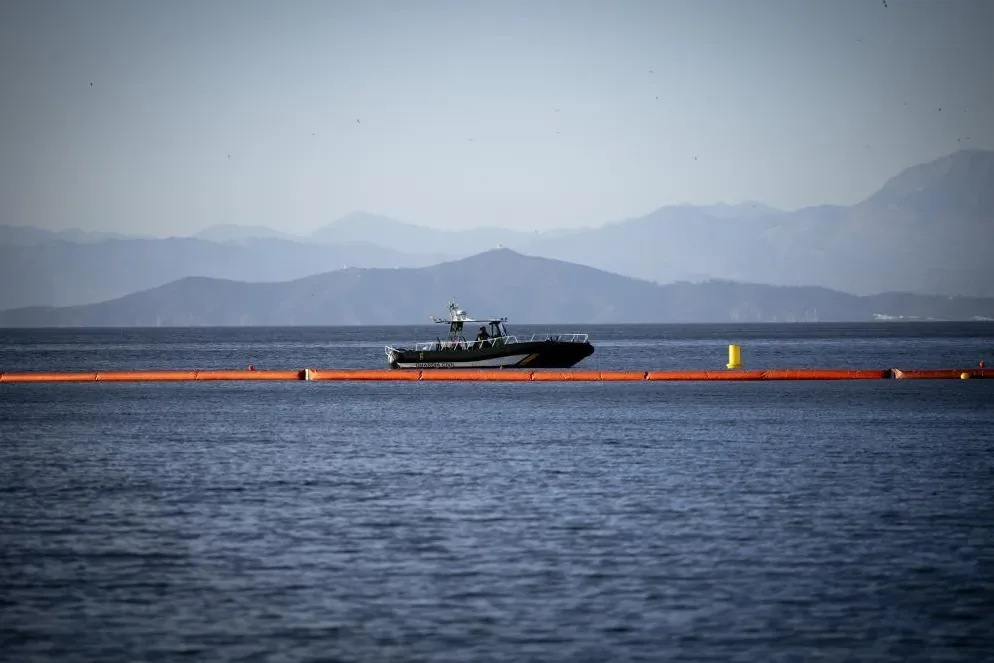
What Marlaska did acknowledge this Tuesday is that his department was aware that, “as happens in other summer seasons,” there could be an increase in irregular entries and that this rise could be “encouraged” by the Supreme Court ruling of last July 8, which ratifies the prohibition of hot returns of those who arrive swimming to the Spanish coast without crossing any containment element. Regarding this, he confirmed that “prior” to the massive arrival of immigrants they were already evaluating “how to place a pneumatic barrier and then a second one of buoys,” which is the solution forced by the court ruling itself to try to prevent what precisely happened three weeks later, without being in time to avoid it.
It was last Friday, July 31, during Sánchez’s visit to Ceuta after what he called “an attack on the integrity of Spain,” when the Prime Minister publicly announced that a physical maritime border would be placed between the autonomous city and the coast of Morocco. Not even 24 hours later, an inflatable structure 500 meters long, between 30 and 70 centimeters high, and with a submerged part up to one meter, had already been deployed.
Read more How the Spanish Stock Market has conquered 20,000 points making everyone rich except the Spaniards
Marlaska, revealing that work on installing that floating wall was underway even before the avalanche, admits that it did not arrive in time. However, for the minister “action has been taken quickly, as appropriate and as we are used to doing.” Between the Supreme Court ruling and the arrival, 22 days passed.
Barriers in Melilla
Interior now plans to install maritime barriers also in Melilla, which will allow immediate returns without violating the Supreme Court ruling. Since it was extended on Saturday along the coast of the other autonomous city, “entries have completely stopped,” as the Interior Minister highlighted this Tuesday.
The Government continues to confine the blame for the “unbearable tragedy” in Ceuta, which has already claimed at least 75 lives, to an operation “orchestrated by the entire set of mafias” that traffic people “using networks and with the excuse of an interested reading” of the High Court ruling. The only one who has distanced herself from the official narrative has been Robles, who has demanded Morocco to “investigate and go to the end” to clarify what happened and warned that “whoever was behind this, or whoever allowed or tolerated it, will have to assume responsibilities.”
Of the 72,000 immigrants who arrived irregularly on the Ceuta coast, mostly between Wednesday and Thursday last week, Interior estimated this Tuesday that 70,000 returns have been carried out, once again highlighting the “collaboration” of the Moroccan authorities. Regarding the involuntary expulsions being forced by military forces, including minors – as confirmed by EL MUNDO reporters in the area – Marlaska limited himself to saying that “in Spain the fundamental rights of minors and adults are respected” and that this “is beyond discussion.”