





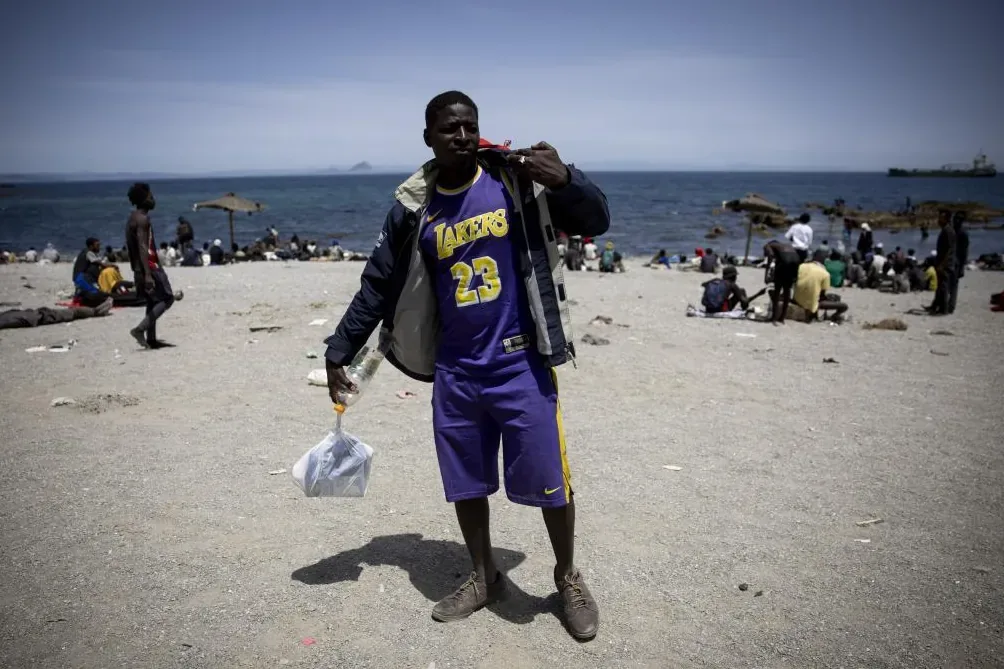
Mussa, 20 years old, is alone in Ceuta despite being on a crowded beach. He left Mali with four friends. None remain. “My four friends died swimming trying to reach Ceuta,” he recounts sitting on the Trampolín beach. He wears a Los Angeles Lakers outfit and an old windbreaker that a neighbor gave him after seeing him shiver.
Read more Tajani criticizes that Spain did not consult the EU about the regularization of migrants
For two years he barely survived as a waiter in various cities in Morocco and even slept among stoves. Last week the opportunity to cross arose and the five friends headed to the sea. Mussa was the only one who arrived.
He now remains stranded with hundreds of Africans on a beach where on Monday night they received their first meal in days from the Red Cross. There they sleep, clean themselves, and try to protect their scarce belongings on the sand.
“The migration policy of the Spanish Government always puts human rights at the center,” Interior Minister Fernando Grande-Marlaska said Tuesday when asked about the legal protection of the returns of citizens captured by the Army near the beach witnessed by this newspaper on Monday.

Marlaska insists there was no “report, notice, or communication” from the CNI about “anything like” the arrival of 72,000 people in Ceuta
- Editorial: MARTA BELVER Madrid

The minister praises and defends in Brussels the role of Morocco in the migration crisis: “He has explained the important role it has played in securing the situation”
- Editorial: DANIEL VIAÑA
Until the arrival of the Red Cross on Monday night, neither Mussa nor many of the Malians and Sudanese gathered there had received any food from Spanish institutions. The first ration consisted of some cookies, a can of sardines, pasta, a baguette, and a bottle of water per person.
Those who still had some money had survived by buying bread in nearby shops. The others depended on the charity of neighbors or what they got by begging. This Tuesday, the line in front of one of the stores stretched almost to the corner. Those who had managed to exchange their dirhams waited to buy a loaf.
Some wore old mechanic overalls hanging from their bodies like nightgowns, despite the temperature exceeding 35 degrees. Others kept the swimsuit they had crossed with and wore it over jeans, or piled several t-shirts to avoid being left with nothing.
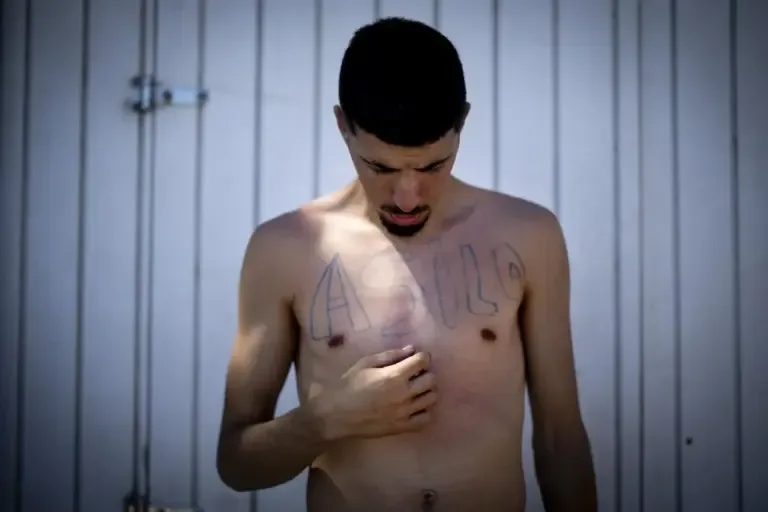
Mohammed, one of the few Algerians remaining there, has the word “asylum” written on his chest with a marker and says he had “a terrible night”: “When I was sleeping, an African stole the bag where I kept my clothes.” Now he only has the swimsuit, some flip-flops, and a piece of paper with the phone numbers of his mother and sister in Algeria.
He asks to make a video call to his sister: “Sara, I am in limbo. We Algerians all are. Tell mom that I am fine.”
The few Maghrebis are an exception on a beach mainly occupied by sub-Saharan Africans. During the previous day, men with Maghrebi or Arab features had been captured and expelled by the Legion.
The Interior Minister raised the number of people who had arrived in Ceuta to 72,000, compared to a previous official estimate of between 50,000 and 60,000. According to Grande-Marlaska, 70,000 had already returned. On the sand, however, hundreds of men remain who do not know when they will be able to leave the beach or what will happen to them.
Moha, 19 years old, comes from Sudan. He left his country and crossed North Africa on foot until reaching the Ceuta border. He entered on Monday. His group has no money and the food distributed by the Red Cross is the first they have tasted since their arrival.
“In Spain, the fundamental rights of minors and adults are respected. That is beyond discussion,” Grande-Marlaska insisted.
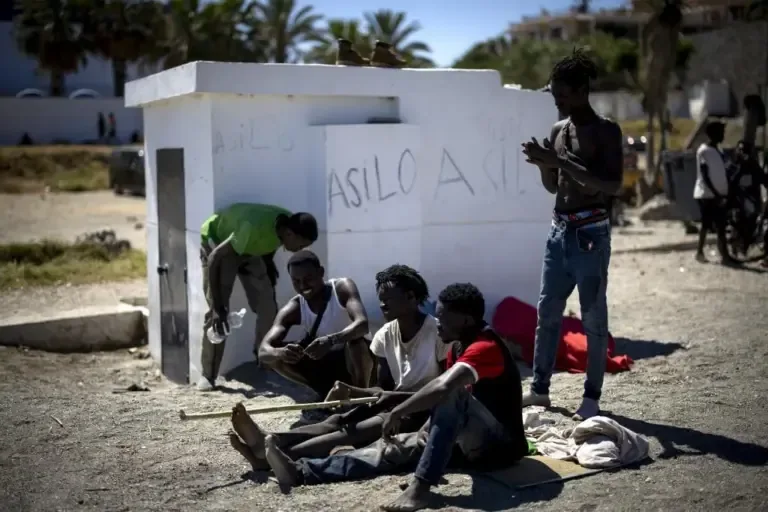
At Trampolín, men face a lack of water, absence of medical assistance, and thefts. They wash clothes directly in the sea or use the beach showers, whose supply had been interrupted and was restored this Tuesday.
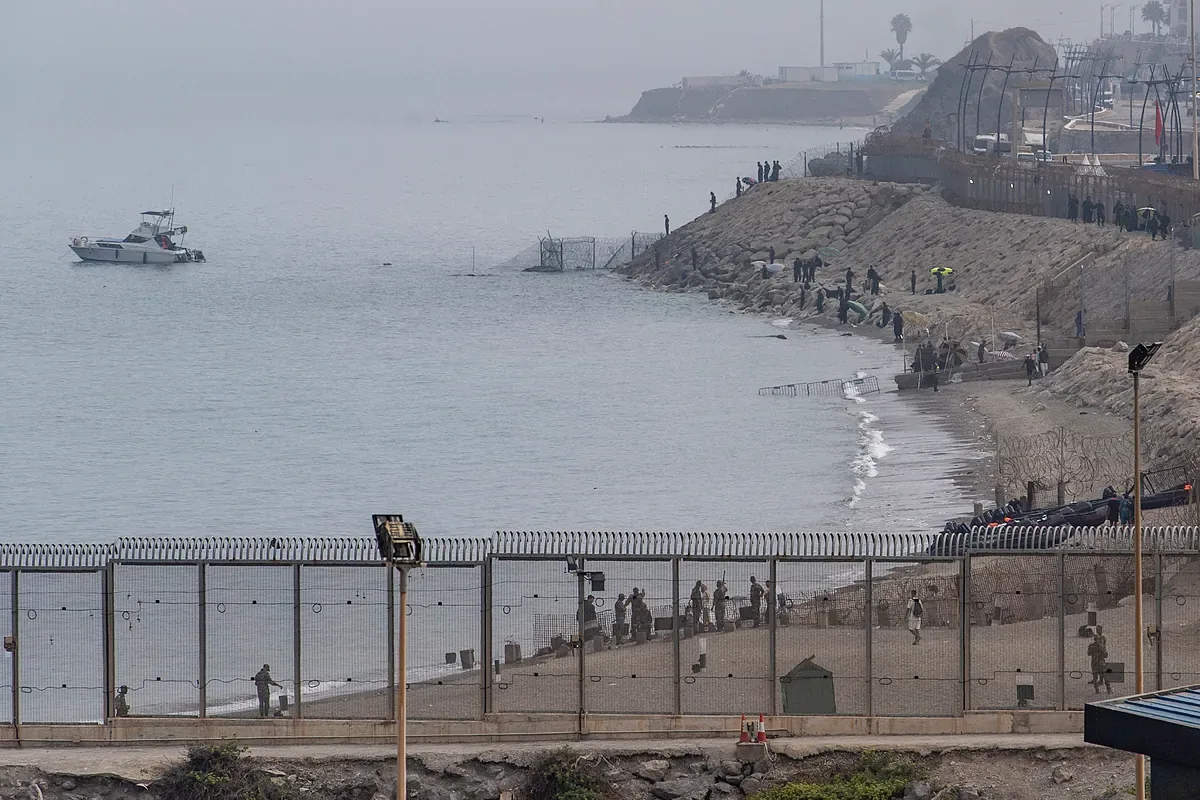
The reopening of the showers coincides with the cessation of pressure exerted by the military during previous days. This Tuesday, Morocco accepts no one through the border. From Tarajal and a nearby hill, Moroccan infantry can be seen guarding their side of the fence.
Among hundreds of men, there are barely any women. The only visible one remains under an umbrella, wrapped in two fabrics: one covers her hair and the other hides her face, leaving only her eyes exposed. She dresses like a man and is surrounded by several companions. She only lowers the fabric for a few seconds to drink from a bottle that one of them filled at a shower.
In the official discourse, fundamental rights are “beyond discussion” and Spain “has been up to the task.” On Trampolín beach, that migration policy translates into a woman hiding her gender among hundreds of men, clothes washed in the sea, lines to get a loaf of bread, and young people clinging to papers with their mothers’ phone numbers.