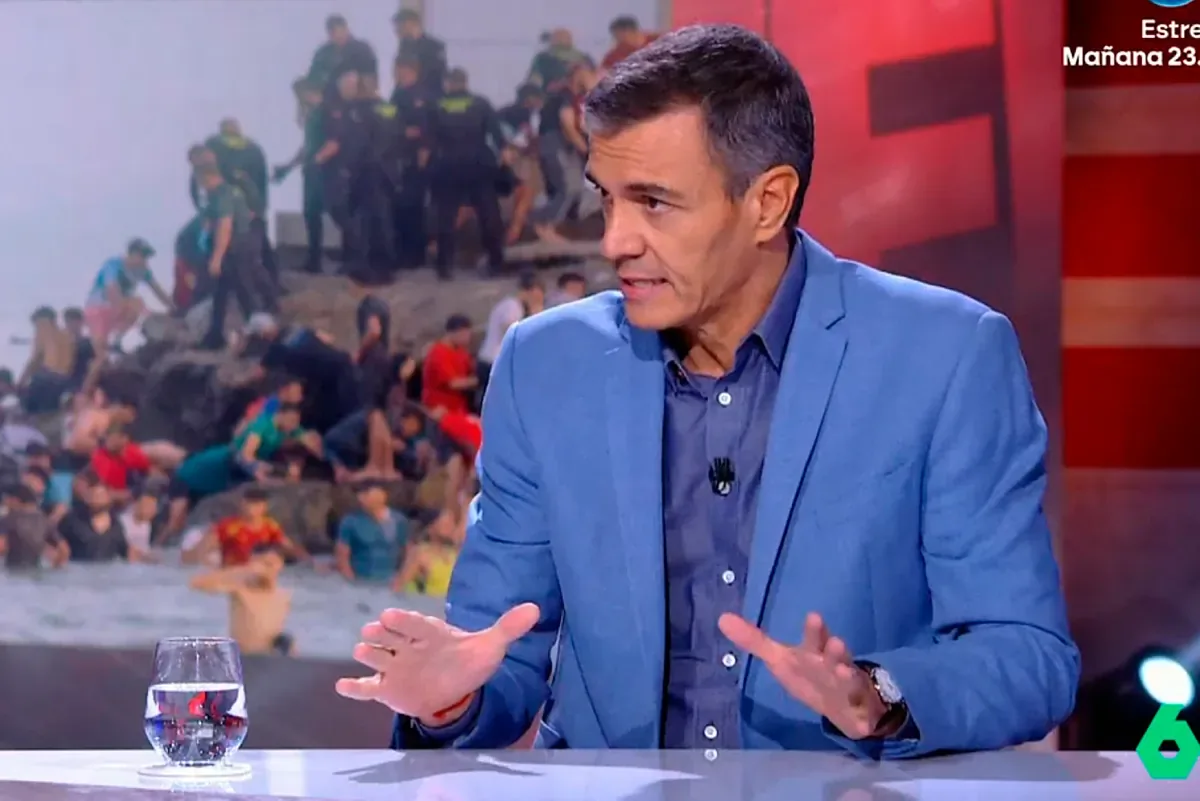










The massive crossing of migrants at the border between Ceuta and Morocco has already gone beyond the national level and has become a European problem. And far from showing unity, Spain’s partners have not expressed their disagreement with Spain’s migration policy, which is already causing a diplomatic crisis with Italy and France.
The country led by Giorgia Meloni announced yesterday that they would study the closure of their Schengen area with Spain as a measure to contain the possible entry of migrants following their arrival in Ceuta. This decision can be taken unilaterally by European countries in the face of a supervening threat. But the decision and the way it was announced did not please the Government.
The Italian president stated on X: “Italy will not stand idly by. We are convening the competent bodies, and at the end of these meetings we are prepared to intervene also with extraordinary instruments to defend the borders and the security of citizens, such as the suspension of the Schengen area with Spain.” Antonio Tajani, the Italian Foreign Minister, went further, stating that “the images coming from Ceuta show how the Madrid Government’s decision to grant Spanish citizenship, and therefore European citizenship, to more than 500,000 irregular immigrants is profoundly wrong and encourages human trafficking.”
This reaction and the words of the Italian politicians provoked the anger of the head of Spanish diplomacy, José Manuel Albares, who described on his social networks the publication by his Italian counterpart as “unbecoming of the Foreign Minister of a partner and friendly country from whom we expect European solidarity and not partisan demagogy.” Subsequently, Albares announced that he had summoned the Italian ambassador to Spain, Giuseppe Buccino, a diplomatic tool to express displeasure over the events.
Furthermore, to reinforce the Government’s stance, convinced that the migrants’ crossing is due to the ruling that no longer allows hot returns, the Diplomatic Information Office sent just after ten o’clock on Thursday night a three-paragraph text stating that “this crisis in Ceuta has nothing to do with the migrant regularization approved by the Spanish Government as falsely claimed by some quarters. It is false that anyone who has crossed in recent days can benefit from this process since it requires very specific conditions, such as proving residence in Spain before January 1, 2026, and having stayed in Spain continuously for 5 months at the time of application.”
They also reiterated that “this crisis originates from a interpretation of the Supreme Court’s decision, which prohibits the return of people who enter by swimming, which has been exploited by mafias and criminal organizations to take advantage of the extreme vulnerability of migrants.” And despite the passivity of the Moroccan police in acting against the crossing of people, they insisted that “the relationship with Morocco is excellent and coordination on migration and other areas remains very intense. Both countries have agreed on mechanisms for the return of migrants who have crossed the border illegally.” To reach a wider audience, they also sent the message in English, something the DIO does not usually do.
Despite Albares’ quick reaction to try to stop criticism from partners, other countries friendly to Spain have also pointed to the Government’s management as responsible for the massive crossing of people. Thus, Michel Barnier, former French Prime Minister, calls to “turn [European migration] legislation into action: anyone who is illegally present and has no legal right to stay must be effectively returned.” He also states that “France cannot bear the consequences of its neighbors’ migration policies. If a member state makes decisions that create a pull factor for irregular migration, we must be able to protect our borders immediately, particularly with Spain.”
Subsequently, the French Interior Minister Laurent Núñez announced “the reinforcement of controls at the border” with Spain in response to the crisis caused by the massive influx of thousands of immigrants swimming into Ceuta. Italian Prime Minister Giorgia Meloni went even further and called for the suspension of the Schengen area and the return of border controls within the European Union,
“We have control at the Franco-Spanish border,” Núñez told RTL. “In fact, it has intensified in recent months, as we have a mobile force permanently present to reinforce these controls.”
Núñez, focused during the last week on monitoring the Gironde mega-fire that has burned more than 42,000 hectares, took a break on Thursday—and will do so again on Friday—to speak by phone with Spanish Foreign Minister Manuel Albares and monitor the situation in Ceuta.
“Yesterday I spoke with my Spanish counterpart and we will take measures,” he emphasized. “Naturally, we will reinforce controls at the Franco-Spanish border.”
Former Interior Minister Bruno Retailleau, a candidate in the presidential elections with The Republicans, meanwhile recalled his call for the suspension of the Schengen area, first made when Pedro Sánchez granted amnesty to irregular immigrants.
From Finland, the country’s Interior Minister, Mari Rantanen, has supported Spain’s exclusion from the Schengen area. “Spain has completely failed to protect the external border of the Schengen area against irregular migration. This cannot continue. All European countries must support Meloni’s proposal. Countries that do not fulfill their obligation to protect the external border cannot be members of Schengen,” Rantanen wrote in a post on X.
Read more Actor Manolo Solo, star of the recent flourishing of Spanish cinema, dies at 62 years old