





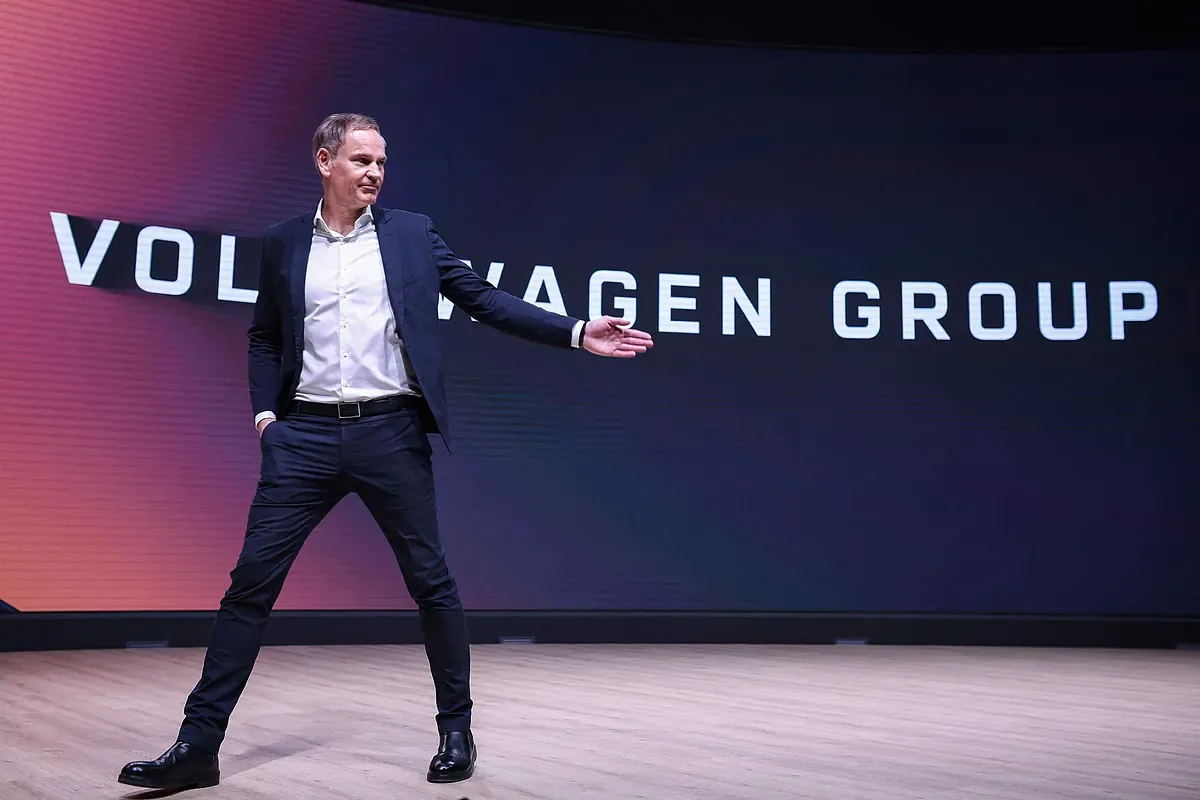
Volkswagen will undertake a new and profound restructuring that could mean the disappearance of around 50,000 jobs worldwide. The Supervisory Board of the largest European car manufacturer unanimously approved this Thursday the so-called Future Plan 2030, with which management aims to reduce costs and regain competitiveness in the face of pressure from Chinese manufacturers, weak demand, and the technological transformation of the sector.
Read more Marcos Llorente leaves the Spanish National Team: “I know many of you will not understand it”
The cut would add to the adjustment of about 50,000 jobs already agreed since the end of 2024 at Volkswagen, Audi, Porsche and the software subsidiary Cariad in Germany until 2030. Of these, about 37,000 departures are already agreed. However, the company specifies that the other 50,000 jobs now at stake do not constitute a fixed number of layoffs. It is, according to the group’s president, Oliver Blume, an estimate derived from the savings Volkswagen needs to bring its costs closer to those of its competitors.
The restructuring also maintains uncertainty about four major German factories: Emden, Zwickau, and Hannover, of Volkswagen, and Neckarsulm, of Audi. The production currently assigned to these plants ends progressively between 2031 and 2034, and management admits that for now it cannot guarantee new models that would allow them to operate competitively.
That does not mean that their closure has been decided. This is precisely one of the points where workers’ representatives have managed to halt the harshest plans considered in recent months. Volkswagen will study alternative uses for the four plants and must present a concept to sustainably reorganize its European production before the end of June 2027.
“The Future Plan creates the conditions to make the Volkswagen Group and its brands more efficient, competitive, and prepared for the future,” Blume said after the vote. The consortium, he added, will invest over the coming years an amount in the “triple-digit billions” to strengthen its brands. Management considers the restructuring essential to guarantee the group’s long-term survival and competitiveness.
In the air, the closure of the SEAT brand
For now, it has not been revealed whether Volkswagen will finally close the Seat brand, as reported by the German economic weekly WirtschaftsWoche, which had access to a confidential restructuring plan prepared by the group’s management.
In the mentioned document, titled Report on the Conceptual Decision of the Supervisory Board of September 3 and 4, 2026, it was stated that “the Seat brand will be withdrawn in an orderly manner and with optimized costs no later than the end of 2029.”
Weeks of confrontation with workers
The agreement ends, at least for now, weeks of strong confrontation between Blume and the workers’ representatives. The chairwoman of the group’s works council, Daniela Cavallo, had declared at the end of August that trust in management, and particularly in Blume, was “damaged, although not irreparably.” More than 10,000 workers then listened to the president in a tense assembly at the Wolfsburg headquarters.
IG Metall and the works council consider that the agreement reached this Thursday has avoided an escalation. “No factory has been abandoned and, contrary to several published reports, no closure has been decided,” the union emphasized. Management, it added, now has to “do its homework” and find concrete solutions for the threatened centers.
The chairwoman of IG Metall, Christiane Benner, had warned this week that the union would not accept their closure. “With IG Metall, the factories in Emden, Zwickau, Hannover, and Neckarsulm will not be closed,” she said. Benner also accused Blume of having made “a serious mistake” by simultaneously putting new job cuts, possible closures, and the goal of drastically increasing the group’s profitability on the table.
The crisis originates from an industrial structure too large for Volkswagen’s current sales. The group intends to reduce its global production capacity from approximately ten million to nine million vehicles annually and cut the number of models by up to half. Management also maintains that its administrative and other functions not directly linked to manufacturing costs are about 30% higher than comparable companies.
“If we continued in Germany as we have until now, we would permanently have a disadvantage of about 1.5 billion euros per year,” Blume recently warned workers. Approximately half of the new adjustment would affect, he explained then, Germany, and the rest would be distributed among the nearly 170 companies Volkswagen has in other countries.
The German manufacturer faces one of the biggest transformations in its history at a particularly difficult time for the European automotive industry. Competition from Chinese manufacturers, Volkswagen’s loss of market share in China, high production costs in Germany, and a slower-than-expected transition to electric vehicles have left the Wolfsburg giant with factories and workforces sized for a market that no longer exists.