







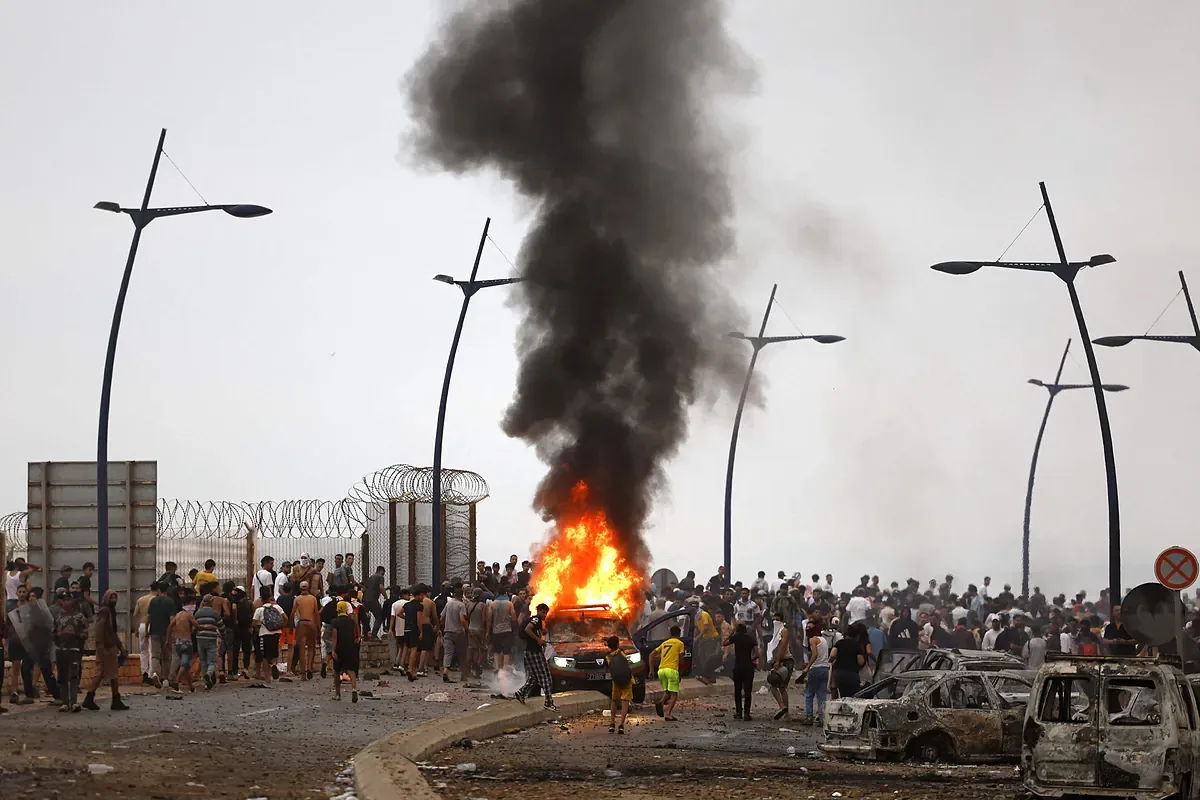
The swim crossing at El Tarajal was a constant trickle of people since summer began. Eight, nine, or 10 individuals arrived daily on the Ceuta coast, something the inhabitants of this 18-square-kilometer autonomous city had gotten used to. But three weeks ago, the Supreme Court ruled that hot returns could not be carried out for those arriving without crossing physical borders. And the news went viral among Moroccan youth. They began to move towards the border, crowding together. Morocco was aware of this and, as on previous occasions, allowed the first arrivals: a couple of nights with just over a hundred crossings. Taking advantage of the opportunity to show their superiority over Spain. But the control they exert over the migration tap exploded on them from Wednesday afternoon. That is the first conclusion reached by security sources consulted by this newspaper, who believe that the country led by Mohamed VI wanted to “use those young people to remind that they are the ones who organize migration, but it got out of their hands.”
The first to arrive knew the Supreme Court ruling, as “they organize themselves through groups on social networks like Facebook or Telegram,” explain consulted sources. These would supposedly be the ones Morocco let pass. What the country’s authorities did not expect was what experts call a “massive call effect” that caused the arrival of several tens of thousands to Spain. In total, about 50,000 in just over 24 hours, according to government sources. Ceuta authorities raised that figure to 60,000. Of them, by six in the afternoon yesterday, always according to Moncloa, 48,300 had returned to Morocco and 57 had died during the crossing.
When Spain and Morocco became aware of the seriousness of the matter, the “twisted” way of acting of the Alaouite kingdom, as one of the consulted persons calls it, was to order to close “but calmly.” A passivity to which two internal problems of Morocco were added again: corruption and poverty. Although no one dies of hunger in the country, they note the Gendarmerie’s ability to “look the other way” voluntarily if there is no contrary order. Another source sums it up like this: “They found the fuse in the Supreme Court ruling, saw that they were crossing and said: we are not going to do anything.”
This person agrees that Morocco “did not motivate it, but it did allow an open flood of entries.” The goal of this massive arrival would be twofold for Morocco. On the one hand, “to control Spanish foreign policy.” According to the analyst, “the only way Spain had to control the relationship with Morocco and Algeria was through the role of neutrality as the administering power of the Sahara; once that role was abandoned, we lost advantage.”
The second goal of the Alaouite kingdom would be to draw conclusions: “This serves Morocco to measure how Spain, the European Union, and the United States react. It watches and observes for the day it wants to deliver the final blow [an attempt to take Ceuta and Melilla].” Although that attack on Spanish sovereignty does not seem likely to happen soon, as Mohamed VI’s court is very aware that the autonomous cities “are development poles for two poor areas of Morocco: Nador and Tetouan.”
In the opinion of another consulted person, the government’s decision to thank Morocco repeatedly for its cooperation and not blame them for any surveillance errors is a mistake: “The appeasement policy with Morocco is impossible, the only thing it understands is to show its teeth,” they analyze. Although they recognize that getting along with the neighboring country is essential, they reiterate that “one must be very firm.” They also consider it a mistake to blame the problem on mafias, as they do not believe they are responsible for the massive crossing in this case. “Everyone in Morocco knows that Ceuta is crossed through Castillejos and it is very easy to get there. Mafias make money when people need to be transported, not when they risk their lives swimming.”
Beyond Morocco’s internal keys, this crisis shows Spain’s lack of tools to fight this phenomenon. The government claimed to have mobilized 106 personnel to support the Civil Guard and 200 to back the Police. However, both the Armed Institute and the police staff highlight that, although these reinforcements seem “many,” they are not “so many on the street as an effective force.”
Sources from both bodies point out that these resources “arrived late because the situation was already collapsed.” And they insist: “We have learned nothing from the massive entry of 2021.” The Unified Association of Civil Guards (AUGC) has been demanding since then “an increase in human and material resources to face this migratory drama.” Also, the extension of the El Tarajal breakwater. “We had even requested that Ceuta be declared a zone of special singularity so that there is an extraordinary allocation of resources,” says the AUGC spokesperson in Ceuta. “How is it possible that Europe’s southern border can be stormed in 48 hours with the ease with which it has happened?” they ask.
For its part, the Justice for the Civil Guard association (Jucil) highlights that on April 6, 2026, the Citizen Security Unit, of about 30 members, was created at their own request. In addition, Jucil sources reiterate that the necessary division by shifts and subgroups considerably reduces the effective deployment across the city.
In the same vein, the police union Jupol highlights that the lack of personnel forces riot units to have fewer officers than they should, and they assure that the Ministry of the Interior’s orders are being “improvised.” According to union sources, the work consists of “taking walks and rounds, and only acting in case of public disorder because the mass of people is such that there is no other option.” The Ministry has reinforced these units with 98 additional personnel who “will double shifts, through the provision of overtime.”