







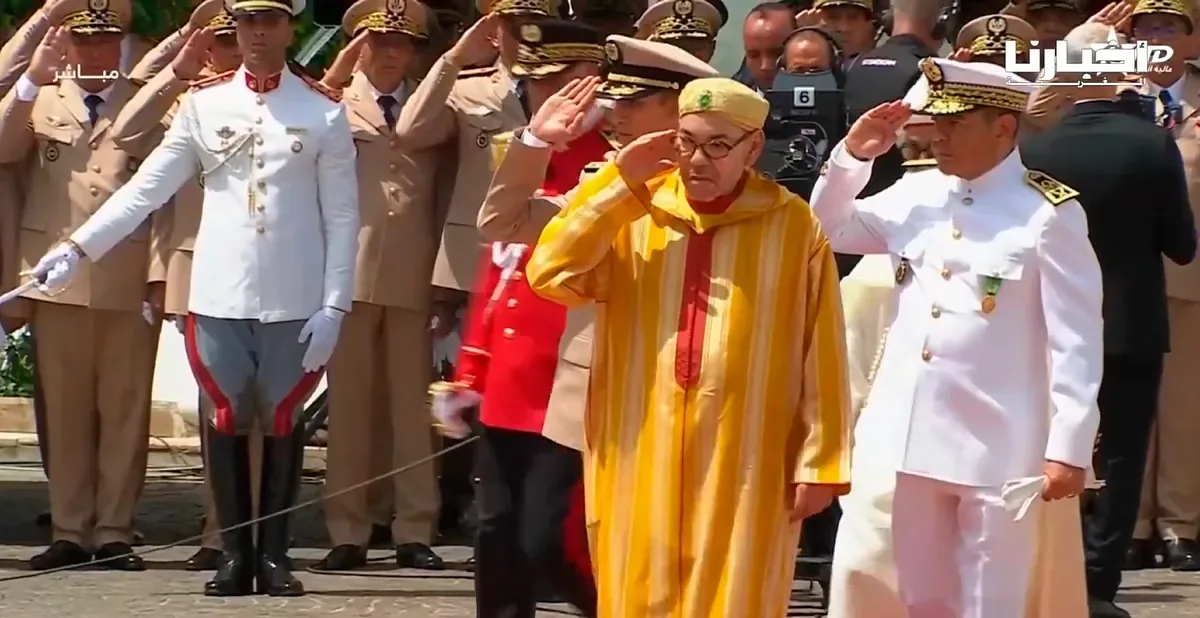
As if in Ceuta there was not an avalanche crossing the Moroccan border in an “attack on the integrity of Spain,” in the words of Pedro Sánchez, just 40 kilometers away Mohamed VI continued yesterday with the final celebrations on the occasion of his 27th anniversary on the throne. The Alaouite king presided over the ceremony of loyalty or vassalage in Tetouan – known in Arabic as Bay’a – in which the newly graduated officers from different military institutes swore allegiance. The centennial event, of great importance in the traditions and rituals of the Moroccan Monarchy, once again became a display of submission by the kingdom’s main authorities to the Crown and its holder, not only as head of state but also as Commander of the Faithful.
Read more «A Morocco got out of hand»: the first analyses on the Ceuta avalanche point to Rabat
Just as had happened the day before with the reception of the sovereign in M’diq – Rincón del Medik -, near Tetouan and very close to the Spanish autonomous city, the entry of tens of thousands of people dominated the entire atmosphere. To the point that the news, in the midst of the Throne Day celebrations, led Moroccan media to highlight interpretations that seemed like another anniversary gift to the honored Mohamed VI. The Moroccan digital newspaper Le360, very close to both the Palace and the Majzén – the famous deep state or shadow government of Morocco – did not hesitate to headline “The recovery of Ceuta and Melilla is inevitable”, in a broad report which, pushing its own agenda, emphasized that “this episode brutally reveals the geopolitical anomaly of Ceuta and Melilla, two occupied cities on Moroccan territory whose current situation is clearly unsustainable“.
Beyond the obligatory praises from the Spanish government for Moroccan cooperation, the truth is that the Alaouite Monarchy’s claim over the two autonomous cities is a pillar of its nationalist narrative which, with more or less intensity depending on the times and the state of bilateral relations between Rabat and Madrid, inflames the messages from the North African kingdom’s authorities. Mohamed VI, as his predecessor Hassan II did before him, will never give up stirring the claim over what he defines as two “occupied cities.” And from the Throne, in recent times, wings have been given to a relaunch of the irredentist ideology centered around the concept of Greater Morocco, which ardently claims the recovery of the former borders cut by Spanish and French colonization, even if this means a complete distortion of History in light of realities such as the centuries-old Spanishness of Ceuta and Melilla or the sovereignty of the former Moroccan sultans over the current Western Sahara.
Claim after the Perejil incident
The first time Mohamed VI made a direct reference to the two cities was in 2002, in his fourth Throne Day speech, three years after his proclamation. The Perejil Island incident had taken place, and the monarch firmly warned that “the ultimate goal of our diplomacy is to make Morocco a country with its territorial integrity completed… (…) which, no matter the cost, cannot abandon or compromise. (…) Since its independence, Morocco has not ceased to demand from Spain the definitive end of its occupation of Ceuta, Melilla, and the neighboring islands usurped in the north of the kingdom.”
During Mohamed VI’s reign, it has not been common for him to mention the names of the two autonomous cities. This is something handled by other subordinates of the regime, not to mention the media or the always giant-sized maps that dominate any public scene. But after the serious bilateral crisis of Perejil, the Alaouite sovereign once again raised his voice and expressed his determination to preserve and guarantee “all our inalienable and legitimate rights of sovereignty” over the two “occupied cities” in 2007, on the occasion of the only visit that Don Juan Carlos and Doña Sofía made as Kings to Ceuta and Melilla, in November of that year. Mohamed VI condemned the brief visit as a “regrettable” and “counterproductive” act that put the bilateral relationship at risk and represented, according to his outburst, a “flagrant disrespect by the Spanish government of the letter and spirit of the Treaty of Friendship” between the two countries signed in 1991.
The relationship between Mohamed VI’s parents and Felipe VI was fraternal, forged when Don Juan Carlos was still just a Prince of Spain with uncertainty about whether he would occupy the throne after Franco‘s death. But if there was a thorny issue between the two monarchs, it was precisely Ceuta and Melilla. The current Emeritus recounts in his controversial recently published memoirs that Hassan II frankly expressed his view that the matter should not be resolved in his generation, but it would be up to future ones to decide the fate of the two autonomous cities. It is also known that, during the Transition, Juan Carlos I was at least imprudent in private conversations about this issue, such as the one he had with Edmund Muskie, envoy of US President Jimmy Carter, to whom he admitted the possibility of ceding Melilla to Rabat in 1979, as reflected in a secret telegram declassified much later, as revealed by Charles Powell in one of his books.
Mohamed VI, and even more so his Heir, Prince Moulay Hassan, belong to other generations, as the astute Hassan II appealed. And if the current Alaouite monarch is showing anything, it is that his desires for Ceuta and Melilla are not mere rhetorical statements. Hence, every now and then the Maghreb kingdom exerts pressure on both cities through various mechanisms. Moreover, the Alaouite king feels especially emboldened by the support he has found in the Trump Administration. It is worth noting how an internal report from the US House of Representatives, prepared by the Appropriations Committee, included last spring a reference to Ceuta and Melilla as “cities administered by Spain located on Moroccan territory” and linked them to the historical claim of the Alaouite kingdom. The non-binding document suggested that the State Department should encourage diplomatic engagement between Rabat and Madrid on the future status of the cities.
What more could Mohamed VI wish for to rub his hands? The Maghreb monarch knows that his best weapon against Spain is time, since the kingdom has shown abundantly that it is increasingly difficult to manage the pressure that even without human avalanches like those of recent days, the two cities as Spanish as Lugo, Valladolid, or Seville endure daily, and in which, however, the Kings of Spain cannot set foot.