

After the arrival of Pedro Sánchez at La Moncloa, the PSOE reached a membership count similar to the population of Santander, which is ranked among the 25 most populous provincial capitals in Spain. Now that figure is closer to the registered census of Salamanca, a medium-sized city. In other words: in round numbers, between 2019 and 2025, the party has lost a total of 23,388 members, about an average of 10 per day.
The leadership at Ferraz is not inclined to provide information on how many of its supporters also hold membership cards. In fact, this newspaper has requested it on several occasions, without success. However, in the annual reports that the political party has posted in the transparency section of its website, data on the evolution of the number of people who regularly pay their dues is included.
According to these official reports, when Sánchez returned to the General Secretariat after defeating Susana Díaz in the 2017 primaries, that year ended with a total of 174,853 socialist members. In 2018, with the leader already as president after winning the no-confidence motion against the PP, the figure fell to 170,938, that is, 3,915 fewer. But in 2019, after the only 18 months of a progressive government alone, there was a slight increase of 98 new memberships, reaching 171,036.
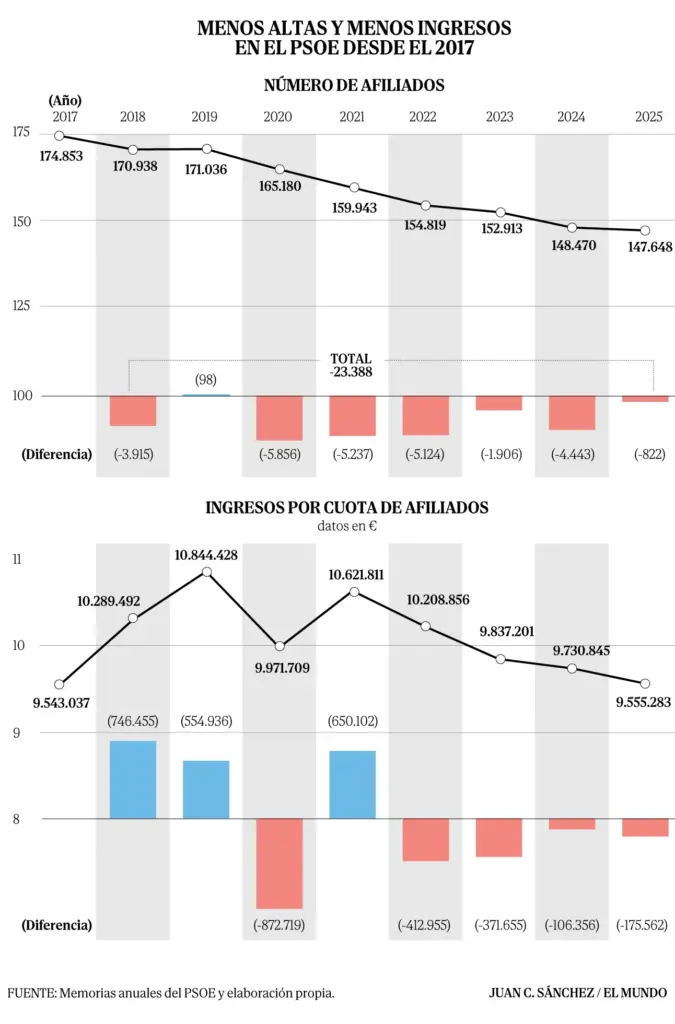
Since then, the curve has had a sustained downward trajectory. Only in the current legislature, marked by concessions to parliamentary partners and the multiplication of corruption cases affecting both the party and the coalition leader’s environment, the difference between new and lost memberships recorded at the end of 2025 was 5,265 memberships negative compared to the previous year, leaving the balance at 147,648.
Six euro fee
At the same time, the PSOE now also receives a lower amount from membership fees than seven years ago, although in this case the trend is not linear. Internal sources explain that there is not “necessarily” a correlation between the reduction in the number of members and the drop in income from this concept because different reduced payment options are available to those interested if their personal conditions change. Those without a discount pay six euros per month.
According to the 2025 report, the party received 9,555,283 euros through this channel, 36.7% of its private funding, which totaled 26 million euros. The rest came from mandatory contributions from its public officials, lottery sales, “own activity products,” property rentals, collection of booths at popular festivals, and donations and legacies.
Since these reports have been public—the first corresponds to 2018 and also contains data from 2017—the year the party collected the most from its members was 2019, with 10,844,428 euros. In this case, the amount represented only 32.2% of its non-public income since at that time the concept “municipal group agreements,” a large amount, was counted in this section, which disappeared from 2022 onwards.
‘Conspiracy theory’
On May 27, while the Central Operative Unit (UCO) of the Civil Guard was inside the central headquarters in Madrid requesting documentation about the alleged plot to “destabilize” the judicial cases against the party, which is being investigated in the Cloacas case—which features the plumber Leire Díez—a former magistrate entered the building proclaiming before the crowd of media present at the doors that he was going to join. “They are coming to finish off the PSOE and the freedom of political parties,” he argued in line with the conspiracy theory encouraged both from Ferraz and Moncloa.
However, the tally of new and lost members reveals that within its own ranks there are more who do not accept the official argument than those who do. Only during 2025, the balance of losses in the census was 822 people, after two former socialist Organization secretaries, Santos Cerdán and José Luis Ábalos, had been imprisoned accused of corruption, after Sánchez’s brother—now already convicted of administrative prevarication—was sent to trial, and after the investigation against the president’s wife, Begoña Gómez, advanced, who will be tried for influence peddling and embezzlement of public funds.
The comparison of the reports shows higher drops in memberships in 2020 (5,856) and 2021 (5,237), years already complex due to the global Covid pandemic that left thousands dead. However, significant declines were also seen in 2022 (5,124), when the only yes is yes law was approved, which led to a controversial reduction of sentences for rapists, and in 2024 (4,443), when the amnesty for those convicted for 1-O came into effect.
The federations with the most memberships
Of the PSOE’s annual reports published on its website, only the 2018 one—which includes data from 2017—provides information on income from membership fees broken down by federations. According to that financial report, Andalusia, the Valencian Community, and Madrid were, in that order, the ones contributing the most members to the party.
Internal sources consulted confirm that territorial power is still distributed similarly, although in recent years the number three in the ranking—now led by Óscar López—has approached the second—led by Diana Morant.
The Andalusian socialists, led by María Jesús Montero, concentrate around 26% of the organic weight given their volume of card-holding supporters. They are followed by the Valencians (11%) and the Madrilenians (10%).
The fourth position goes to the PSC, a legally distinct organization but federated and closely linked to the PSOE since the late 1970s. It contributes around 9% of the total membership.
In fifth place is Castilla-La Mancha (7.5%), the only one of the four socialist governments with an absolute majority. Completing the top positions are Extremadura, Galicia, and Castilla y León, with a three-way tie of 6% of the total in their membership censuses.