




The Government launched an offensive in April last year against private universities that was tempered after José Luis Rodríguez Zapatero addressed the claims of two campuses belonging to the Planeta group. Fourteen days after Pedro Sánchez declared war on this business model by announcing a plan to curb what he called “beach bars,” the former president received on his mobile phone the allegations to the new regulation prepared by the UNIE and the International University of Valencia (VIU). The version of the royal decree that was finally approved in October by the Council of Ministers was much softer than initially expected, with fewer demands and more relaxed deadlines.
Zapatero is being investigated by the National Court for alleged influence peddling, among other crimes. The judge attributes to him the alleged leadership of a network that used high-level business contacts to influence Government decisions. Chats with his secretary Gertrudis Alcázar reveal that he had contacts with members of the Executive, including Pedro Sánchez. On April 14, 2025, Gertru forwarded to his WhatsApp three files: two with the allegations of the UNIE and VIU to the new decree on the creation and authorization of universities – the reform of decree 640/2021 – and another called “note on priorities.”
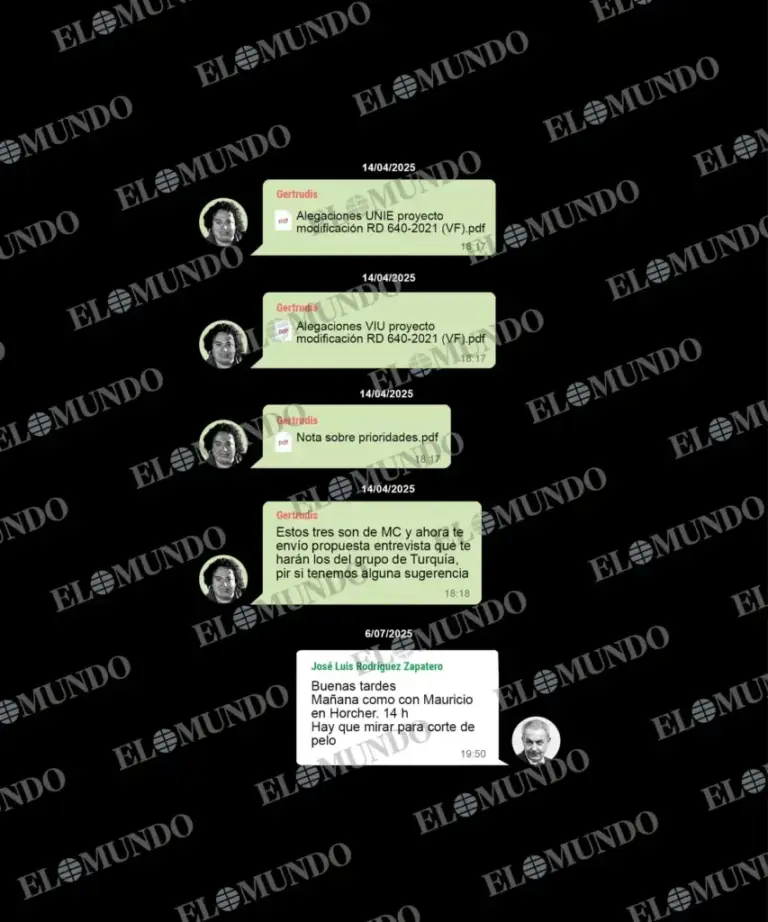
The secretary, who is also being investigated by the judge, told her boss that these documents had been sent by “MC,” supposedly referring to Mauricio Casals, president of the newspaper La Razón and deputy to the presidency of Atresmedia, a group majority-owned by Planeta. Casals has described himself on some occasions as an external advisor to Planeta.
Judging by what the agendas included in the file show, Zapatero and Casals have a very close relationship. In the 2024 agenda, there is a dinner on January 29, another at the Hotel Palace on May 13, and a lunch on July 8 at the Horcher restaurant, one of the most exclusive and expensive in Madrid. In 2025, there are two dinners at the Palace on January 13 and December 8 and two meals at Horcher on July 7 and September 29. The war against private universities was activated in October 2024 with a parliamentary initiative from the PSOE urging the Government to “strengthen” the requirements to create new universities. But even before that, the Government had been showing concern about the great proliferation of private campuses that ran parallel to a decline in students in public ones and sought to improve decree 640, approved in 2021 by Minister Manuel Castells precisely to raise the quality of the centers, although it did not succeed.

Zapatero demands the Treasury cancel the “arbitrary” tax inspection opened against him and his wife or at least suspend it while the ‘Plus Ultra case’ is open
- Editorial: MANUEL MARRACO Madrid
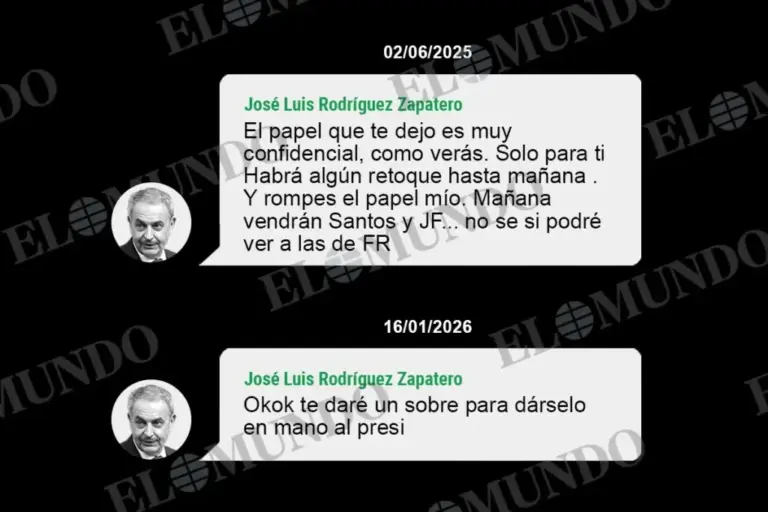
Zapatero ordered “to hand directly to the president” an envelope with the secret negotiation with Junts
- Editorial: ESTEBAN URREIZTIETA Madrid
The new regulation, drafted by Minister Diana Morant, initially triggered all alarms in economic sectors due to the threat it posed to an expanding market. On June 13, it became known that the National Commission on Markets and Competition (CNMC) had reported that it demanded “unjustified and discriminatory requirements.” The Ministry of Economy also warned that some of the new criteria were not necessarily linked to the quality of teaching, such as having a minimum of 4,500 enrolled students or requiring 75% of the professors at online universities to reside in Spain. Zapatero’s agendas show that on that date – June 16, 2025 – he had an appointment with the Minister of Economy, Carlos Cuerpo.
During the processing of the regulation, they met at Horcher and at the Palace
The text finally approved by the Council of Ministers on October 7, 2025 introduced greater flexibility of requirements and exceptions for specific campuses. The royal decree gives universities more time to reach the required quality levels, especially for those whose activity began in the three years prior to the entry into force of the decree, as is the case with UNIE: they now have a special five-year period to adapt compared to the general three years. The draft of April 1, 2025 did not include any exceptions or distinctions for young centers like this.
Read more Experts warn about forest management problems: «The forest territory is the result of abandonment»
For online universities, such as the International University of Valencia, it is beneficial that the requirement that 75% of professors reside in Spain has been relaxed: they can also live in any EU country, a vital issue for attracting international talent. Likewise, the deadline for these virtual campuses to adapt to residency conditions has improved, increasing from one to four years.
Zapatero met with Cuerpo, who had raised objections to the draft
And, if in April online campuses like VIU had a much more direct dependence on the State, with the central Government assuming all supervisory functions, the final version introduces safeguards to remain linked to the regional Government. Additionally, more safeguards are introduced: new universities will not always have to be created by a law of the General Courts, but can be approved by a regional law, as has been the case until now.
It is more advantageous for all private universities that the requirement that 60% of doctors have a positive evaluation of their research must now be met at the end of the seventh year, instead of the fifth. It also helps that the minimum percentage of 50% of doctors is calculated based on the equivalent full-time dedication rather than the entire staff, a system initially planned to be much stricter for institutions that usually have part-time active professionals.
A new ‘online’ center of the group is going to be approved in Extremadura
In the finally approved version, a new paragraph has been added so that private universities only have to report the net amount of their turnover in their annual accounts, simplifying the detail of institutional expenses and income initially required. And internships agreements are considerably facilitated, as the approved text allows presenting a written list of commitments with companies, instead of requiring the list of already signed and definitive agreements demanded by the April text. These improvements not only help campuses like UNIE and online centers like VIU, but will also benefit the Open University of Extremadura, a distance campus also promoted by Planeta that recently took another step in its processing with the favorable opinion of the Economic and Social Council of Extremadura.